





Low-molecular-weight hyaluronic acid can be useful in leave-on products, but it is not inherently more effective than higher-molecular-weight grades. Smaller chains can interact differently with the skin and, under suitable conditions, reach beyond the surface more readily. That does not automatically produce better hydration, greater comfort, or more visible wrinkle improvement.
The practical choice depends on what the finished product needs to achieve. A lightweight serum, a protective moisturizer, and a product intended for easily irritated skin do not have identical requirements. Molecular weight is one formulation variable; concentration, the surrounding ingredients, polymer quality, and performance during repeated use determine whether a lower-molecular-weight grade earns its place.
Define “better” before comparing molecular weights
The question “Is low molecular weight hyaluronic acid more effective in leave-on products?” becomes useful only when effectiveness has a defined endpoint. Increased skin hydration, reduced water loss, smoother-looking fine lines, and a less tacky finish are different outcomes. A grade that improves one may not improve the others.
For a hydrating serum, the priority might be increased stratum corneum hydration without excessive stickiness. For a moisturizer, sustained hydration and compatibility with the emulsion may matter more. For a fine-line claim, the relevant evidence is a measurable change in skin appearance after use—not simply a laboratory demonstration of penetration.
These distinctions prevent a common development error: choosing the smallest available molecule and then searching for a claim to justify it. The more defensible approach is to choose the endpoint, establish a suitable benchmark formula, and determine whether changing the HA grade improves that endpoint.
What molecular size changes—and what it does not
Hyaluronic acid, or HA, is a water-binding polymer. Many cosmetic ingredients are supplied as its sodium salt, sodium hyaluronate. Their chain lengths influence solution viscosity, film formation, and interaction with the skin surface.
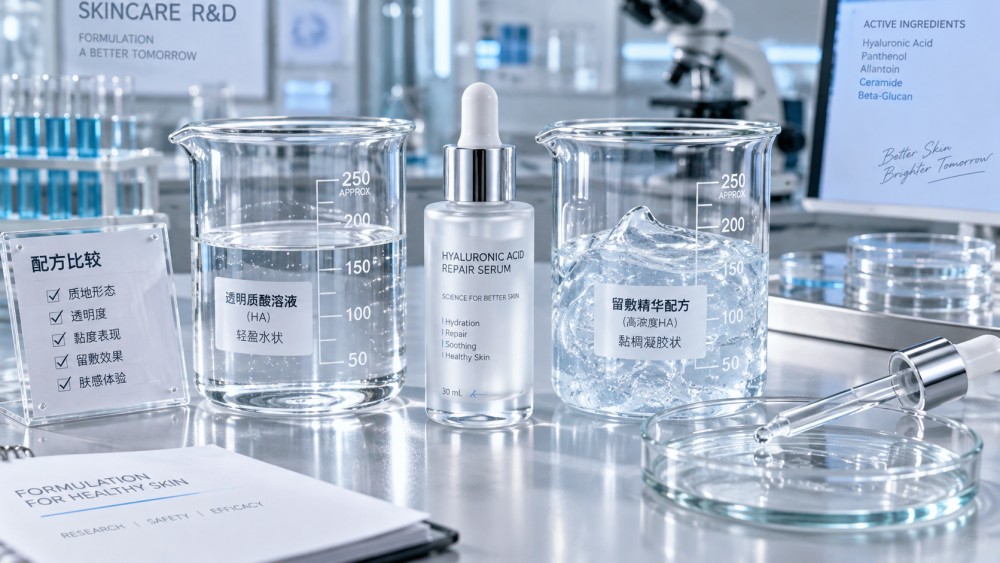
Higher-molecular-weight HA generally contributes more viscosity at a comparable concentration and can form a hydrated surface film. That surface activity is not a disadvantage merely because the polymer does not reach deeper tissue. Moisturization is closely connected to the condition of the stratum corneum, the outermost skin layer.
Lower-molecular-weight grades generally contribute less viscosity at the same active concentration. They can therefore provide a different texture and may show greater access to portions of the stratum corneum in experimental systems. Neither property proves superior finished-product performance.
“Low,” “medium,” and “high” molecular weight are not universally standardized cosmetic categories. A supplier’s low-molecular-weight grade may overlap another supplier’s intermediate range. A specification expressed in kilodaltons is more informative than a marketing label, but even an average molecular weight does not describe the complete distribution of chain sizes.
Do not use penetration as a substitute for efficacy
Intact skin is a selective barrier, not an open sponge. HA is hydrophilic, and even relatively short HA chains remain large compared with many molecules used for conventional topical delivery. Reducing chain length can change access to skin layers, but it does not remove the barrier constraints.
When reviewing a penetration study, distinguish material detected on the surface, within the stratum corneum, in the viable epidermis, and in the dermis. These locations have different implications. Evidence of entry into the outer skin layers should not be rewritten as evidence of deep dermal replenishment.
The experimental method also matters. Excised skin, reconstructed skin, and living human skin are not interchangeable. Exposure time, vehicle composition, skin integrity, and application conditions can affect the result. For labeled HA, the method should establish whether the detected signal represents intact polymer rather than free label or degradation products.
Leave-on contact gives an ingredient more time to act than a brief rinse-off application, but time alone does not establish meaningful delivery. The vehicle dries, ingredients redistribute, and surface residues remain. A penetration result obtained under prolonged occlusion may not represent a serum applied normally.
Published human studies of topical HA formulations have reported improvements in hydration and wrinkle-related measurements. However, evidence supporting a particular formulation is not proof that every lower-molecular-weight grade outperforms every higher-molecular-weight grade. Vehicle, dose, study duration, and the molecular-weight ranges tested all limit how widely a result can be applied.
Separate hydration from water-loss control
HA can increase water retention in the surface layers, but hydration and barrier performance are not identical. Corneometry assesses electrical properties associated with stratum corneum hydration. Transepidermal water loss, or TEWL, measures water flux through the skin under specified conditions. A product can improve one measurement without producing a corresponding improvement in the other.
This is why a HA serum and a complete moisturizer should not be evaluated as equivalent systems. Glycerin and other humectants contribute to hydration; emollients affect softness and flexibility; occlusive ingredients help limit evaporation. The finished combination may matter more than a change in HA molecular weight.
The claim that HA inevitably “pulls water out of the skin” in dry conditions is also too simplistic. Water movement depends on the formulation, surrounding humidity, skin condition, and the presence of ingredients that limit evaporation. HA alone does not guarantee lasting moisturization, but its behavior cannot be reduced to a universal drying effect.
When a lower-molecular-weight serum seems more comfortable, the improvement may come from reduced polymer viscosity or a better-balanced base rather than greater penetration. That is still a useful result, provided it is described accurately.
Evaluate tolerance without treating all small fragments alike
HA fragment biology deserves attention, especially for leave-ons intended for reactive skin. Experimental research has associated some HA fragments with inflammatory signaling under particular conditions. Those observations should not be translated directly into a claim that all low-molecular-weight cosmetic HA causes inflammation.
Fragment size, concentration, experimental model, and purity can influence the findings. Contaminants, including endotoxin in relevant biological experiments, can complicate interpretation. Equally, the fact that HA occurs naturally in the body is not sufficient proof that every processed grade and finished formula will be equally well tolerated.
A useful assessment combines supplier quality information with finished-product testing. Check the molecular-weight distribution, manufacturing controls, microbiological quality, and impurity information appropriate to the material and its intended use. “Ultra-low molecular weight” is neither a safety warning nor a safety guarantee by itself.
For products intended for compromised or easily irritated skin, assess repeated-use comfort as well as immediate reactions. Stinging, persistent redness, tightness, and discontinuation provide information that an isolated ingredient assay cannot. Fragrance, preservatives, solvents, and other actives must remain part of the investigation rather than attributing every response to HA.
Build a comparison that can answer the formulation question
A meaningful comparison begins with a consistent base. If the lower-molecular-weight prototype also contains more glycerin, a different emulsifier, or additional occlusive ingredients, its performance cannot be attributed to molecular size alone.
Use a vehicle control where feasible, alongside formulas containing the candidate grades at matched HA active concentrations. Match active polymer—not the addition rate of commercial solutions. A concentrated powder and a diluted liquid ingredient can deliver very different amounts of HA at the same nominal use level.
There are two useful comparisons, and they answer different questions. Holding the base constant helps isolate the effect of changing HA grade. Optimizing each formula for comparable texture helps establish which finished product performs best in practice. The second comparison is commercially relevant, but rheology adjustments become additional variables and should be documented.
Select measurements that reflect the intended claim:
- Hydration: assess the immediate response and persistence at relevant intervals under controlled conditions.
- Barrier-related performance: measure TEWL if reduced water loss is an intended benefit, without treating it as interchangeable with hydration.
- Visible fine lines: use standardized imaging or validated surface measurements rather than relying only on user impressions.
- Wear and comfort: assess tack, residue, pilling, stinging, and compatibility with products likely to be layered over it.
Control application amount, acclimatization, measurement timing, and environmental conditions. Instrument readings soon after application can be affected by product residue, so the protocol should distinguish that influence from sustained changes in skin hydration. Repeated-use testing is necessary when the claim extends beyond an immediate effect.
Use blends when they solve a demonstrated problem
Combining molecular weights can be reasonable when one grade provides useful film formation and another helps achieve the desired texture or hydration profile. It is not automatically better to include the greatest number of molecular sizes.
A blend should outperform an appropriate single-grade benchmark or resolve a specific formulation limitation. Otherwise, it adds cost, sourcing complexity, and quality-control requirements without establishing additional value. Claims about “multi-layer hydration” need evidence for the finished blend; counting molecular-weight grades does not prove activity at corresponding skin depths.
Blending also requires clarity about concentration. A formula with several grades may contain very little of each. Conversely, adding more total HA can worsen tack or pilling without improving hydration. The relevant optimization is the balance of active level, molecular-weight distribution, and the entire moisturizing system.
Check whether the selected grade survives manufacture and storage
The molecular weight on a raw-material specification is only the starting point. Processing and storage conditions can alter HA chain length. Heat, extreme pH, oxidative conditions, and sufficiently severe mechanical processing may contribute to degradation, depending on exposure and formulation.
Follow grade-specific incorporation guidance rather than assuming all HA materials behave alike. Confirm dispersion and hydration procedures, pH compatibility, and the point of addition. If molecular weight is central to the product’s performance claim, consider how its retention will be supported during stability assessment.
Viscosity is useful for monitoring a formula, but it is not a definitive measure of HA integrity. Other thickeners, electrolytes, and emulsion structure can conceal or imitate a viscosity change. Shelf-life assessment should also cover preservation, physical stability, sensory performance, and packaging compatibility.
The specification therefore needs to connect raw-material identity with finished-product function. Request the molecular-weight range and measurement method, active content, and relevant quality limits. A trade name or “low molecular weight” designation is insufficient for comparing quotations or qualifying a replacement source.
Low-molecular-weight HA is worth choosing when a specified grade delivers a measurable benefit in the intended leave-on formula, at an acceptable level of tolerance and complexity. If it offers only a stronger penetration narrative, while hydration and wear remain unchanged, the case for replacement is weak. Higher-molecular-weight HA remains a valid choice for surface-focused moisturization, and a blend is justified when testing shows that its complementary properties improve the product—not merely its ingredient story.
Related News
- Galderma Marks 30 Years of Hyaluronic Acid Injectable InnovationOct 24, 2026Cosmeceutical Formulator
- Sihuan Pharmaceutical’s Two Self-Developed Aesthetic Products Approved in Hong KongOct 21, 2026Cosmeceutical Formulator
- Does Low-Molecular-Weight Hyaluronic Acid Work Better in Leave-Ons?Oct 23, 2026Cosmeceutical Formulator
- How high purity actives for serums reduce formula instability riskSep 30, 2026Cosmeceutical Formulator
Related News
- 00
0000-00
Wissen Research: Global Cosmetics Market to Reach $497.2 Billion by 2031 - 00
0000-00
Can biomimetic peptides improve skin firmness? - 00
0000-00
China Records 543 New Cosmetic Ingredients, Including 167 in 2026 - 00
0000-00
How to check a fragrance raw material specification for IFRA compliance - 00
0000-00
Australia and New Zealand Weigh Wider Steviol Glycoside Use in Griddle Products
Cosmeceutical Formulator
Weekly Insights
Stay ahead with our curated technology reports delivered every Monday.