





On June 25, 2026, the high-purity hyaluronic acid market moved sharply after a supply disruption tied to medical-grade HA intermediates. According to the latest export price monitoring released by Chemical Market Analytics on June 28, the average FOB China main ports price for hyaluronic acid with purity of 95% or above reached $892/kg, up 8.6% from the previous week. This development deserves attention from export traders, raw material buyers, high-end HA producers, and downstream users because it combines a visible price change with longer delivery cycles, making both procurement timing and order fulfillment more sensitive.
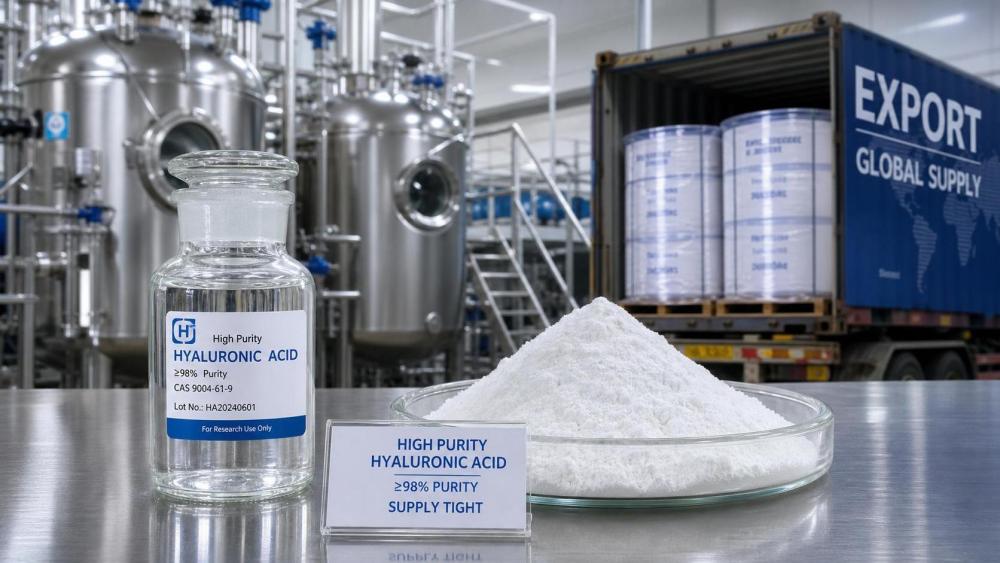
A Price Move Backed by a Clear Supply Trigger
Chemical Market Analytics reported on June 28, 2026 that the average FOB China main ports export quotation for high-purity hyaluronic acid at 95% purity and above stood at $892/kg, representing a week-on-week increase of 8.6%.
The reported trigger was LG Chem of South Korea abruptly suspending exports of medical-grade HA intermediates to China on June 25. As described in the input information, this put pressure on domestic high-end HA synthesis capacity and extended general lead times to 8-10 weeks.
Where the Pressure May Appear Along the Chain
Export-facing trading activity is likely to feel quotation volatility first
From an industry perspective, direct trading companies may be among the first to face the impact because they sit between changing upstream quotations and downstream delivery commitments. What deserves closer attention is whether offers can remain valid for normal negotiation periods when weekly price movement is this visible and delivery times are already being stretched.
Procurement teams may need to focus on availability as much as price
For companies purchasing high-purity HA, the issue is not only the higher FOB reference level. The extension of lead times to 8-10 weeks suggests that sourcing decisions may increasingly hinge on shipment certainty, allocation timing, and whether existing procurement plans still match customer delivery windows.
High-end HA producers face pressure in production scheduling
Processing and manufacturing companies tied to higher-end HA synthesis are likely to be affected through production rhythm and capacity planning. Analysis shows that when an imported intermediate supply is interrupted, the immediate business risk is often concentrated in output continuity, scheduling efficiency, and the ability to keep customer commitments aligned with actual production readiness.
Downstream users may need earlier communication on delivery expectations
For downstream application businesses and buyers, the most relevant change may be the interaction between price movement and longer lead times. Observably, even without assuming further market tightening, customers that rely on stable delivery cycles may need earlier confirmation on order timing, specification matching, and shipment expectations.
What Companies Should Watch Right Now
Supplier statements and any follow-up clarification
Companies directly exposed to medical-grade HA or high-purity HA procurement should closely track any formal follow-up wording from the parties tied to the interruption described in the input. The practical issue is whether the suspension remains temporary, is adjusted, or leads to further changes in supply arrangements. At this stage, that remains a point for verification rather than a confirmed outcome.
Contract timing and quotation validity
With FOB China main ports prices rising 8.6% week on week, businesses should review how long quotations can reasonably remain open and whether internal approval cycles are fast enough for current market conditions. This is especially relevant where pricing, allocation, and shipment windows are normally confirmed in separate steps.
Lead-time risk in customer commitments
The reported extension to 8-10 weeks makes delivery-cycle management a practical priority. Companies should pay attention to whether sales commitments, procurement plans, and production schedules still align under the longer lead-time assumption reflected in the market update.
Documentation and supplier readiness
For procurement and supply-chain teams, it is worth focusing on whether supplier qualifications, product documentation, and order confirmation processes are complete enough to avoid additional delays once material becomes available. Analysis shows that in a tighter supply window, execution discipline often matters as much as headline price.
How This Signal Should Be Read
Analysis shows that this update should first be understood as a market reaction to a specific supply-side disruption rather than as proof of a settled long-term pricing direction. The fact pattern provided is clear on three points: export quotations moved higher within one week, a named supply interruption occurred on June 25, and lead times lengthened to 8-10 weeks.
What deserves closer attention is whether this remains a short-cycle supply shock or develops into a broader reset in high-purity HA availability and pricing behavior. Based on the information provided, it would be premature to treat the current move as a fully established long-term trend.
Why the Market Will Keep Watching This
For the industry, the significance of this development lies in the combination of price movement, upstream supply dependence, and delivery extension in a relatively short time frame. That makes it more than a simple weekly quotation change. At the same time, it is more appropriate to understand this as a development requiring continued observation, rather than a definitive conclusion about where the market will settle next.
A neutral reading is that the latest move has immediate operational relevance for companies handling high-purity HA, especially those balancing procurement, production, and export delivery. The next phase of market interpretation will depend on whether supply conditions normalize or remain constrained.
Basis of This Article
This article is based on the user-provided news title, event date, and event summary concerning the weekly 8.6% rise in global high-purity hyaluronic acid export quotations. The specific official source link was not provided in the input, so further verification remains necessary.
For this type of market development, relevant source categories typically include official announcements, company statements, industry association updates, authoritative media reporting, and standard-setting or market-monitoring publications. Follow-up attention should remain on any official clarification related to the reported export suspension, subsequent export price monitoring, and whether reported lead times continue to hold.
Related News
- How high purity actives for serums reduce formula instability riskSep 30, 2026Cosmeceutical Formulator
- How to evaluate ingredient solution references for skincare claimsSep 27, 2026Cosmeceutical Formulator
- What does hyaluronic acid serum grade mean for cosmetic formulators?Sep 05, 2026Cosmeceutical Formulator
- Which transdermal delivery ingredients for skincare improve actives absorption without raising irritation riskAug 17, 2026Cosmeceutical Formulator
Related News
- 00
0000-00
How to assess color stability from a natural food colors manufacturer - 00
0000-00
When does amino acid surfactant powder improve cleanser mildness? - 00
0000-00
How to verify a cosmetic nanotechnology supplier's safety documentation - 00
0000-00
How rheological thickeners for shampoo affect suspension stability - 00
0000-00
How to assess recombinant collagen ingredients for cream stability
Cosmeceutical Formulator
Weekly Insights
Stay ahead with our curated technology reports delivered every Monday.