





High-Purity Hyaluronic Acid: How to Compare Grade and Cost
For procurement teams evaluating high-purity hyaluronic acid, grade labels and price quotes rarely tell the full story.
True value depends on purity profile, molecular weight consistency, fermentation quality, regulatory readiness, and application fit across food, beauty, and health products.
This guide explains how to compare hyaluronic acid grades and cost structures with more commercial clarity.
The goal is simple: buy the right hyaluronic acid for performance, compliance, and margin protection.
Why Grade Labels Alone Are Not Enough
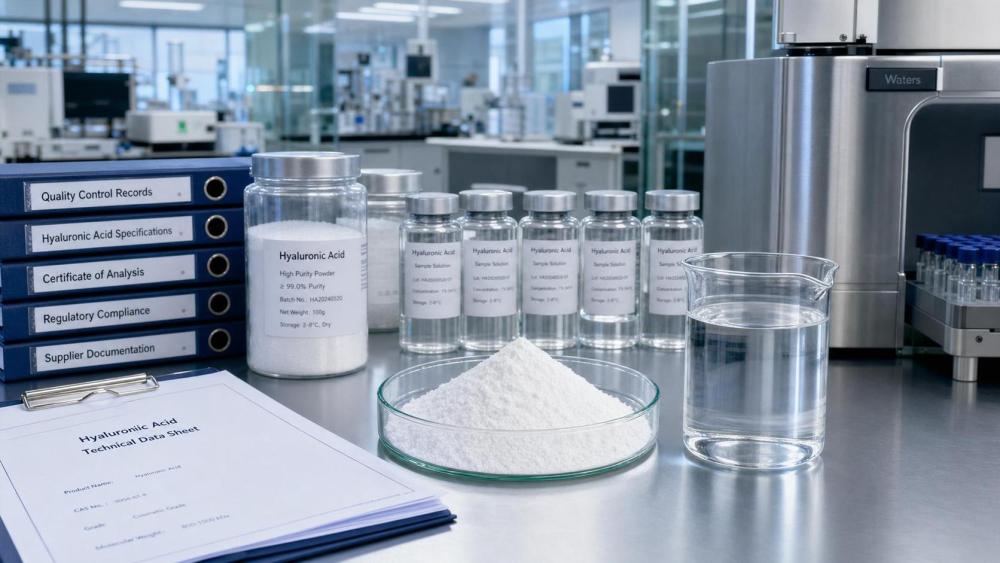
On paper, two suppliers may both offer high-purity hyaluronic acid.
In practice, their materials can behave very differently in formulation, registration, and finished product stability.
That gap usually comes from what the quote does not show.
A hyaluronic acid price may exclude details on endotoxin level, protein residue, solvent profile, or batch-to-batch molecular weight spread.
Those factors affect whether the ingredient fits skin care serums, medical-adjacent applications, ingestible products, or premium nutricosmetics.
More importantly, they affect real delivered cost.
A lower hyaluronic acid price can become expensive after reformulation, failed QA, delayed customs clearance, or extra documentation work.
What High-Purity Hyaluronic Acid Actually Means
High-purity hyaluronic acid is not a single universal grade.
It is a commercial category shaped by application, specification, and risk tolerance.
Most buyers should verify at least five technical dimensions before comparing hyaluronic acid cost.
1. Assay and impurity profile
Look beyond stated purity percentage.
Check residual protein, nucleic acid, heavy metals, ash, and microbial limits.
For premium products, lower impurity load often supports cleaner sensory performance and lower regulatory friction.
2. Molecular weight range
Hyaluronic acid can be high, medium, low, or ultra-low molecular weight.
Each grade changes viscosity, skin feel, absorption story, and dosage economics.
A wide distribution may create inconsistent texture and uneven performance claims.
3. Fermentation source and process control
Most modern hyaluronic acid comes from microbial fermentation.
The quality difference often comes from strain selection, media design, purification steps, and contamination control.
In actual sourcing, process discipline often matters more than marketing language.
4. Regulatory positioning
A cosmetic-grade hyaluronic acid is not automatically suitable for food or supplement use.
Documents such as COA, TDS, SDS, allergen statement, non-GMO statement, and market-specific compliance files should be reviewed early.
5. Functional fit
The best hyaluronic acid is the one that performs in the target formula at the right use level.
This includes dispersibility, solution clarity, pH compatibility, sensory feel, and shelf-life behavior.
How to Compare Hyaluronic Acid Cost Correctly
Quoted hyaluronic acid cost is only the starting point.
A useful purchasing comparison should focus on total cost of use, not only cost per kilogram.
That becomes more important when the ingredient sits in a high-value anti-aging, beauty-from-within, or premium food concept.
Compare these cost layers
- Unit price by grade, assay, and molecular weight.
- Effective dosage needed to achieve target performance.
- Yield loss during production or rework risk.
- Testing costs for identity, purity, and micro limits.
- Documentation support for export or registration.
- Lead time stability and safety stock burden.
- Claim value in the finished product.
For example, a more expensive hyaluronic acid may allow a lower inclusion level.
It may also support stronger premium positioning in serum, capsule, beverage, or functional confectionery formats.
That changes the cost discussion from raw material spend to margin contribution.
A Practical Grade and Cost Comparison Framework
When several suppliers offer similar hyaluronic acid, a simple matrix helps separate real value from polished sales language.
This structure also makes internal alignment easier.
Technical, regulatory, and finance teams can score the same hyaluronic acid supplier from different angles without losing comparability.
Application Matters More Than Many Buyers Expect
One reason hyaluronic acid pricing looks confusing is that application standards are different.
A grade that works for a moisturizing toner may not be the best choice for oral beauty sticks or premium gummies.
In cosmetics
Texture, clarity, molecular weight story, and skin feel often drive grade selection.
Here, a higher hyaluronic acid cost may still make sense if the serum feels cleaner and supports stronger anti-aging claims.
In food and supplements
Taste neutrality, microbiological quality, traceability, and region-specific compliance move to the front.
A cheap hyaluronic acid with weak documentation can slow launches and increase audit pressure.
In premium wellness concepts
The market increasingly rewards ingredients that combine efficacy, clean positioning, and supply transparency.
That means hyaluronic acid grade selection now shapes branding as much as formulation.
Questions That Should Go Into Every RFQ
A stronger RFQ often leads to cleaner quotes and faster supplier screening.
- What is the exact hyaluronic acid molecular weight range and test method?
- What are the limits for heavy metals, protein, and microbial content?
- Is the hyaluronic acid intended for cosmetic, food, or supplement use?
- What fermentation organism and purification process are used?
- What documentation is available for target export markets?
- What is the minimum order quantity, lead time, and lot reservation policy?
- Can the supplier provide retained samples and recent batch data?
These questions quickly reveal whether a hyaluronic acid supplier is process-driven or only quote-driven.
Final Buying View
The most useful way to compare high-purity hyaluronic acid is to connect grade, cost, compliance, and commercial fit in one decision frame.
Price matters, but isolated price rarely predicts sourcing success.
A better hyaluronic acid decision comes from testing how each grade performs across application needs, documentation demands, and premium value creation.
From a purchasing perspective, the best supplier is usually the one that reduces uncertainty while keeping formulation and launch economics under control.
That is where high-purity hyaluronic acid shifts from a commodity line item to a strategic ingredient decision.
Use that lens in the next sourcing round, and hyaluronic acid cost comparisons become far more accurate and commercially useful.
Related News
- How high purity actives for serums reduce formula instability riskSep 30, 2026Cosmeceutical Formulator
- How to evaluate ingredient solution references for skincare claimsSep 27, 2026Cosmeceutical Formulator
- What does hyaluronic acid serum grade mean for cosmetic formulators?Sep 05, 2026Cosmeceutical Formulator
- Which transdermal delivery ingredients for skincare improve actives absorption without raising irritation riskAug 17, 2026Cosmeceutical Formulator
Related News
- 00
0000-00
Can biomimetic peptides in cosmetics reduce the look of wrinkles? - 00
0000-00
How to assess a bio-based thickener manufacturer's batch consistency - 00
0000-00
Verifying halal status of hydrocolloid ingredients in the Middle East - 00
0000-00
How to interpret active matter on a surfactant specification sheet - 00
0000-00
How Do You Test Hydrocolloid Viscosity After Changing a Thickener?
Cosmeceutical Formulator
Weekly Insights
Stay ahead with our curated technology reports delivered every Monday.