





High purity actives for serums reduce instability risk because they give formulators a more predictable starting material. Purity is not simply a premium claim on an ingredient specification. It affects how reliably an active behaves when it meets water, oils, solvents, chelators, preservatives, packaging, air, light, and heat over the product’s intended shelf life.
A serum can fail even when its headline active is chemically sound. Trace metals may catalyze oxidation. Residual process solvents can alter solubility or odor. Related compounds, degradation products, salts, and uncharacterized minor fractions may shift pH, discolor the formula, increase haze, or interfere with another ingredient. When these variables differ between lots, a formula that passed development can become difficult to reproduce at pilot or commercial scale.
The practical value of a purified active is therefore not that it removes the need for formulation work. It reduces the number of unknowns that the formulation must absorb.
Purity affects the whole instability pathway
Serum stability is usually discussed through visible outcomes: yellowing, sediment, phase separation, loss of viscosity, odor change, or a failed active assay. Those outcomes are the end of a chain of chemical and physical events. The impurity profile of an active can influence several points in that chain at once.
For oxidation-sensitive materials, such as some vitamin derivatives, botanical fractions, polyphenolic compounds, and certain peptides, transition-metal traces are especially relevant. Iron and copper can accelerate radical-driven degradation reactions at very low levels. An active with a controlled metal profile may therefore remain easier to protect with a standard antioxidant and chelation system, while a less consistent grade may require stronger stabilization measures without delivering the same result.
Residual solvents and low-molecular-weight by-products can create a different problem. They may change the active’s apparent solubility, introduce a noticeable odor, or disturb the solubilizer balance in a clear water-based serum. In emulsified or anhydrous systems, they can also affect crystallization behavior and create haze over time. The defect may appear to be a base-formula problem even though the root cause is carried in with the active.
Related substances matter as well. A peptide material, for example, may contain truncated sequences, oxidized variants, counterion variation, or residual starting materials. These minor components do not automatically make the material unsuitable, but they can alter assay interpretation, charge balance, and compatibility with preservatives or polymers. A nominally identical dosage based on total powder weight may not deliver identical functional composition.
High purity actives for serums are most useful when the formula has little tolerance for these differences: clear aqueous serums, low-color formulations, high-load active systems, minimalist preservative systems, and products expected to maintain a narrow sensory profile.
What “high purity” should mean in an evaluation file
A single purity percentage is not enough to judge formulation risk. It indicates how much of a measured sample corresponds to the intended material under a particular analytical method, but it does not describe every impurity that could influence stability. A robust evaluation looks at the full identity and quality package.
The choice of analytical method is part of the assessment. A broad chromatographic assay can be useful for one active, while a material with closely related isomers or peptide variants may require separation methods that show the impurity pattern rather than only a total result. For serum development, a certificate of analysis is most valuable when it clarifies what was measured, not merely when it reports a favorable number.
It is also important to separate chemical purity from formulation readiness. A highly purified hydrophobic molecule can still be unsuitable for a water serum if its delivery form crystallizes, its solvent system is incompatible, or its required pH range conflicts with the rest of the formula. Purity lowers uncertainty; it does not replace solubility, pH, packaging, and preservation design.
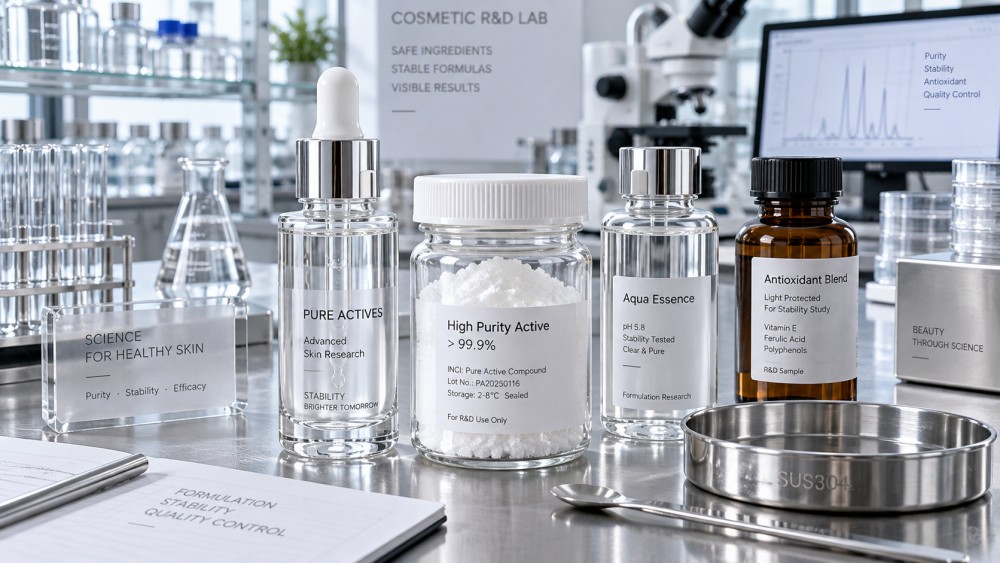
How impurities turn into visible formula failures
Oxidation and color drift
Color change is often treated as an expected feature of a sensitive active. That assumption can hide a controllable material-quality problem. Metal contaminants, peroxides in carrier materials, or oxidized fractions already present in the active can reduce the formula’s oxidative reserve before filling. Exposure to dissolved oxygen, headspace oxygen, light, or elevated temperature then makes the failure visible.
Adding more antioxidant is not always the right response. Antioxidants have their own solubility limits, odor profiles, color, and interactions. In some systems they can also make claims, labeling, or sensory work more complicated. A cleaner incoming active can allow the stabilization system to remain proportionate to the actual risk.
Precipitation, haze, and loss of clarity
Clear serums are sensitive to small changes in solubility. An impurity may be less soluble than the intended active, or it may interact with a solubilizer, electrolyte, or polymeric thickener. The serum can look acceptable immediately after mixing but become hazy after cooling, centrifugation, or storage. This is why visual inspection at room temperature is a weak screen for an active intended for a transparent product.
Purification can reduce poorly soluble related compounds, but the active’s own saturation limit still governs the formula. A clean active should not be forced beyond its stable concentration by relying on temporary clarity from high processing temperature or aggressive mixing.
pH drift and preservative interaction
Many cosmetic actives are supplied as salts, buffered blends, or solutions. Differences in counterion level, acidity, alkalinity, or residual processing components can shift the formula pH after addition. Even a modest pH movement may affect preservative performance, polymer viscosity, peptide integrity, or the solubility of another active.
This issue is common when a laboratory formula is adjusted to target pH only once, shortly after manufacture. A more useful check measures pH after the active has fully equilibrated and repeats the reading through stability storage. Where the active is a concentrated solution, the composition of its carrier should be treated as part of the formula rather than as an insignificant delivery detail.
Odor and sensory inconsistency
Odor is a quality signal as well as a sensory concern. Residual solvents, oxidized oils, trace volatile by-products, or natural-source coextractives can create notes that become more apparent after aging. In fragrance-free serums, there is little opportunity to mask these changes. A purified active with a controlled volatile profile reduces the chance that a technically stable formula becomes commercially unacceptable because its odor has shifted.
Purity control is most valuable at formulation handoffs
Development teams can sometimes compensate for a challenging lot through pH adjustment, chelation, filtration, longer mixing, or a modified solubilization step. These workarounds create risk when the formula moves to a different site, batch size, equipment train, or active lot. What looks like process expertise may actually be repeated correction for incoming-material variation.
For scale-up, identify which active attributes are truly critical to the serum, then connect them to observable outcomes. If discoloration is the primary concern, assay alone is not an adequate release criterion; relevant metal traces, initial color, oxidized fractions, and peroxide exposure from carriers may be more informative. If turbidity is the failure mode, related-substance profile, particle size where applicable, salt load, and dissolution behavior may deserve greater attention.
This approach avoids a common mistake: accepting a broad general specification for a material that has a narrow use case. An active grade suitable for an opaque cream may not offer enough control for a transparent serum containing multiple oxidation-sensitive ingredients. The intended finished format should shape the incoming-material standard.
A practical way to qualify an active for a serum platform
Qualification is more efficient when it moves from material understanding to formula-specific evidence. The goal is not to test every imaginable failure mechanism, but to test the failures the proposed serum makes plausible.
- Map the active’s exposure conditions. Record target concentration, pH, water activity, oxygen exposure, light exposure, temperature during processing, and contact with other reactive ingredients.
- Review the supplier’s quality documentation beyond the headline assay. Focus on impurity identification, residuals, water content, carrier composition, storage conditions, and lot trends.
- Run a compatibility screen in the actual base. Test the intended pH and concentration, then compare the active with and without key stressors such as chelator, antioxidant, electrolyte, or fragrance where relevant.
- Use stress testing to reveal relative risk, not to manufacture a shelf-life claim. Observe color, odor, pH, clarity, viscosity, and active content using methods appropriate to the material.
- Challenge representative lots. One conforming lot establishes feasibility; more than one lot helps reveal whether the system is robust to normal manufacturing variation.
- Translate findings into a purchasing specification. Include the attributes linked to actual formula risk, along with packaging, storage, sampling, and change-notification expectations.
Incoming control should remain proportionate. Repeating every supplier test for a low-risk, well-characterized active may add cost without improving decisions. Independent verification becomes more valuable when the active is high-load, oxidation-sensitive, newly sourced, delivered in a complex carrier, or central to a product claim.
Do not confuse a clean active with a complete stability strategy
Even the best controlled active can fail in an unsuitable formula. An oxygen-permeable package, insufficient headspace control, poor mixing order, uncontrolled processing temperature, or an incompatible pH can overwhelm the benefit of high material purity. Likewise, a serum containing several unstable actives may require an integrated approach to chelation, antioxidant selection, packaging, and manufacturing sequence.
Purity also has diminishing returns. Once a critical impurity is below the level that affects the intended system, a more purified grade may not create a meaningful stability advantage. In that situation, better value may come from a more appropriate derivative, encapsulated format, revised solvent architecture, or package improvement. The right question is not “Which material has the highest stated purity?” but “Which material has a controlled profile that removes the risks this formula cannot tolerate?”
Build the decision around critical attributes, not marketing language
For high-end anti-aging serum development, material quality should be treated as a design input. FFAI’s coverage of cosmetic actives and formulation intelligence reflects this practical connection: molecular quality, transdermal delivery expectations, sensory performance, and finished-product robustness cannot be assessed in isolation.
A defensible selection decision identifies the active’s likely degradation routes, checks whether the supplier controls the impurities that influence those routes, and confirms performance in the intended serum base across representative lots. This creates a clearer foundation for validation and scale-up than relying on a single purity statement or solving every symptom later with extra stabilizers.
Related News
- How high purity actives for serums reduce formula instability riskSep 30, 2026Cosmeceutical Formulator
- How to evaluate ingredient solution references for skincare claimsSep 27, 2026Cosmeceutical Formulator
- What does hyaluronic acid serum grade mean for cosmetic formulators?Sep 05, 2026Cosmeceutical Formulator
- Which transdermal delivery ingredients for skincare improve actives absorption without raising irritation riskAug 17, 2026Cosmeceutical Formulator
Related News
- 00
0000-00
What drives fragrance ingredients price changes in bulk orders? - 00
0000-00
How to assess a food antioxidants distributor’s traceability practices - 00
0000-00
How minimum order quantities shape private label ingredient sourcing costs - 00
0000-00
What drives personal care ingredient price volatility in sourcing - 00
0000-00
What drives micelles price differences in cosmetic formulations?
Cosmeceutical Formulator
Weekly Insights
Stay ahead with our curated technology reports delivered every Monday.