





Fast-absorbing skincare has made low molecular hyaluronic acid actives a priority, but evaluation cannot stop at a supplier’s molecular weight label.
What matters is how the material behaves in a real formula, on skin, and across regulatory markets that expect both efficacy and safety.
For platforms such as FFAI, which track high-end cosmetic actives alongside broader FMCG ingredient intelligence, this topic sits at the intersection of transdermal science, formulation practicality, and commercial credibility.
A sound review framework should connect penetration, hydration persistence, purity, compatibility, and claims support before any ingredient is treated as premium-ready.
Why low molecular weight is only the starting point
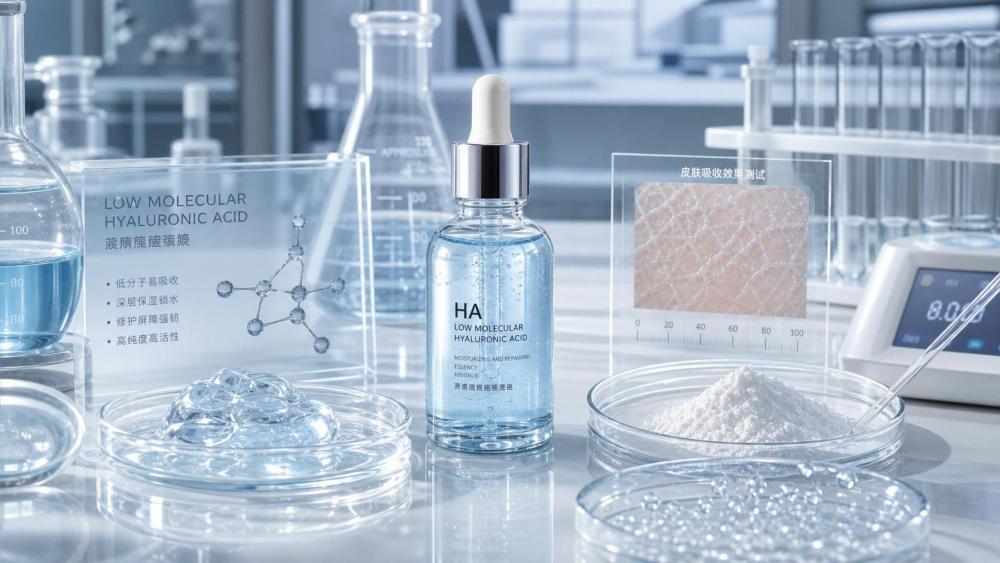
In skincare, hyaluronic acid is valued for water binding, film formation, and visible plumping.
Traditional high molecular grades stay closer to the surface and mainly improve immediate feel.
Low molecular hyaluronic acid actives are designed to move faster into the upper skin layers and deliver a lighter sensory profile.
That sounds simple, yet the phrase “low molecular” covers a wide range.
A 50 kDa material, a 10 kDa fraction, and an enzymatically hydrolyzed blend may all be marketed similarly, while performing very differently.
Some versions improve fast hydration and skin smoothness.
Others create irritation risk, lose viscosity contribution, or weaken a premium anti-aging narrative if characterization is incomplete.
The key point is that low molecular hyaluronic acid actives should be reviewed as defined biomaterials, not as a generic commodity.
What the market is really asking for
Current demand is shaped by three pressures at once: faster absorption, stronger proof, and cleaner positioning.
Consumers increasingly want lightweight serums that hydrate quickly without tackiness.
Brands want claimable differentiation in crowded anti-aging categories.
Regulators and retail channels want clearer traceability, impurity control, and defensible language.
That is why low molecular hyaluronic acid actives now sit beside peptides, ferments, and barrier-support ingredients in many advanced product briefs.
From an FMCG intelligence perspective, this mirrors what FFAI tracks across ingredient sectors.
High-value ingredients succeed when molecular performance, sensory outcome, compliance, and pricing logic all align.
The core evaluation dimensions
A practical review usually begins with a short list of technical checkpoints.
Each one affects whether low molecular hyaluronic acid actives can support fast-absorbing skincare claims in a believable way.
Molecular distribution, not just average size
Ask for the molecular weight range and distribution curve, not only a single average value.
Broad distributions can make batch behavior inconsistent.
Very small fractions may improve penetration signals, yet they can also alter biological response.
Penetration behavior and hydration outcome
Fast absorption should not be reduced to “goes deeper.”
More relevant measures include water retention in upper layers, transepidermal water loss trends, and visible smoothness over time.
Look for in vitro or ex vivo data that connect size with functional skin benefit.
Purity and process residues
Fermentation origin, hydrolysis method, protein residues, solvents, and bioburden all matter.
Low molecular hyaluronic acid actives used in prestige skincare need high purity because impurities can undermine tolerance and quality positioning.
Formula compatibility
An excellent active can fail in use if it clashes with pH, electrolytes, alcohol systems, cationic polymers, or preservation strategies.
Fast-absorbing products often use lean textures, so compatibility testing becomes even more important.
How to judge performance in real formulations
Bench data can look impressive while finished formulas tell a different story.
That is especially true for low molecular hyaluronic acid actives used in water-light gel serums, ampoules, and hybrid essence systems.
In practice, performance should be checked at use level, not only at concentrated raw material level.
A useful screen includes sensory spread, tack after one minute, dry-down speed, hydration after two hours, and stability after heat cycling.
It also helps to compare the active against sodium hyaluronate grades with higher molecular weight.
This reveals whether the lower molecular version truly improves absorption and finish, or simply reduces surface cushioning.
More worth watching is synergy.
Low molecular hyaluronic acid actives often perform better when paired with polyglutamic acid, ectoin, niacinamide, or selected peptides.
The objective is not to make one ingredient do everything, but to build a hydration system with fast uptake and sustained comfort.
Risk points that are easy to miss
A lower molecular profile does not automatically mean a better anti-aging active.
There are several areas where technical reviews often need more rigor.
- Overreliance on marketing phrases such as “deep penetration” without method details.
- Insufficient distinction between hydrolyzed hyaluronic acid and well-characterized low molecular sodium hyaluronate.
- Weak preservation compatibility in minimalist formulas with high water activity.
- Instability in systems containing strong acids, high alcohol, or reactive botanical extracts.
- Claims language that exceeds the available cosmetic evidence in target regions.
This is where an intelligence-led view is useful.
FFAI’s cross-category perspective matters because the same discipline used to assess preservatives, thickeners, and sensory systems also sharpens cosmetic active selection.
A good ingredient should fit a full product architecture, not only a headline claim.
Compliance and business relevance
For international skincare projects, documentation quality can be as important as laboratory performance.
Review the INCI naming, origin statement, manufacturing process summary, specification sheet, safety package, and regional claim boundaries.
The ingredient should also make economic sense.
Some low molecular hyaluronic acid actives command a premium because they offer cleaner sensory performance, better evidence, and stronger positioning in anti-aging ranges.
Others mainly add cost.
Commercial relevance improves when the active helps support a clear product story: rapid hydration, elegant absorption, barrier comfort, and premium scientific credibility.
That balance between efficacy moat and market fit is exactly where careful ingredient intelligence creates value.
A practical next step for evaluation
The best way to assess low molecular hyaluronic acid actives is to build a short comparison matrix before formula lock.
Include size distribution, purity profile, hydration data, sensory impact, compatibility window, dossier strength, and cost-in-use.
Then test at realistic concentrations in the exact texture system being developed.
This approach makes it easier to separate fashionable ingredient language from actives that genuinely improve fast-absorbing skincare.
Where evidence still looks thin, the next move is not broad adoption.
It is targeted verification, tighter supplier questions, and a clearer standard for what performance must look like in the final product.
Related News
- How high purity actives for serums reduce formula instability riskSep 30, 2026Cosmeceutical Formulator
- How to evaluate ingredient solution references for skincare claimsSep 27, 2026Cosmeceutical Formulator
- What does hyaluronic acid serum grade mean for cosmetic formulators?Sep 05, 2026Cosmeceutical Formulator
- Which transdermal delivery ingredients for skincare improve actives absorption without raising irritation riskAug 17, 2026Cosmeceutical Formulator
Related News
- 00
0000-00
Verifying halal status of hydrocolloid ingredients in the Middle East - 00
0000-00
How to interpret active matter on a surfactant specification sheet - 00
0000-00
What Quality Checks Should You Run on Fragrance Ingredient Suppliers? - 00
0000-00
How to assess a flavor chemistry manufacturer's batch consistency - 00
0000-00
What drives fragrance ingredients price changes in bulk orders?
Cosmeceutical Formulator
Weekly Insights
Stay ahead with our curated technology reports delivered every Monday.