





Hyaluronic Acid Production: why cost and purity are discussed together
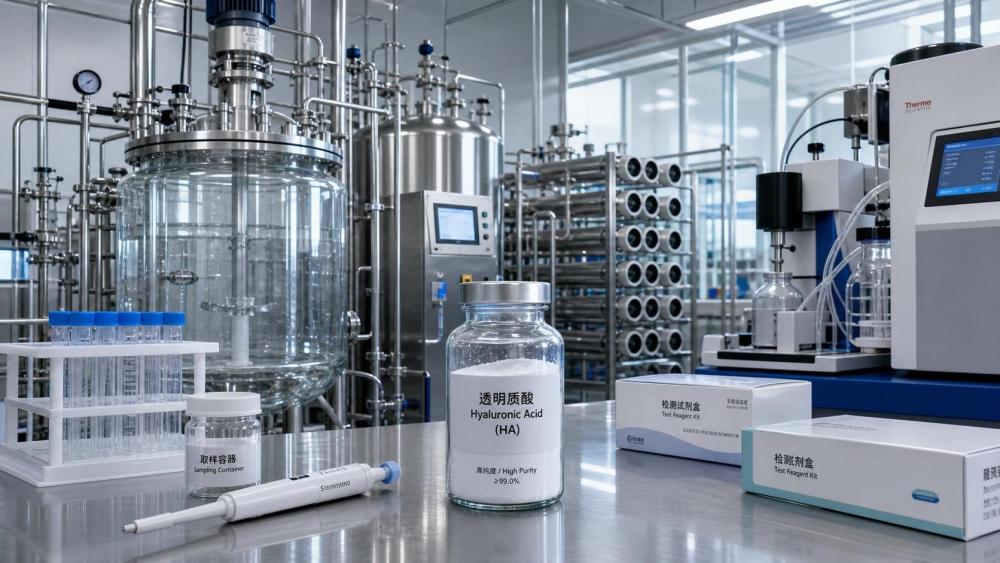
Hyaluronic acid production is rarely judged by price alone. In real sourcing work, purity consistency usually decides whether a quote is truly competitive.
That is especially true across food, beauty, and active ingredient markets, where one material may sit inside a premium serum, a supplement, or a complex formulation.
The practical question is simple: what exactly makes one hyaluronic acid production route more expensive, and when is that premium justified?
A useful answer needs both chemistry and market context. That is where FFAI’s perspective matters, because ingredient decisions are shaped by efficacy, sensory fit, compliance, and downstream pricing power.
In other words, hyaluronic acid production should be read as a supply chain decision, not just a laboratory topic. Cost control starts with understanding the process behind the assay number.
What really happens inside hyaluronic acid production?
Most modern hyaluronic acid production uses microbial fermentation. The process sounds straightforward, but cost variation appears at nearly every stage.
First comes strain selection. Some producers rely on mature, stable strains with predictable output. Others use optimized strains that raise yield but demand tighter process control.
Then comes the fermentation medium. Carbon source quality, nitrogen source choice, trace elements, and contamination control directly influence yield and impurity load.
After fermentation, the difficult part begins. Broth clarification, deproteinization, desalting, concentration, precipitation, drying, and milling all affect final purity and molecular weight stability.
This is why two suppliers can both claim hyaluronic acid production capability, yet deliver very different material performance in viscosity, color, odor, bioburden, and residual solvents.
For applications tied to clean-label thinking, skin safety, or high-end actives, downstream purification usually matters more than headline capacity.
Which cost drivers move the quotation the most?
The biggest mistake is assuming raw materials explain most of the price. In hyaluronic acid production, they matter, but they are only one layer.
More often, the final quotation reflects a combined burden of yield, purification intensity, specification tightness, and document readiness.
- Fermentation efficiency: low yield raises unit cost quickly, especially when energy and sterilization cycles are high.
- Purification depth: tighter impurity removal increases water use, filtration load, solvent recovery, and labor input.
- Molecular weight control: narrow ranges require better process stability and more batch-level testing.
- Compliance package: COA alone is cheap; a full technical dossier, allergen review, and regional declarations are not.
- Packaging and storage: moisture protection, lot segregation, and cold-chain needs can reshape delivered cost.
In practical comparison work, a lower quote may hide weaker batch reproducibility. That often creates larger losses later through reformulation delays or extra incoming inspection.
FFAI often tracks this same pattern across other functional ingredients. Premium pricing becomes easier to defend when purity and application performance support a stronger finished-product claim.
A quick reference for cost review
How pure does hyaluronic acid need to be for different applications?
Purity is not a single universal threshold. The right benchmark depends on where the ingredient will be used and how sensitive the formula is.
For topical beauty, appearance and skin feel matter alongside assay. A high-purity grade with controlled molecular weight often disperses better and supports a cleaner sensory profile.
For nutraceutical or food-adjacent uses, attention often shifts to microbial limits, residual proteins, heavy metals, and regional acceptability of the production route.
For advanced active ingredient systems, narrow impurity control may matter because even small deviations can influence stability, compatibility, or claim substantiation.
A useful benchmark table helps prevent confusion between “high assay” and “fit for purpose.” Those are related, but not identical.
In actual evaluation, the better question is not “What is the highest purity available?” It is “What purity level protects formula performance without paying for unnecessary overprocessing?”
When two suppliers look similar, what separates a safe choice from a risky one?
This is where many sourcing decisions become difficult. Datasheets can look almost identical, while real supply reliability differs sharply.
A safer comparison starts with the process story behind the specification. Ask how the supplier controls batch variation, not just what the target number is.
It also helps to check whether hyaluronic acid production is a core line or a secondary product. Dedicated facilities usually manage cross-contamination and process tuning more carefully.
Documentation depth is another separator. In sectors watched closely by FFAI, incomplete compliance files often slow exports more than the material itself.
- Request recent batch trend data, not one ideal COA.
- Confirm assay method and molecular weight test method.
- Check residual impurity definitions across suppliers.
- Review lead time under peak demand conditions.
- Clarify change-control notice periods before approval.
These points sound operational, but they directly affect total cost. A cheaper material loses value quickly if every second lot behaves differently in formulation.
Are there common misunderstandings about hyaluronic acid production costs?
Yes, and several are costly.
One common misunderstanding is treating assay as the whole quality picture. High assay does not automatically guarantee low bioburden, stable viscosity, or clean sensory performance.
Another is assuming larger pack sizes always reduce the real unit cost. If shelf life, moisture uptake, or slower consumption increases scrap risk, the savings disappear.
There is also a tendency to underestimate compliance costs. For cross-border business, declarations, traceability, and regional safety files can decide whether a material is usable on schedule.
In premium beauty and health categories, FFAI repeatedly sees the same pattern: a small impurity issue upstream can become a large positioning issue downstream.
That matters because hyaluronic acid production often supports claims linked to hydration, texture refinement, or anti-aging systems. Claims are expensive to defend with inconsistent raw material.
A short decision checklist before comparing offers
- Define the required molecular weight range before asking for quotations.
- Separate mandatory purity items from preferred extras.
- Calculate testing, approval, and failure costs beside ex-works price.
- Match documentation needs to destination market rules.
- Request a retained sample or pilot lot for formulation confirmation.
What is the smartest next step when reviewing hyaluronic acid production options?
Start by narrowing the use case. A quote only becomes meaningful when application, purity target, molecular weight range, and document requirements are already defined.
Then compare suppliers on three levels at once: process credibility, delivered specification, and total commercial risk. That usually gives a clearer answer than unit price alone.
For teams following FFAI’s broader ingredient logic, this approach is familiar. Whether the material is a preservative, fragrance component, thickener, surfactant, or anti-aging active, value comes from performance plus compliance.
Hyaluronic acid production is no different. The better buying decision usually comes from understanding where cost is created, where purity is protected, and where hidden risk enters the chain.
A practical next move is to build a side-by-side review sheet covering assay, impurity profile, molecular weight control, batch history, lead time, and dossier completeness.
Once those points are visible, quotations become easier to judge, negotiation becomes more precise, and long-term margin control becomes more realistic.
Related News
- How high purity actives for serums reduce formula instability riskSep 30, 2026Cosmeceutical Formulator
- How to evaluate ingredient solution references for skincare claimsSep 27, 2026Cosmeceutical Formulator
- What does hyaluronic acid serum grade mean for cosmetic formulators?Sep 05, 2026Cosmeceutical Formulator
- Which transdermal delivery ingredients for skincare improve actives absorption without raising irritation riskAug 17, 2026Cosmeceutical Formulator
Related News
- 00
0000-00
Verifying halal status of hydrocolloid ingredients in the Middle East - 00
0000-00
How to interpret active matter on a surfactant specification sheet - 00
0000-00
What Quality Checks Should You Run on Fragrance Ingredient Suppliers? - 00
0000-00
How to assess a flavor chemistry manufacturer's batch consistency - 00
0000-00
What drives fragrance ingredients price changes in bulk orders?
Cosmeceutical Formulator
Weekly Insights
Stay ahead with our curated technology reports delivered every Monday.