





On June 1, 2026, New Zealand’s MPI released new requirements for registered food importers and imported food offered for sale, immediately raising the compliance threshold for imports involving high-activity ingredients such as natural antioxidants, Pro-Xylane, Anti-aging Peptides, and High-purity Hyaluronic Acid. The rule matters not only to importers, but also to ingredient suppliers, processors, distributors, and downstream buyers, because market access is now tied to whether a registered importer can provide FDA GRAS or EFSA scientific opinion materials as the product’s safety basis, with only a 30-day transition window.
What the new requirement clearly says
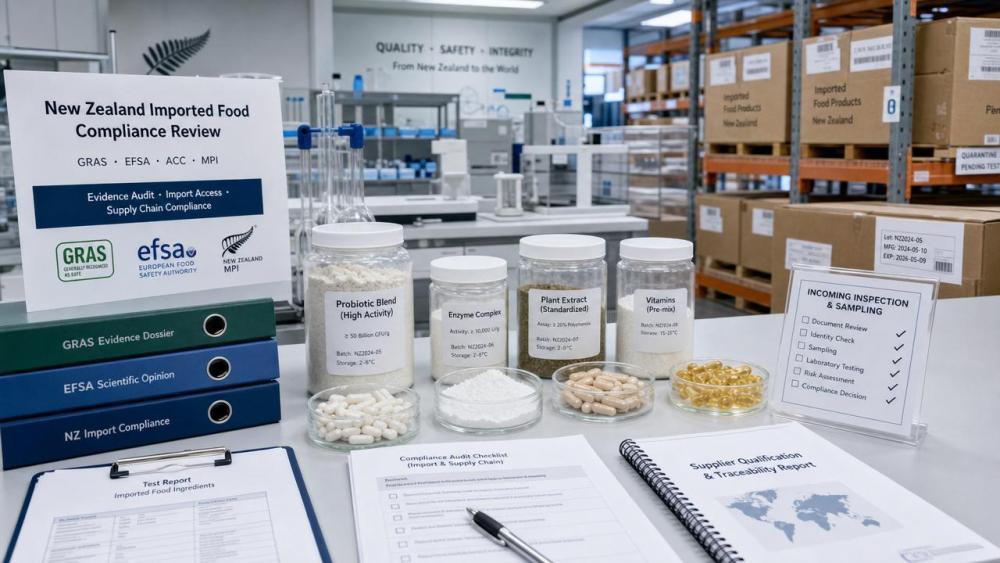
According to the information provided, MPI issued the document titled Requirements for Registered Food Importers and Imported Food for Sale on June 1, 2026. Under this requirement, companies importing high-activity ingredients into New Zealand, including natural antioxidants, Pro-Xylane, Anti-aging Peptides, and High-purity Hyaluronic Acid, must have a registered importer submit FDA GRAS or EFSA scientific opinion documentation as the safety basis. If that basis is not provided, the products cannot be placed on the market for sale. The rule took effect on the same day it was released, and the transition period is limited to 30 days.
Where the pressure will likely appear first
Import-facing businesses will carry the immediate compliance burden
From an industry perspective, registered importers are the first point of impact because the rule directly assigns them the responsibility to submit the safety basis. The practical effect is likely to concentrate on document readiness, product screening, and launch timing for covered ingredients.
Ingredient suppliers may face higher documentation demands
Analysis shows that upstream suppliers of the named high-activity ingredients may be affected through customer requests for GRAS- or EFSA-related supporting materials. Even where the supplier is not the party filing into New Zealand, its ability to support importer documentation may become a key factor in maintaining commercial continuity.
Manufacturers and processors may need to reassess formulations bound for New Zealand
For processing and manufacturing businesses, the impact is likely to fall on recipe planning, export allocation, and product release schedules. If a formulation includes ingredients covered by the new rule, the ability to sell into New Zealand may depend on whether the required safety basis can be assembled through the registered importer within the short transition period.
Distributors and downstream buyers may need to watch supply continuity
For distribution channels, brand-side procurement teams, and end-use buyers, the main issue is less about direct filing and more about whether affected products can continue to enter and remain saleable in the market. What deserves closer attention is the risk of short-term disruption in shipments, replenishment, or product availability where documentation is incomplete.
What companies should review now
Check whether exposed products fall within the named ingredient scope
The first practical step is to identify whether current or planned New Zealand-bound products involve natural antioxidants, Pro-Xylane, Anti-aging Peptides, High-purity Hyaluronic Acid, or other high-activity ingredients referenced in the rule summary. This is the basis for determining whether immediate action is required.
Confirm who is acting as the registered importer
Because the rule places the submission obligation on the registered importer, businesses should clarify early which party in the transaction is holding that role. In practice, this affects document collection, responsibility allocation, and communication with suppliers and customers.
Review the availability and usability of GRAS or EFSA materials
Observably, having a document and having a usable market-access basis are not always the same thing. Companies should focus on whether the relevant FDA GRAS or EFSA scientific opinion materials can actually be provided to support the ingredient in question, and whether internal teams and trading partners are aligned on timing during the 30-day transition period.
Prepare for customer and supply-chain communication under a compressed timeline
The same-day effect and short transition period make coordination a near-term priority. Businesses involved in purchasing, shipping, order fulfillment, or customer account management should be ready to explain document status, possible delivery implications, and any product-level restrictions that may arise if the required safety basis is not in place.
Why this looks like more than a one-off filing issue
Analysis shows that this development is not just a narrow paperwork adjustment. It signals a more explicit linkage between imported food market access and externally recognized safety substantiation for certain high-activity ingredients. At the same time, it would be premature to treat the full business impact as settled fact. The current information confirms the rule, the documentation threshold, and the transition period, but the broader operational consequences still need to be observed in actual trade execution and follow-up regulatory communication.
How the market may be reading this at this stage
It is more appropriate to understand this as both an immediate compliance change and a longer-term regulatory signal. Immediate, because products lacking the required safety basis cannot be sold and the transition period is only 30 days. Longer-term, because the rule may influence how companies structure ingredient dossiers, importer relationships, and New Zealand market-entry planning for high-activity food-related ingredients. For now, the most balanced reading is that businesses should treat this as actionable rather than speculative, while still monitoring whether additional clarification emerges.
Basis of this article and what still needs verification
This article is based on the user-provided news title, event date, and event summary. For developments of this type, commonly relevant source categories may include official notices, company announcements, industry association updates, authoritative media reporting, and standards or regulatory documents. A specific official source link was not provided in the input, so the exact underlying publication path still needs ongoing verification. Continued attention should be paid to any further official wording, implementation clarification, or follow-up interpretation related to the scope of affected ingredients and documentation expectations.
Related News
- How high purity actives for serums reduce formula instability riskSep 30, 2026Cosmeceutical Formulator
- How to evaluate ingredient solution references for skincare claimsSep 27, 2026Cosmeceutical Formulator
- What does hyaluronic acid serum grade mean for cosmetic formulators?Sep 05, 2026Cosmeceutical Formulator
- Which transdermal delivery ingredients for skincare improve actives absorption without raising irritation riskAug 17, 2026Cosmeceutical Formulator
Related News
- 00
0000-00
Can biomimetic peptides in cosmetics reduce the look of wrinkles? - 00
0000-00
How to assess a bio-based thickener manufacturer's batch consistency - 00
0000-00
Verifying halal status of hydrocolloid ingredients in the Middle East - 00
0000-00
How to interpret active matter on a surfactant specification sheet - 00
0000-00
How Do You Test Hydrocolloid Viscosity After Changing a Thickener?
Cosmeceutical Formulator
Weekly Insights
Stay ahead with our curated technology reports delivered every Monday.