





A hyaluronic acid serum grade is the supplier-defined specification package that describes which form of hyaluronic acid is being supplied and how it is expected to behave in a water-based cosmetic formula. The word grade does not identify one universal material. Two powders both labeled “hyaluronic acid” can differ substantially in molecular weight distribution, physical form, microbial quality, sodium content, particle handling, solution clarity, and documentation. Those differences affect whether a serum becomes a clear fluid, a cushiony gel, a stringy concentrate, or an unstable system that changes during storage.
For formulation work, the useful question is not whether a material is “serum grade” in a promotional sense. It is whether its documented properties fit the target formula, process, packaging, preservative system, claim direction, and sensory profile. A grade suitable for a high-viscosity hydrating gel may be a poor fit for a low-viscosity dropper serum or a transparent sprayable essence.
What the grade normally communicates
Hyaluronic acid is a polysaccharide with a strong affinity for water. In cosmetics, it is commonly supplied as hyaluronic acid, sodium hyaluronate, hydrolyzed hyaluronic acid, or a modified form. The supplied grade may be a dry powder, granules, pre-dispersed slurry, or standardized aqueous solution. The ingredient name alone does not settle performance, because materials under the same naming family can have very different chain lengths and solution behavior.
A technical data sheet and certificate of analysis often provide the practical identity of the grade. Important fields include appearance, assay or active content, molecular weight or molecular weight range, pH of a defined solution, moisture, viscosity under stated test conditions, microbiological limits, ash or residual salts, and solubility instructions. Some specifications also state bioburden control, endotoxin limits, residual protein, heavy-metal limits, preservative content, or the origin and fermentation status of the raw material.
These items should be read as a group. A viscosity value without the polymer concentration, solvent, temperature, spindle or shear conditions is not enough to predict finished-serum viscosity. Likewise, a molecular weight figure gives a useful directional signal, yet it does not fully describe chain-length distribution or how that distribution interacts with electrolytes, humectants, other polymers, and the chosen preservation system.
Molecular weight changes the formulation problem
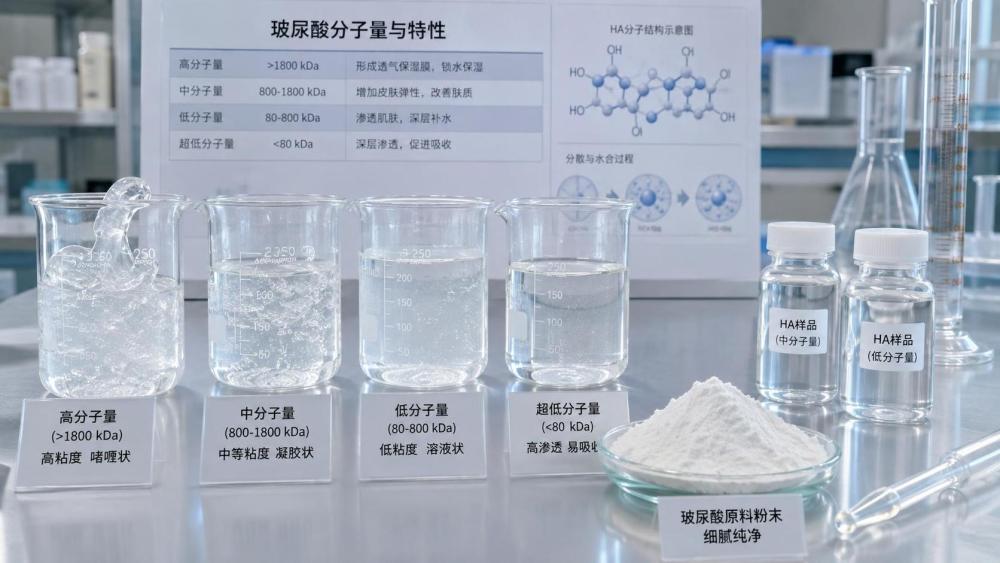
Molecular weight is usually the first parameter associated with hyaluronic acid serum grade. Higher-molecular-weight material tends to create more noticeable viscosity and film formation at low use levels. It can contribute to a fuller, more cushioned application, but it may also create stringiness, slower dissolution, tack, or a gel-like character that conflicts with a fluid serum brief.
Lower-molecular-weight or hydrolyzed material is generally easier to use in thin aqueous systems and may provide a lighter skin feel. It will not necessarily build the same bulk viscosity or surface film. Therefore, replacing a high-molecular-weight sodium hyaluronate with a lower-molecular-weight material at the same percentage is not a direct substitution. The formula can become visibly thinner even when the hydration claim language remains similar.
A blend of grades is often selected when a formula needs both immediate slip and a more substantive finish. That choice still requires controlled testing. A blend can feel elegant in a simple water-and-humectant base, then become sticky or draggy after the addition of a film former, high glycerin level, botanical extract solids, or a second rheology modifier.
Do not treat molecular weight as a penetration claim
Chain length is frequently discussed alongside skin delivery, but molecular weight alone does not prove the biological performance of a finished serum. The final outcome is influenced by concentration, vehicle composition, dry-down behavior, frequency of application, barrier condition, and the presence of other ingredients. A specification should support material selection and substantiation planning; it should not be converted into a performance claim without appropriate evidence for the finished product.
It is also important to distinguish a narrowly specified molecular-weight range from a broad range or an average value. A broad distribution can be entirely usable, but batch-to-batch sensory consistency may need closer attention. If the formula is tuned close to a viscosity, clarity, or pumping limit, a shift in distribution can be more consequential than a small difference in nominal assay.
Purity and microbiological quality are formulation variables
“High purity” is often used loosely. In a serum project, purity has practical meanings: low levels of undesirable process residues, controlled inorganic content, appropriate microbiological quality, and a material that does not introduce unexpected odor, color, haze, or incompatibility. The relevant acceptance criteria depend on the finished product format and internal quality standards.
Powdered hyaluronic acid is highly water-binding. It does not preserve the finished formula simply because it is supplied dry. Once hydrated in water, it becomes part of a system that requires a suitable preservative strategy and challenge testing. The polymer can also affect the availability and diffusion of preservative ingredients within a viscous aqueous matrix. A formula that passes a quick visual stability screen may still need further microbiological evaluation after the target viscosity is reached.
Microbiological specifications should be reviewed alongside the proposed manufacturing route. A low-bioburden raw material does not remove the need for controlled water quality, equipment sanitation, clean addition practices, and packaging hygiene. Materials that require a long hydration period may keep the batch open for longer, which makes process control more relevant than it would be for a rapidly soluble liquid active.
Solubility is often really a dispersion issue
Many hyaluronic acid grades are described as water soluble, yet direct addition to water can form fish-eyes: dry particles enclosed by a hydrated outer layer. Once formed, these lumps can be difficult to break without excessive shear or a long hold period. A formula then appears to have poor solubility when the underlying problem is incomplete wetting and dispersion.
Dry addition rate, agitation geometry, water temperature, batch size, and the order of humectant addition all influence hydration. High-speed mixing can improve initial dispersion in some systems, but aggressive shear after full hydration may reduce viscosity by mechanically degrading polymer chains. The preferred process is therefore grade-specific rather than a generic “mix until clear” instruction.
- A fine powder may require slow, controlled sprinkling into a well-formed vortex so individual particles wet before they contact one another.
- Preblending with a compatible polyol can reduce lump formation, although the selected ratio and order of addition must be tested against the full formula rather than water alone.
- A ready-made solution reduces hydration time but adds water, process preservatives, and transport considerations that need to be included in the formula calculation.
- Heating is not automatically beneficial. It may aid processing for some systems, while prolonged heat exposure and unnecessary hold time can reduce the desired rheological contribution.
Clarity should be assessed after complete hydration, not immediately after dispersion. A freshly made batch can look translucent because undissolved material is still suspended. Conversely, later haze can arise from an incompatibility with salts, extracts, surfactants, or pH adjustment rather than from the grade itself.
Texture design requires looking beyond viscosity
Hyaluronic acid grades are sometimes selected only to achieve a target centipoise value. That approach misses attributes that consumers notice quickly: initial spread, wet slip, stringiness between fingers, dry-down time, residual tack, pilling beneath sunscreen or makeup, and the way the formula releases from a pipette or pump.
Two serum bases with similar measured viscosity can behave differently under shear. A high-molecular-weight grade may provide a more elastic, structured flow, while another thickener may create a shorter, less stringy gel. Combining them can improve suspension or cushion, but it can also produce an overly dense film. Visual appearance matters as well. Some grades yield water-clear solutions at a useful concentration, whereas others give a soft opalescence that may be acceptable only in an intentionally milky format.
pH, salts, and companion ingredients can change the result
Hyaluronic acid performs best within a formulation environment appropriate to the chosen grade and intended skin application. pH adjustment should be made carefully and late enough in development to observe its effect on viscosity, clarity, and odor. A stable pH reading does not guarantee stable rheology over time, especially when the formula contains electrolyte-bearing extracts, mineral salts, neutralized polymers, or actives supplied in buffered solutions.
Electrolytes deserve particular attention. Sodium hyaluronate is already an ionic material, and added salts can alter polymer conformation and perceived viscosity. A formula may appear satisfactory in a laboratory prototype with purified water, then thin after a preservative blend, botanical extract, mineral complex, or neutralizing agent is introduced. The same issue can appear when a water phase is replaced with a commercial ingredient solution carrying its own salts or solvents.
Compatibility work should also cover surfactants, alcohol levels, fragrance solubilizers, cationic ingredients, and exfoliating acids when they are part of the concept. A clear serum does not automatically stay clear after repeated temperature cycling. Packaging interaction is another practical detail: a product that dispenses well through a dropper may dispense poorly through a narrow pump pathway after viscosity builds during storage.
Reading supplier documents without over-reading them
A robust ingredient file links commercial documents to laboratory observations. The technical data sheet explains intended properties and processing guidance. The certificate of analysis confirms lot-specific results against agreed limits. A safety data sheet supports handling and storage procedures. Ingredient identity, composition, origin statements, allergen information where applicable, and regulatory-status documents may be needed for internal review and market-specific product files.
Terms such as pharmaceutical grade, cosmetic grade, fermentation grade, or serum grade should not replace the underlying specifications. They may signal the supplier’s market positioning or quality system, but they are not interchangeable technical standards across all suppliers. Requesting a representative sample is useful only when the sample is processed using the intended manufacturing method and evaluated in the actual base formula.
Storage conditions should be followed closely. Moisture uptake can change powder flow and make accurate dosing harder. Repeated opening of a container in a humid production area can create clumps before the material reaches the batch. For liquid grades, freeze-thaw sensitivity, settling, and preservative compatibility require their own evaluation. Retain samples and lot traceability make it easier to investigate an unexpected shift in appearance or viscosity later.
A practical way to define the needed grade
Start with the finished serum rather than a preferred ingredient label. Define whether the product should be water-thin, lightly viscous, gel-like, clear, opaque, pumpable, or suitable for a dropper. Establish the intended pH range, humectant system, active load, preservative approach, and packaging early. These decisions narrow the suitable molecular-weight and delivery-form options.
Next, compare grades under equal and documented conditions. Prepare solutions at the relevant use level, allow complete hydration, measure pH and viscosity using the same method, and assess appearance after the complete ingredient set is present. Evaluate fresh batches alongside accelerated and temperature-cycling samples. Include a use test for dispensing, spread, tack, layering, and pilling, because a favorable bench viscosity number can conceal an unsuitable application experience.
The most useful meaning of hyaluronic acid serum grade is therefore a defined performance envelope: material identity, chain-length profile, cleanliness, hydration behavior, and handling limits that have been matched to a particular serum architecture. When those elements are documented and tested together, grade selection becomes a controlled formulation decision rather than a reliance on a broad label.
Related News
- How high purity actives for serums reduce formula instability riskSep 30, 2026Cosmeceutical Formulator
- How to evaluate ingredient solution references for skincare claimsSep 27, 2026Cosmeceutical Formulator
- What does hyaluronic acid serum grade mean for cosmetic formulators?Sep 05, 2026Cosmeceutical Formulator
- Which transdermal delivery ingredients for skincare improve actives absorption without raising irritation riskAug 17, 2026Cosmeceutical Formulator
Related News
- 00
0000-00
What drives fragrance ingredients price changes in bulk orders? - 00
0000-00
How to assess a food antioxidants distributor’s traceability practices - 00
0000-00
How minimum order quantities shape private label ingredient sourcing costs - 00
0000-00
What drives personal care ingredient price volatility in sourcing - 00
0000-00
What drives micelles price differences in cosmetic formulations?
Cosmeceutical Formulator
Weekly Insights
Stay ahead with our curated technology reports delivered every Monday.