





For transdermal delivery ingredients for skincare, the practical question is which systems improve active uptake without turning the formula into an irritant. The safest answer is usually not a single “penetration enhancer,” but a combination of solvent, carrier, and release-control ingredients that change partitioning and diffusivity in a controlled way. Ingredients that severely disrupt the stratum corneum lipid structure can raise delivery, but they also tend to increase sting, dryness, and tolerance problems. The better selection logic is to favor materials that increase solubility of the active, maintain thermodynamic activity, and support even deposition on skin rather than aggressive barrier stripping.
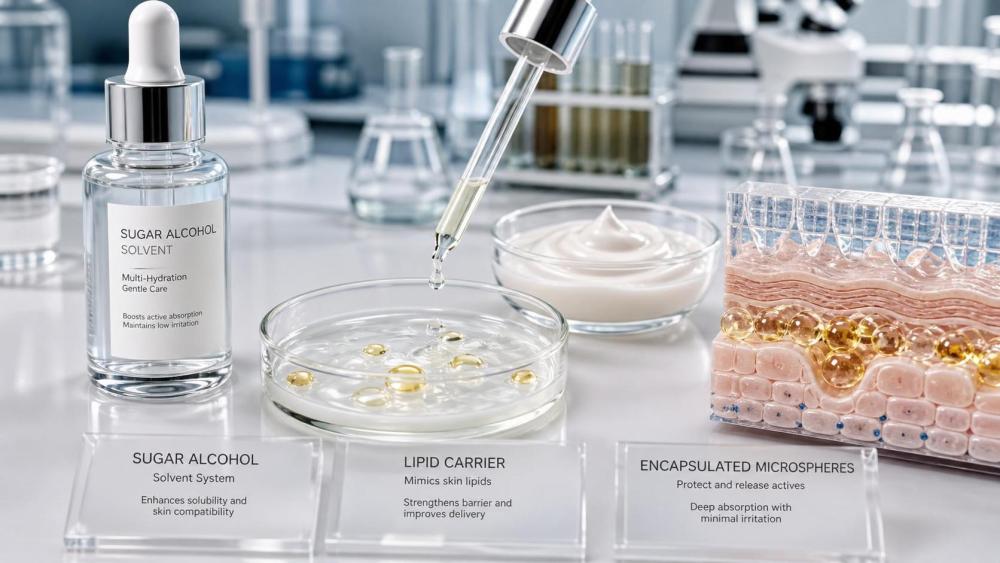
Ingredient classes that usually deserve evaluation first
Glycols are often the starting point because they are familiar, compatible with many water-based systems, and relatively easy to process. Propylene glycol, butylene glycol, pentylene glycol, and related diols can improve wetting and help dissolve polar actives, which may increase the amount available at the skin interface. Their value is formulation-dependent: in low to moderate levels they can support hydration and spreadability, while excessive loading may create tackiness or stinging, especially when the finished product also contains acids, retinoids, or fragrance components. For this reason, glycols are often used as supporting carriers rather than as the main delivery mechanism.
Short-chain lipids and esters are useful when the active leans more lipophilic. Isopropyl myristate, C12-15 alkyl benzoate, caprylic/capric triglyceride, and similar emollients can improve partitioning into the skin surface lipids and reduce drag during application. The main risk is that some of these ingredients are also known to feel occlusive or heavy at the wrong level, and a few can be problematic in acne-prone products if the overall vehicle is poorly balanced. In practice, the question is not whether an ester “penetrates,” but whether it creates a favorable solvent environment for the active without destabilizing the sensory profile.
Phospholipids, lamellar emulsifiers, and ceramide-containing systems are often better suited when barrier respect matters. These ingredients do not force rapid penetration in the same way as harsher enhancers, but they can improve delivery by supporting ordered skin-like structures and reducing the irritation profile of the base. For actives that benefit from sustained residence near the stratum corneum, this type of carrier can be more defensible than a strong disruption strategy. Liposomes, nanoemulsions, and multilamellar emulsions fall into this family, although their real-world performance depends on payload, droplet size, charge, manufacturing shear, and storage stability.
Where irritation usually starts
Irritation risk is often overestimated when teams focus only on the ingredient name and ignore the whole system. Solvents that are acceptable in isolation can become problematic when paired with low pH, oxidation-prone actives, or high fragrance load. Ethanol is a common example: it can help solubilize certain actives and improve fast-dry aesthetics, but it may also increase barrier lipid extraction and transient burning. Terpenes and essential-oil-derived enhancers can behave similarly. They sometimes improve permeation, yet their sensitization history and oxidation behavior make them harder to defend in leave-on skincare unless the use level, antioxidant protection, and packaging are tightly controlled.
Surfactant-like enhancers deserve caution as well. Materials that resemble micelle-forming surfactants may improve wetting and help transport, but they can also denature proteins or disturb the outer barrier if used aggressively. This matters especially in products for thin or already compromised skin. A formulation that looks effective in vitro can still fail in human use if the enhancer raises transepidermal water loss, causes flushing, or magnifies the sting of the active itself.
Useful decision criteria for the formula screen
A sensible screen starts with the active’s polarity, molecular size, and dose. Small, moderately lipophilic molecules often benefit from solvent tuning and mild penetration support. Large peptides, polymers, and highly charged actives rarely respond well to brute-force enhancement; they usually need a carrier architecture, a release modifier, or a skin-surface deposition strategy. If the payload is unstable in water, the main issue may be preservation of activity rather than transport through the barrier. In those cases, a delivery ingredient that improves stability can outperform a stronger enhancer that degrades the molecule before it reaches skin.
Processing matters as much as chemistry. High shear can reduce droplet size and improve uniformity, but it may also destabilize emulsions that rely on delicate lamellar structures. Heat history can strip volatile co-solvents or damage encapsulated actives. pH shifts can change ionization state and alter both solubility and irritation risk. Even the order of addition can matter when a system contains polymers, phospholipids, or solubilizers that compete for the same active.
Packaging and storage conditions are easy to underestimate. If the formula relies on oxidation-sensitive terpenes, botanical solvents, or unsaturated lipids, headspace, oxygen exposure, and light transmission can change the delivery profile over time. A delivery ingredient that looks gentle at fill may become a source of instability after shipping in warm conditions. That is one reason why transport, warehouse temperature, and closure integrity should be part of ingredient selection rather than an afterthought.
Lower-risk options that often balance performance and tolerability
When the objective is measured enhancement rather than maximal penetration, humectant-rich systems are often the most practical starting point. Glycerin, glycols, sodium PCA, and related moisture-binding ingredients can hydrate the stratum corneum, which may increase diffusion without the same irritation burden as harsher enhancers. Hydration changes barrier permeability, so these ingredients can support uptake indirectly while remaining compatible with many sensitive-skin formats.
Encapsulation systems also deserve attention because they can shift the delivery question from “how hard do we push?” to “how do we release steadily?” Cyclodextrins, polymeric microcapsules, and lipid vesicles can help control odor, oxidation, and skin contact intensity. They are not universally superior; some systems load poorly, release too slowly, or collapse under manufacturing stress. Still, when the active is potent or irritation-prone, a controlled-release format is often more useful than a stronger solvent blend.
For oil-phase actives, solvent selection inside the carrier can be more important than the visible emulsion type. A lipophilic active dissolved in the wrong ester may remain stable yet sit at the surface, while a more suitable carrier can improve partitioning with less sting. The practical test is whether the active remains evenly distributed after aging, freeze-thaw, and centrifugation, not whether the ingredient sounds advanced on paper.
Common misreads during evaluation
One frequent mistake is treating higher penetration as automatically better. If a formula increases active flux but also pushes the irritancy threshold into a narrow window, it may perform poorly in repeated use. Another mistake is assuming that “natural” ingredients are safer by default. Botanical solvents and essential oil fractions can be effective delivery aids, but their compositional variability and oxidation sensitivity often complicate control. A third error is focusing only on in vitro diffusion data without checking whether the skin model reflects real barrier recovery, rinse-off exposure, or repeated application.
It is also easy to misjudge a carrier because the finished product feels elegant. A fast-absorbing serum may still contain a delivery system that weakens barrier function after several applications. Conversely, a richer emulsion may appear conservative while actually delivering a more sustainable balance of uptake and comfort. In technical screening, the right question is whether the ingredient package shifts the active toward its intended site of action without changing the skin response in a way that undermines continued use.
Practical selection logic
For most skincare actives, the most defensible path is to begin with mild co-solvents, moisture enhancers, and structurally supportive carriers, then escalate only if the active clearly needs more transport. Strong disruption tools should be reserved for cases where the mechanism and tolerance data justify them. That usually means paying close attention to active class, use level, pH, oxidation control, emulsion structure, and the interaction between delivery aid and the rest of the base.
That is why the best transdermal delivery ingredients for skincare are rarely the most dramatic ones. The more reliable choice is often the ingredient that improves absorption through solubility, hydration, or controlled deposition while keeping the barrier intact enough for repeated use. In formulation work, that balance is usually where performance becomes usable.
Related News
- How high purity actives for serums reduce formula instability riskSep 30, 2026Cosmeceutical Formulator
- How to evaluate ingredient solution references for skincare claimsSep 27, 2026Cosmeceutical Formulator
- What does hyaluronic acid serum grade mean for cosmetic formulators?Sep 05, 2026Cosmeceutical Formulator
- Which transdermal delivery ingredients for skincare improve actives absorption without raising irritation riskAug 17, 2026Cosmeceutical Formulator
Related News
- 00
0000-00
What drives personal care ingredient price volatility in sourcing - 00
0000-00
What drives micelles price differences in cosmetic formulations? - 00
0000-00
How to assess color stability from a natural food colors manufacturer - 00
0000-00
When does amino acid surfactant powder improve cleanser mildness? - 00
0000-00
How to verify a cosmetic nanotechnology supplier's safety documentation
Cosmeceutical Formulator
Weekly Insights
Stay ahead with our curated technology reports delivered every Monday.