





Effective May 30, 2026, China’s General Administration of Customs has mandated 100% pre-export compliance verification for high-purity hyaluronic acid (HA) destined for the European Union. This measure directly impacts manufacturers, exporters, and supply chain stakeholders involved in food-contact material applications—particularly those supplying cosmetic actives, nutraceutical ingredients, or medical-grade HA intermediates to EU-based formulators and brand owners.
Event Overview
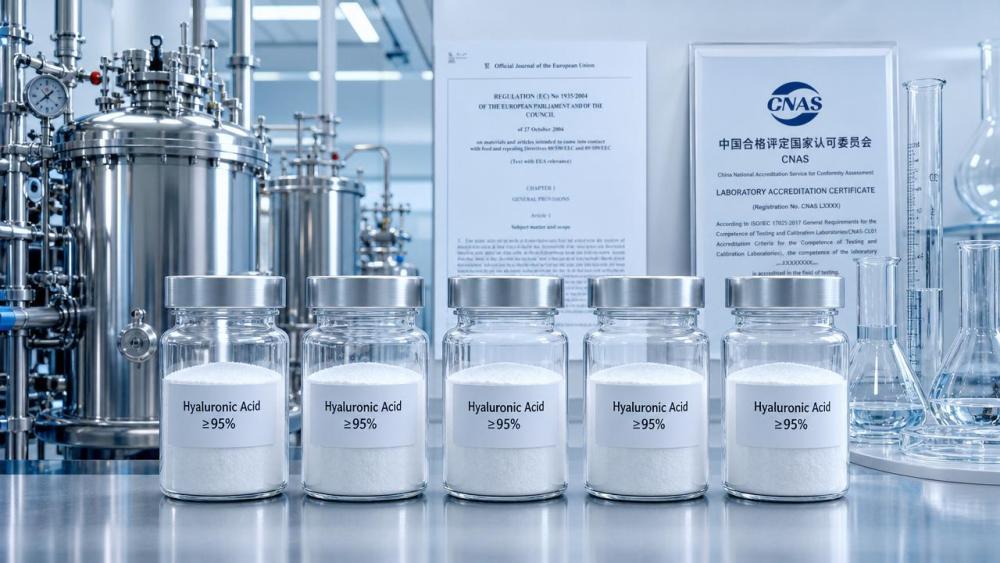
On May 30, 2026, the General Administration of Customs of the People’s Republic of China issued a notice requiring full pre-export compliance verification for exports of high-purity hyaluronic acid to the EU. The verification focuses specifically on compliance with migration limits for bisphenol A (BPA) and five related bisphenol analogues—including bisphenol S—as stipulated under Regulation (EU) 2026/250 on food contact materials. Exporters must submit a third-party migration test report, issued by a laboratory accredited to CNAS or ISO/IEC 17025, covering all six substances at the limit of 1 μg/kg. Without such a report, the customs authority will not issue the Declaration for Exported Food Contact Materials.
Industries Affected
Direct Exporters and Trading Companies
These entities face immediate operational impact: shipments without validated migration reports will be held or rejected at Chinese customs prior to dispatch. Since the requirement applies to 100% of relevant exports—not just random sampling—logistical planning, documentation lead times, and customs clearance windows are now materially constrained.
Raw Material Suppliers (HA Producers)
Manufacturers producing high-purity HA for export must now integrate migration testing into their quality control workflows. Unlike general purity or microbial testing, migration assays require specific food-contact simulation conditions (e.g., 10% ethanol, 3% acetic acid, or olive oil at defined time/temperature), implying new validation protocols and potential reformulation review if leachable bisphenols exceed thresholds.
Contract Manufacturers and Formulators (EU-Based)
While not subject to Chinese customs rules directly, EU-based contract manufacturers receiving HA from China must verify that incoming batches are accompanied by valid, regulation-aligned migration reports. Absent this, they risk non-compliance under EU Regulation (EU) 2026/250 during national market surveillance or border inspections—potentially triggering product recalls or import refusal.
Supply Chain Service Providers (Testing Labs, Certification Bodies)
Demand for CNAS- or ISO/IEC 17025-accredited migration testing has risen sharply. However, capacity remains limited: only labs with validated methods for ultra-trace bisphenol migration (down to 1 μg/kg in food simulants) qualify. Lead times for such reports may extend beyond standard turnaround, affecting shipment scheduling.
Key Considerations and Recommended Actions
Monitor official updates from both Chinese and EU authorities
The scope of ‘high-purity hyaluronic acid’ is not yet formally defined in technical terms (e.g., minimum molecular weight, purity threshold, or intended use). Both the General Administration of Customs and the European Commission may issue clarifications—especially regarding exemptions for non-food-contact grades or research-use quantities. Stakeholders should subscribe to official notices from GACC and EFSA.
Prioritize testing for BPA and bisphenol S—and confirm full six-analyte coverage
The notice explicitly names six bisphenol compounds. While BPA and BPS are most commonly monitored, laboratories must validate methods for all six (including BPF, BPAF, BPB, and BPE) under EU-specified migration conditions. Relying on partial-panel reports risks rejection.
Distinguish between regulatory signal and enforceable requirement
This is an enforcement action—not a consultation or draft policy. As of May 30, 2026, it is fully effective. However, its long-term application may evolve: for example, future alignment with broader EU chemicals strategy (e.g., REACH restriction proposals for bisphenols) remains unconfirmed and should not be assumed.
Adjust procurement and documentation timelines immediately
Given typical lab turnaround of 10–15 working days for full migration testing, exporters should initiate sampling and submission at least three weeks before planned shipment. Internal QA/QC processes must now include migration-readiness checks prior to batch release—not just after production completion.
Editorial Perspective / Industry Observation
Observably, this measure signals a tightening convergence between Chinese export controls and EU-specific chemical safety frameworks—notably in high-value, low-volume specialty biomaterials. It is less a standalone policy shift and more a targeted enforcement escalation reflecting heightened EU scrutiny of endocrine-disrupting substances in food-contact supply chains. Analysis shows that while the rule currently applies only to high-purity HA, similar verification mechanisms could be extended to other polysaccharide-based excipients (e.g., chitosan, alginate) if regulatory concerns around processing aids or reactor linings persist. For now, it functions primarily as an operational checkpoint—not a market access barrier—provided documentation is proactively aligned.
Concluding, this development underscores how regulatory compliance for specialty biochemicals is increasingly determined at the interface of origin-country export controls and destination-market substance restrictions. It is best understood not as a trade restriction per se, but as a formalized accountability mechanism for upstream material safety assurance—requiring coordinated action across manufacturing, testing, and logistics functions.
Source: General Administration of Customs of the People’s Republic of China (Notice issued May 30, 2026); Regulation (EU) 2026/250 on food contact materials.
Note: Definitions of ‘high-purity hyaluronic acid’ and potential scope adjustments remain under observation.
Related News
- What drives fragrance ingredients price changes in bulk orders?Oct 12, 2026Prof. Elian Thorne
- How to assess a food antioxidants distributor’s traceability practicesOct 11, 2026Food Preservation Scientist
- How minimum order quantities shape private label ingredient sourcing costsOct 10, 2026Prof. Elian Thorne
- What drives personal care ingredient price volatility in sourcingOct 08, 2026Prof. Elian Thorne
Related News
- 00
0000-00
What drives fragrance ingredients price changes in bulk orders? - 00
0000-00
How to assess a food antioxidants distributor’s traceability practices - 00
0000-00
How minimum order quantities shape private label ingredient sourcing costs - 00
0000-00
What drives personal care ingredient price volatility in sourcing - 00
0000-00
What drives micelles price differences in cosmetic formulations?
Industry Global
Weekly Insights
Stay ahead with our curated technology reports delivered every Monday.