





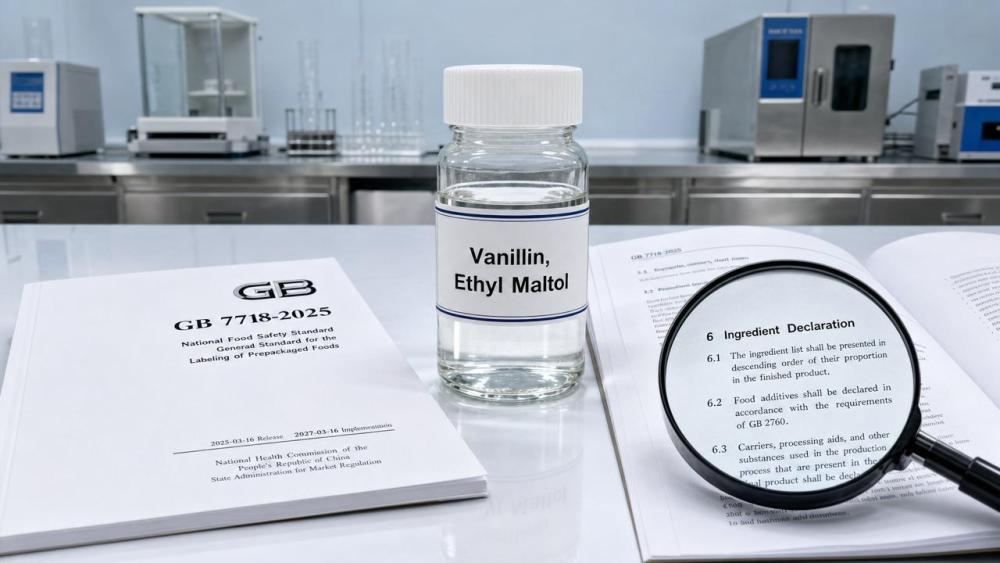
On March 27, 2025, China’s State Administration for Market Regulation (SAMR) officially released the Food Safety National Standard – General Principles for Labelling of Prepackaged Foods (GB 7718-2025). The standard introduces, for the first time, a mandatory requirement that prepackaged foods containing water-soluble flavors must declare specific flavoring substances—such as ethyl maltol and vanillin—in the ingredient list, rather than using the generic term “food flavoring.” Effective October 1, 2026, the regulation applies to domestic sales and requires concurrent updates to export labels and formula registrations during the transition period. Food manufacturers, flavor suppliers, exporters, and labeling service providers are among the most directly affected stakeholders.
Event Overview
On March 27, 2025, SAMR published GB 7718-2025. The standard explicitly stipulates that when water-soluble flavors are used in prepackaged foods, the ingredient list must specify individual flavor compounds (e.g., ethyl maltol, vanillin), not merely list “food flavoring.” This requirement takes effect on October 1, 2026. During the transition period, enterprises must align both domestic labeling and export label documentation—including formula filing—with the new provisions.
Industries Affected by the Amendment
Food Manufacturing Enterprises
Manufacturers producing beverages, confectionery, dairy alternatives, and flavored snacks often rely on water-soluble flavors for cost-effective, uniform flavor delivery. Under GB 7718-2025, they must now revise formulations or sourcing strategies to ensure full traceability of flavor components—and update all product labels accordingly. Impact manifests in reformulation timelines, label design cycles, and regulatory compliance verification for each SKU.
Flavor Ingredient Suppliers
Suppliers of water-soluble flavor systems—including compound flavor houses and single-component producers—must provide detailed, verifiable composition data to clients. Previously acceptable technical specifications (e.g., “vanilla-type water-soluble flavor”) no longer suffice; batch-level disclosure of quantified key constituents becomes essential for client compliance. This increases documentation burden and may affect confidentiality agreements and formulation IP management.
Export-Oriented Trading Companies
Trading firms handling cross-border distribution of Chinese-made food products face dual-labeling requirements: domestic labels must comply with GB 7718-2025, while export labels must remain consistent with overseas market regulations (e.g., FDA 21 CFR, EU Regulation (EC) No 1334/2008). Discrepancies—for instance, where a flavor component permitted in China is restricted elsewhere—may trigger rework, delays, or rejection at foreign customs. Alignment between domestic compliance and international labeling rules becomes operationally critical.
Labeling & Regulatory Compliance Service Providers
Third-party labeling consultants, regulatory affairs agencies, and packaging designers must adapt their workflows to verify and validate flavor-specific declarations. Template libraries, compliance checklists, and digital labeling platforms require updates to accommodate mandatory substance-level entries—not just functional categories. Audits and pre-submission reviews will now include ingredient-level cross-referencing with supplier COAs and flavor technical dossiers.
Key Considerations and Recommended Actions for Enterprises
Monitor official implementation guidance and interpretation notices
SAMR and the National Center for Food Safety Risk Assessment (CFSA) are expected to issue technical guidance documents clarifying scope boundaries—e.g., whether “water-soluble flavor” includes ethanol-diluted solutions or only aqueous dispersions—and defining thresholds for mandatory disclosure. Enterprises should subscribe to official channels and participate in upcoming industry briefings.
Prioritize high-volume, export-exposed, or reformulation-sensitive product lines
Not all SKUs carry equal risk. Focus initial compliance efforts on categories with frequent use of water-soluble flavors (e.g., plant-based milk, flavored syrups, powdered beverages) and those destined for markets with strict labeling enforcement (e.g., EU, Canada, South Korea). These segments demand earliest revision of formulas, supplier agreements, and label artwork.
Distinguish policy intent from operational readiness
The rule signals a broader regulatory shift toward ingredient transparency—not just allergen or additive disclosure—but its practical execution depends on supplier capability, testing infrastructure, and analytical method harmonization. Enterprises should assess current gaps in raw material traceability and lab capacity before assuming full compliance is achievable within the transition window.
Initiate cross-functional alignment and supplier communication now
Procurement, R&D, QA, and regulatory teams must jointly map existing water-soluble flavor usage across products. Concurrently, initiate formal requests to flavor suppliers for updated specification sheets, batch-level composition data, and supporting analytical reports. Document all communications and retention periods—these may be required during future SAMR inspections or export certification audits.
Editorial Perspective / Industry Observation
Observably, GB 7718-2025 represents more than a labeling refinement—it reflects a maturing phase in China’s food regulatory framework, where functional terminology is giving way to compositional precision. Analysis shows this change is less about immediate enforcement pressure and more about establishing a long-term baseline for traceability, especially as AI-driven supply chain monitoring and blockchain-based provenance tools gain traction. From an industry standpoint, the requirement is best understood not as a standalone compliance task, but as an inflection point prompting systematic upgrades in ingredient data governance. It also signals growing convergence between China’s labeling expectations and those of major export destinations—though divergence remains on thresholds, nomenclature, and verification rigor.
Conclusion
GB 7718-2025 does not introduce a sudden disruption, but it does mark a structural tightening in how flavor ingredients are documented and disclosed in China’s food supply chain. Its significance lies not in immediate penalties, but in the cumulative operational adjustments it demands across formulation, procurement, labeling, and export logistics. Currently, it is more appropriately understood as a forward-looking regulatory signal—one requiring proactive mapping, supplier engagement, and phased implementation—rather than a binary go/no-go compliance milestone.
Information Sources
Main source: Official announcement issued by the State Administration for Market Regulation (SAMR), March 27, 2025, regarding GB 7718-2025. Technical details confirmed via the publicly released standard text (draft final version). Note: Implementation guidance documents, official Q&A materials, and testing methodology standards referenced in the standard are still pending release and remain under observation.
Related News
- Can biomimetic peptides in cosmetics reduce the look of wrinkles?Oct 17, 2026Cosmeceutical Formulator
- How to assess a bio-based thickener manufacturer's batch consistencyOct 16, 2026Food Rheology Expert
- Verifying halal status of hydrocolloid ingredients in the Middle EastOct 15, 2026Food Rheology Expert
- How to interpret active matter on a surfactant specification sheetOct 14, 2026Prof. Elian Thorne
Related News
- 00
0000-00
Can biomimetic peptides in cosmetics reduce the look of wrinkles? - 00
0000-00
How to assess a bio-based thickener manufacturer's batch consistency - 00
0000-00
Verifying halal status of hydrocolloid ingredients in the Middle East - 00
0000-00
How to interpret active matter on a surfactant specification sheet - 00
0000-00
How Do You Test Hydrocolloid Viscosity After Changing a Thickener?
Industry Global
Weekly Insights
Stay ahead with our curated technology reports delivered every Monday.