





On June 22, 2026, a new CPNP filing requirement took effect in the EU for cosmetic products containing microencapsulated fragrances. The change matters because it turns formulation details that may previously have stayed deeper in technical files into mandatory disclosure items at notification stage, directly affecting document readiness, compliance review, and delivery coordination for fragrance ODM suppliers, distributors, and export-facing product teams.
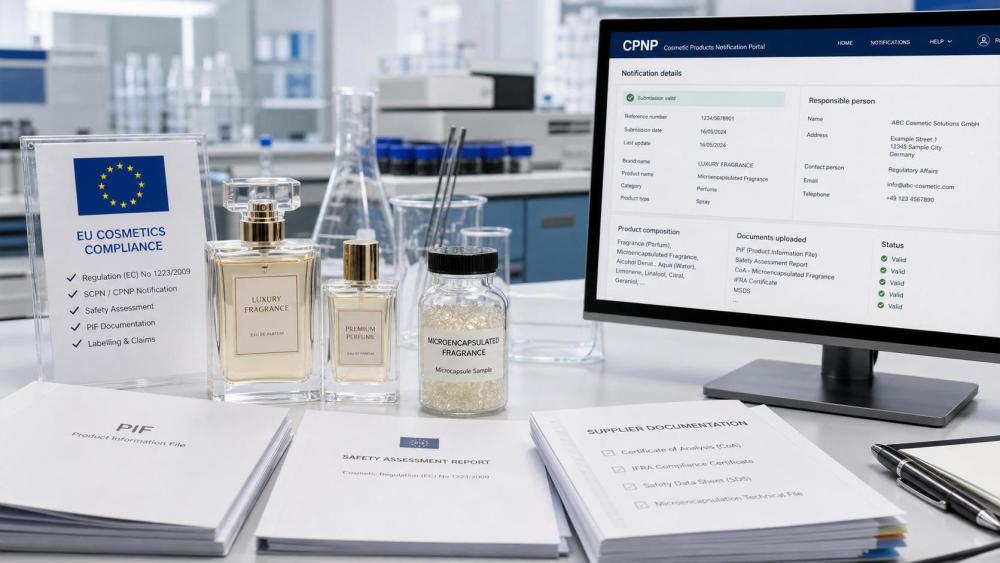
What the new CPNP filing requirement now asks for
According to the provided event summary, from June 22, 2026, the EU Cosmetic Products Notification Portal (CPNP) requires all products containing Microencapsulated Fragrances to disclose three categories of information during notification: the capsule wall material, such as ethyl cellulose or sodium alginate; the release trigger conditions, including pH, temperature, or friction; and the encapsulation ratio range. The same summary also states that incomplete compliance may lead to products being removed from sale or refused entry.
Where the pressure is likely to appear in the supply chain
Technical file handover becomes more sensitive
From an industry perspective, fragrance ODM suppliers serving EU-bound customers may face the most immediate pressure in technical documentation handover. The reason is straightforward: if capsule wall composition, release mechanism, and encapsulation ratio range must be declared at notification stage, upstream data gaps can directly affect whether downstream distributors receive a complete filing package.
EU-facing distributors may need tighter document checks
For distributors handling EU market notifications, the impact is likely to concentrate in submission review and product acceptance decisions. What deserves closer attention is whether incoming technical documents are sufficiently complete to support a CPNP notification without later supplementation, because missing disclosure items may create listing, import, or product continuity risks.
Export and delivery coordination may face added friction
For export-oriented product teams and supply chain coordinators, the change may influence delivery scheduling, customer document requests, and pre-shipment review. Analysis shows that even when the product formula itself is unchanged, the compliance package required for market access may need to be more detailed than before, making document readiness part of the delivery risk assessment.
What companies should watch in current practice
Check whether product scope touches the new disclosure items
Companies dealing with fragrance-containing cosmetics should first identify whether any notified products use microencapsulated fragrances. If yes, the practical issue is not only ingredient presence, but whether the product dossier can clearly support disclosure of wall materials, release triggers, and encapsulation ratio ranges.
Review technical documents before distributor submission
Observably, the quality of pre-submission documentation may now matter more than general product descriptions. Businesses should pay close attention to whether specification sheets, formulation support documents, and other technical records are aligned well enough for EU-facing notification work. The provided information does not define a detailed enforcement method, so this remains a point for continued checking rather than a fixed procedural conclusion.
Reassess supplier communication and procurement documentation
Where fragrance systems are sourced externally, procurement and supplier management teams may need to confirm whether supporting information can be provided in a usable form for downstream compliance filings. This is especially relevant when the party manufacturing the fragrance system is different from the party completing the EU market notification.
Prepare for trade and post-delivery compliance risk
Analysis shows that the stated risk of removal from sale or refusal of entry makes document completeness a trade issue as well as a regulatory one. Companies may therefore need to look more closely at shipment support files, customer-facing compliance responses, and traceability of formulation-related disclosures for affected product lines.
Why this looks more like an execution signal than a distant policy discussion
It is more appropriate to understand this development as an already effective compliance change rather than a preliminary policy direction, because the provided information states that the requirement took effect on June 22, 2026. At the same time, it should not yet be overstated as a fully settled enforcement landscape, since the input does not provide detailed official interpretation, review practice, or market feedback. From an industry perspective, the key signal is that disclosure expectations around microencapsulated fragrance systems are moving closer to front-end notification and market-access control.
How this update is best understood for now
At this stage, the event is best read as a concrete compliance threshold change for products containing microencapsulated fragrances in EU notification work. Its practical importance lies less in broad market speculation and more in whether companies can supply complete, submission-ready technical information across formulation, procurement, export, and distributor handover stages. Observably, the immediate priority is document completeness, while the longer-term execution effect still deserves continued monitoring.
Basis of this article and points still requiring verification
This article is generated from the user-provided news title, event date, and event summary. For developments of this kind, commonly relevant source types may include official notices, releases from regulatory authorities, customs or trade administration updates, industry association communications, standard-setting documents, and reporting by established industry media. A specific official source link was not provided in the input, so further verification is still necessary. What remains worth tracking includes any later official wording, practical notification standards, changes in tender or technical documentation requirements, industry feedback, and how companies implement the rule in actual delivery and compliance workflows.
Related News
- How to Choose Fragrance Ingredients for Diffusers That Stay Stable in Oil BasesAug 04, 2026Aromatics & Perfumery Fellow
- How to Choose Aroma Ingredients for Candles Based on Scent Throw and Wax CompatibilityAug 03, 2026Aromatics & Perfumery Fellow
- Home Diffuser Series Technical Guide for Fragrance BuyersJul 21, 2026Aromatics & Perfumery Fellow
- EU Bans More Microencapsulated Fragrance AllergensJul 16, 2026Aromatics & Perfumery Fellow
Related News
- 00
0000-00
What drives fragrance ingredients price changes in bulk orders? - 00
0000-00
How to assess a food antioxidants distributor’s traceability practices - 00
0000-00
How minimum order quantities shape private label ingredient sourcing costs - 00
0000-00
What drives personal care ingredient price volatility in sourcing - 00
0000-00
What drives micelles price differences in cosmetic formulations?
Aromatics & Perfumery Fellow
Weekly Insights
Stay ahead with our curated technology reports delivered every Monday.