





In flavor, fragrance, and active-ingredient manufacturing, molecular encapsulation has moved from a niche formulation tactic to a practical risk-control tool. It helps retain volatile notes, shield sensitive compounds from heat, oxygen, and moisture, and create more predictable processing windows. For companies operating across food, beauty, and home care, that matters because sensory loss is rarely just a technical issue. It affects yield, compliance confidence, premium positioning, and the consistency customers notice first.
Why molecular encapsulation is gaining strategic attention
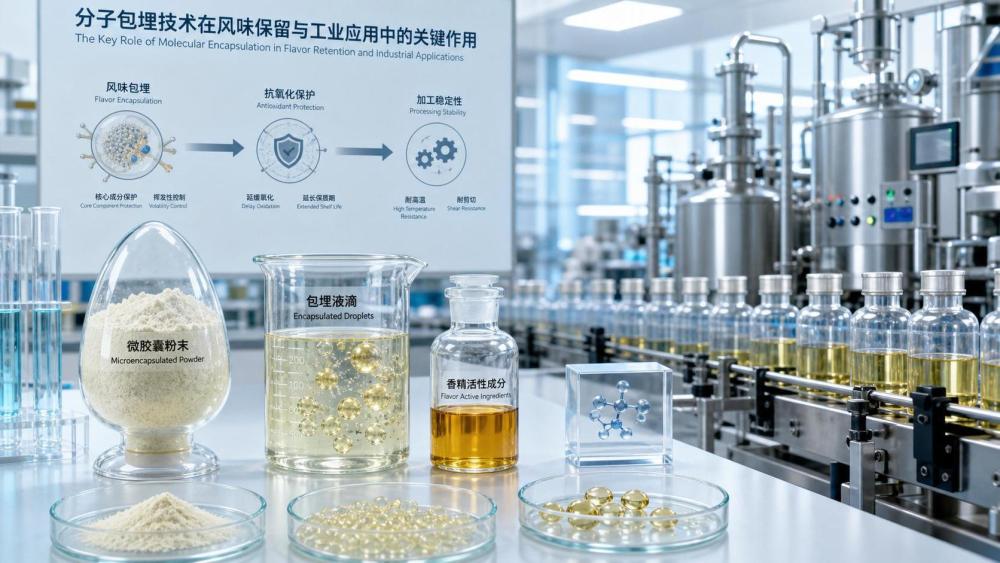
Global FMCG supply chains now ask more from ingredients than simple performance at the point of mixing. A flavor must survive drying, transport, storage, and filling. A cosmetic active must remain stable before reaching skin. An essential oil must hold character without creating handling hazards.
That pressure explains the rising interest in molecular encapsulation. In simple terms, it surrounds a sensitive core material with a protective matrix or shell. The shell can be designed to reduce evaporation, delay release, mask odor, improve dispersibility, or protect against destructive conditions.
The concept is not new. What has changed is its business importance. As clean-label scrutiny grows, premium actives become more expensive, and cross-border compliance becomes tighter, loss during processing is harder to accept as a normal cost of production.
This is especially relevant in the FFAI landscape, where antioxidants, thickeners, aroma systems, cosmetic actives, and surfactant-based formulations all depend on molecular behavior under stress. Molecular encapsulation fits naturally into that broader effort to protect efficacy and sensory value without losing sight of safety and manufacturability.
What it actually solves on the production floor
The appeal of molecular encapsulation becomes clearer when viewed through routine production risks rather than lab theory. In most cases, it is used to solve a narrow set of costly problems.
- Volatility loss during heating, spray drying, baking, extrusion, or hot filling.
- Oxidation of sensitive compounds exposed to air, light, or reactive ingredients.
- Premature interaction between actives and the surrounding formula.
- Uncontrolled release that weakens flavor impact or compromises product experience.
- Dusting, odor exposure, and operator-safety concerns during ingredient handling.
A good example is top-note flavor chemistry. Fresh citrus, mint, berry, and roasted notes often disappear first under thermal stress. Encapsulation does not make them indestructible, but it can meaningfully reduce losses and improve retention until the moment of consumption.
The same logic applies to fragile anti-aging actives. When a peptide or botanical compound degrades in bulk storage, the commercial loss is larger than the ingredient cost alone. It also weakens claims support, batch consistency, and brand trust.
Where it creates value across food, fragrance, beauty, and home care
Molecular encapsulation is not a single-market technology. Its value changes with the product category, release target, and stress profile.
Food and beverage systems
In food, encapsulation often protects flavors, antioxidants, pigments, and certain nutraceutical ingredients. It can reduce flavor fade in powdered drinks, baked snacks, confectionery fillings, dairy applications, and shelf-stable products.
It also helps where rheology matters. Encapsulated actives may interact differently with hydrocolloids and thickeners, making pilot testing essential. The formulation question is not only whether the core survives, but whether texture, release timing, and mouthfeel still work together.
Fragrance and sensory design
In fragrances, molecular encapsulation is often used to preserve delicate top notes, reduce evaporation during storage, and support controlled scent release. This matters in fine fragrance, air care, detergents, shampoos, and fabric applications.
For home care, it can also support scent longevity after washing or cleaning. That extends the perceived performance of the product, which often influences repurchase more than technical cleaning claims alone.
Cosmetic and active-ingredient delivery
For high-value cosmetic actives, molecular encapsulation can stabilize oxidation-prone materials, improve compatibility in emulsions, and shape release on skin. Not every active needs this approach, but premium compounds often justify it because the cost of degradation is high.
In these categories, the conversation quickly expands beyond protection. Delivery, sensory elegance, claims substantiation, and regulatory documentation all become part of the evaluation.
Not all encapsulation systems behave the same way
The term molecular encapsulation covers several technical routes. Decision quality improves when teams compare systems by fit, not by novelty.
The right system depends on the real point of failure. If loss occurs during drying, the answer may differ from a formula that fails after six months in humid storage. That sounds obvious, yet many projects still evaluate encapsulation before mapping when and where the loss actually happens.
How to judge whether the added cost is justified
Encapsulation usually raises ingredient cost, process complexity, or both. The question is whether it lowers total commercial risk enough to outweigh that premium.
A useful evaluation starts with four dimensions. First, measure current loss. Second, estimate the value of recovered performance. Third, test operational impact. Fourth, check the regulatory and claims path.
- Retention gain: how much of the core ingredient remains after key stress points.
- Process safety: whether dust, odor, flammability, or exposure risk is reduced.
- Formula compatibility: whether viscosity, color, release, and sensory profile stay acceptable.
- Commercial return: whether the benefit appears in margin, claims strength, or product differentiation.
This is where an intelligence-led approach becomes valuable. FFAI’s cross-category lens is relevant because flavor retention, antioxidant survival, transdermal delivery, and compliance review are rarely isolated questions. They influence one another in real formulations.
For instance, a system that improves aroma survival may complicate label positioning. A shell material that protects a cosmetic active may alter sensorial feel. A safer handling profile may justify the switch even if release performance improves only moderately.
Practical signals that a formulation should be reviewed
Not every product needs molecular encapsulation. Still, several signs suggest it deserves serious review rather than casual dismissal.
- Pilot batches show strong sensory performance, but commercial batches fade too quickly.
- A costly active loses potency before the end of declared shelf life.
- Heat, oxygen, or moisture exposure cannot be reduced by process changes alone.
- Operator handling, odor management, or dust control is becoming a plant concern.
- The product needs a premium sensory story supported by measurable stability.
When these signals appear, the next step is not to default to the most advanced delivery technology. It is to identify the weakest point in the ingredient journey, from raw-material storage to end-use release.
A grounded next step for evaluation
Molecular encapsulation is most effective when treated as a business filter, not a buzzword. Start with the ingredient that loses the most value in transit, processing, or storage. Define the desired release moment. Then compare encapsulation options against the actual thermal, oxidative, and mechanical stresses involved.
From there, align technical testing with compliance and market positioning. In food, that may mean balancing protection with label expectations. In fragrance, it may mean matching release longevity with sensory identity. In cosmetic actives, it may mean validating stability together with delivery logic.
The most useful decisions rarely come from asking whether molecular encapsulation is innovative. They come from asking where flavor loss, active degradation, or processing risk is quietly eroding product value today, and whether a more protective molecular design can recover it with measurable confidence.
Related News
- How to Choose Fragrance Ingredients for Diffusers That Stay Stable in Oil BasesAug 04, 2026Aromatics & Perfumery Fellow
- How to Choose Aroma Ingredients for Candles Based on Scent Throw and Wax CompatibilityAug 03, 2026Aromatics & Perfumery Fellow
- Home Diffuser Series Technical Guide for Fragrance BuyersJul 21, 2026Aromatics & Perfumery Fellow
- EU Bans More Microencapsulated Fragrance AllergensJul 16, 2026Aromatics & Perfumery Fellow
Related News
- 00
0000-00
Can biomimetic peptides in cosmetics reduce the look of wrinkles? - 00
0000-00
How to assess a bio-based thickener manufacturer's batch consistency - 00
0000-00
Verifying halal status of hydrocolloid ingredients in the Middle East - 00
0000-00
How to interpret active matter on a surfactant specification sheet - 00
0000-00
How Do You Test Hydrocolloid Viscosity After Changing a Thickener?
Aromatics & Perfumery Fellow
Weekly Insights
Stay ahead with our curated technology reports delivered every Monday.