





Olfactory engineering in perfume creation is moving from artistry alone to engineered sensory value
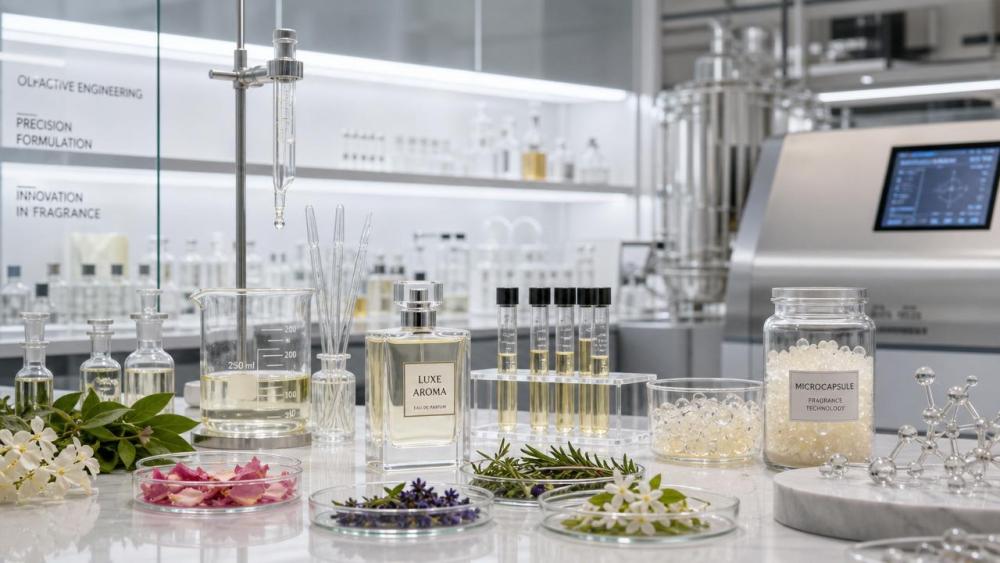
Olfactory engineering in perfume creation is no longer a niche laboratory idea.
It is becoming a commercial framework for translating molecules, mood, safety, and brand identity into one coherent scent system.
That shift matters across beauty, personal care, home care, and adjacent FMCG categories.
A perfume now competes on memory retention, ingredient transparency, diffusion control, and regulatory resilience at the same time.
From recent market signals, the most successful launches are not simply stronger or more novel scents.
They are better designed olfactory experiences, shaped with measurable intent.
This is why olfactory engineering in perfume creation increasingly sits beside data science, ingredient strategy, and compliance planning.
For an intelligence platform like FFAI, this shift fits a broader pattern.
Global taste, beauty, and wellness products are being rebuilt around molecular precision and sensory trust.
Perfume is simply where that transformation becomes easiest to smell.
Why the change is becoming more visible now
Several forces are pushing olfactory engineering in perfume creation into the strategic mainstream.
The first is consumer expectation.
People increasingly want scents that feel personal, cleaner, longer lasting, and less chemically opaque.
The second is formulation complexity.
Natural extracts, biotech aroma molecules, encapsulation systems, and low-allergen reformulation do not behave like legacy fragrance palettes.
The third is the premiumization of sensory performance.
Brands want top notes that open crisply, heart notes that stay emotionally legible, and base notes that evolve with skin or fabric conditions.
That kind of control requires engineering, not intuition alone.
A fourth driver is regulation.
As ingredient scrutiny intensifies, scent design must account for IFRA guidance, export documentation, and region-specific safety expectations much earlier.
This is where FFAI’s broader lens becomes useful.
The same logic shaping antioxidants, thickeners, surfactants, and cosmetic actives also shapes fragrance innovation.
Performance now has to survive real formulations, supply chains, and compliance reviews.
The pressure points behind new scent design
The new directions are more precise, more emotional, and more system-driven
One clear direction in olfactory engineering in perfume creation is data-guided formulation.
Perfumers are not being replaced.
Their work is being supported by stronger prediction tools.
These tools estimate volatility, note interaction, sensory fatigue, and stability inside complex bases.
Another direction is emotion-led aroma architecture.
Instead of building only around note families, teams increasingly build around behavioral outcomes.
Calm, energy, comfort, skin intimacy, and ritualized luxury are becoming design targets.
That changes ingredient selection and dosage logic.
A third direction is controlled performance over time.
Encapsulation, solvent tuning, fixative alternatives, and matrix-aware blending are helping scents behave differently on skin, hair, air, and fabric.
This matters especially in categories where fragrance supports a broader product promise.
Home care wants cleanliness without harshness.
Beauty wants sensorial elegance without irritation risk.
Fine fragrance wants distinction without instability.
Where olfactory engineering in perfume creation now creates the most value
- Improving the link between fragrance profile and brand positioning
- Reducing reformulation losses when allergens or materials change
- Making premium claims more credible through measurable sensory performance
- Supporting line extensions across perfume, body care, and home fragrance families
- Creating defensible differentiation in saturated scent categories
The impact is spreading well beyond fine fragrance
A more interesting signal is that olfactory engineering in perfume creation is affecting formulation logic across sectors.
In skin care, fragrance decisions now interact with active delivery, barrier sensitivity, and premium experience design.
In hair care, surfactant systems and fragrance deposition increasingly need to work together.
In food-adjacent aroma work, the line between flavor memory and fragrance expectation is also becoming more strategically relevant.
This wider influence mirrors FFAI’s cross-category view.
Texture, preservation, efficacy, and scent are no longer isolated formulation layers.
They increasingly function as one sensory-commercial system.
That changes investment priorities.
A fragrance brief now has implications for stability testing, claims support, consumer research, and margin architecture.
It also changes partnership models.
Teams need molecular science, regulatory judgment, and market interpretation to move together.
What deserves closer attention over the next planning cycle
The next phase of olfactory engineering in perfume creation will likely reward disciplined observation more than fast imitation.
Several questions now matter more than broad trend headlines.
- Can a fragrance concept survive reformulation without losing emotional identity?
- Are key aroma materials secure under future compliance and sourcing pressure?
- Does the scent profile align with premium claims across every touchpoint?
- Is testing measuring real sensory performance, not only lab stability?
- Can the same olfactory language scale across regions without cultural distortion?
The strongest programs are already asking these questions early.
They treat fragrance architecture as part of portfolio strategy, not as a final-stage decorative decision.
That approach reduces late-stage surprises and protects long-term scent equity.
A practical decision framework
In practical terms, the next move is rarely to chase more ingredients.
It is to improve the quality of connections between formula, feeling, safety, and business model.
The next advantage will come from integrated intelligence, not isolated creativity
Olfactory engineering in perfume creation is becoming a defining capability because scent now carries more strategic weight.
It signals safety, quality, aspiration, and technical control in one moment of perception.
That is why the field is moving toward integrated intelligence.
The strongest fragrance decisions will come from combining molecular science, consumer insight, and compliance discipline from the start.
FFAI’s perspective is relevant here because it tracks how ingredients create commercial meaning across food, beauty, and care systems.
For teams evaluating new scent directions, the immediate task is clear.
Review which fragrance assets still rely on intuition alone.
Compare them against data-backed sensory goals, compliance exposure, and formulation durability.
Then build a staged plan for testing, substitution readiness, and cross-category scent consistency.
That is where olfactory engineering in perfume creation stops being a trend phrase and becomes a durable growth tool.
Related News
- How to Choose Fragrance Ingredients for Diffusers That Stay Stable in Oil BasesAug 04, 2026Aromatics & Perfumery Fellow
- How to Choose Aroma Ingredients for Candles Based on Scent Throw and Wax CompatibilityAug 03, 2026Aromatics & Perfumery Fellow
- Home Diffuser Series Technical Guide for Fragrance BuyersJul 21, 2026Aromatics & Perfumery Fellow
- EU Bans More Microencapsulated Fragrance AllergensJul 16, 2026Aromatics & Perfumery Fellow
Related News
- 00
0000-00
Can biomimetic peptides in cosmetics reduce the look of wrinkles? - 00
0000-00
How to assess a bio-based thickener manufacturer's batch consistency - 00
0000-00
Verifying halal status of hydrocolloid ingredients in the Middle East - 00
0000-00
How to interpret active matter on a surfactant specification sheet - 00
0000-00
How Do You Test Hydrocolloid Viscosity After Changing a Thickener?
Aromatics & Perfumery Fellow
Weekly Insights
Stay ahead with our curated technology reports delivered every Monday.