





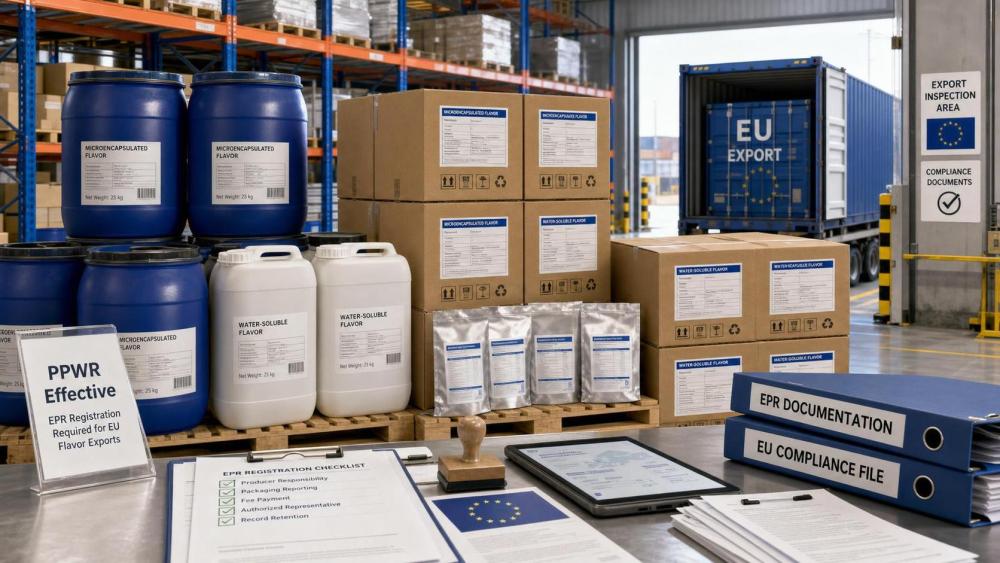
On August 12, 2026, the EU Packaging and Packaging Waste Regulation (PPWR) is set to take effect in a way that directly affects food flavor products sold in Europe. For importers handling products such as Microencapsulated Fragrances and Water-soluble Flavors, EPR registration in the relevant markets becomes a practical market-access requirement rather than a background compliance item. With Amazon Europe already updating its seller system so that unregistered sellers cannot list new products, this development deserves attention from exporters, importers, channel operators, and supply-chain teams because it may change how compliance, launch timing, and delivery planning are managed.
What the rule change confirms at this stage
The confirmed information is clear on several points. The EU's PPWR will formally enter into effect on August 12, 2026. Under the information provided, importers selling food flavor products in Europe, including Microencapsulated Fragrances and Water-soluble Flavors, are required to complete Extended Producer Responsibility (EPR) registration in the relevant markets. Amazon Europe has also updated its seller backend so that parties that have not completed registration will be unable to launch new products. In practical terms, this raises the compliance cost and response timeline for higher-value flavor ingredients entering the EU market.
Where the pressure is likely to appear first
Export decisions may shift from product readiness to compliance readiness
From an industry perspective, exporters of flavor ingredients may be affected first because market entry is no longer determined only by product supply and customer demand. Where EU sales are involved, EPR registration now becomes a front-end requirement tied to market access. What deserves closer attention is the risk of delays between shipment planning, product launch schedules, and registration completion.
Import and channel teams face tighter listing coordination
For importers and channel operators, the rule change matters because the compliance step is now connected to whether new products can be listed. The Amazon Europe backend update signals that registration status may directly affect launch execution. This means teams handling assortment expansion, seasonal launches, or new customer onboarding may need closer coordination between compliance review and platform operations.
Procurement and supply-chain planning may need longer lead times
For procurement and supply-chain service teams, the issue is not only regulatory interpretation but also timing. Analysis shows that when compliance costs and response cycles rise, purchasing plans, replenishment timing, and delivery commitments may all need adjustment. Products such as microencapsulated and water-soluble flavor ingredients could face more front-loaded document and registration checks before commercial movement proceeds smoothly.
What companies should monitor now
Check whether current EU-facing product flows depend on EPR completion
Companies involved in EU flavor sales should first identify which product lines, customers, and sales channels are tied to this requirement. The key practical question is whether existing export or listing workflows assume that registration can be handled later, because the current signal suggests it is moving forward as a prerequisite step.
Reassess launch files and compliance documentation timing
Observably, the pressure point may not be limited to registration itself, but to how registration status aligns with product launch files, internal approval checkpoints, and supporting technical or trade documentation. If businesses rely on fixed launch windows, they may need to review whether compliance preparation starts early enough to avoid disruptions.
Watch for changes in execution language and downstream requirements
The information provided confirms the effective date and the platform-side consequence for unregistered sellers, but it does not provide full operational detail. It is therefore more appropriate to understand the current stage as one requiring close attention to follow-up execution language, documentation expectations, and any changes that may appear in customer requirements, procurement conditions, or channel onboarding rules.
Prepare for longer response cycles on higher-value ingredients
For businesses dealing in higher-value flavor components, the immediate issue is not only added cost but also a potentially longer response cycle before products can move into the EU market. Companies may need to factor this into shipment commitments, supply planning, and communication with buyers or channel partners.
Why this looks like an execution signal, not just a policy headline
Analysis shows that this development is more than a general regulatory update because it links a formal rule change with a practical market-control point. The effective date gives the regulatory milestone, while the Amazon Europe backend adjustment gives an execution signal that non-compliance can translate into blocked new listings. At the same time, it would be premature to treat every downstream effect as fully settled, because the input does not provide detailed enforcement pathways beyond the confirmed registration requirement and platform restriction.
How this should be understood for now
At this stage, the more balanced reading is that PPWR implementation is turning EPR registration into a real precondition for certain EU-facing flavor business activities, especially where new product listings are involved. The significance lies less in abstract regulatory change and more in the fact that compliance timing may now influence trade readiness, channel access, and delivery planning. It is more appropriate to understand this as a rule landing with visible execution signals, while still requiring continued observation of how implementation is reflected in operational requirements and market feedback.
Basis of this article and what still needs verification
This article is generated based on the user-provided title, event date, and event summary. For developments of this type, relevant source categories usually include official announcements, regulator releases, customs or trade authority information, industry association updates, standard-setting documents, platform compliance notices, and reporting by established professional media. A specific official source link was not provided in the input, so the exact official reference path still requires ongoing verification. What remains worth monitoring includes detailed implementation language, EPR execution standards, changes in procurement or listing documents, market feedback, and how affected companies carry out compliance in practice.
Related News
- How to Choose Fragrance Ingredients for Diffusers That Stay Stable in Oil BasesAug 04, 2026Aromatics & Perfumery Fellow
- How to Choose Aroma Ingredients for Candles Based on Scent Throw and Wax CompatibilityAug 03, 2026Aromatics & Perfumery Fellow
- Home Diffuser Series Technical Guide for Fragrance BuyersJul 21, 2026Aromatics & Perfumery Fellow
- EU Bans More Microencapsulated Fragrance AllergensJul 16, 2026Aromatics & Perfumery Fellow
Related News
- 00
0000-00
Can biomimetic peptides in cosmetics reduce the look of wrinkles? - 00
0000-00
How to assess a bio-based thickener manufacturer's batch consistency - 00
0000-00
Verifying halal status of hydrocolloid ingredients in the Middle East - 00
0000-00
How to interpret active matter on a surfactant specification sheet - 00
0000-00
How Do You Test Hydrocolloid Viscosity After Changing a Thickener?
Aromatics & Perfumery Fellow
Weekly Insights
Stay ahead with our curated technology reports delivered every Monday.