





For technical evaluators, the central question is not whether a bitter API can be made less unpleasant in a sensory panel. It is which flavor masking technology for bitter drugs can reliably improve real-world compliance without undermining release performance, stability, manufacturability, cost, or regulatory acceptance.
The short answer is that no single masking tool consistently works across all bitter molecules. The approaches that most often improve compliance are those that match the bitterness mechanism, dosage form, patient profile, and release target. In practice, successful programs usually combine more than one strategy rather than depending on flavor addition alone.
Search intent around this topic is therefore highly practical. Readers are typically evaluating technologies, suppliers, or formulation pathways. They want to know what actually works, when it works, where it fails, and how to compare options in a development or procurement setting.
For technical evaluators, the most useful discussion is not a broad overview of taste science. It is a decision-oriented review of masking performance, formulation constraints, scale-up risk, and regulatory practicality. That is where this article focuses.
What Actually Improves Compliance, Not Just Sensory Scores
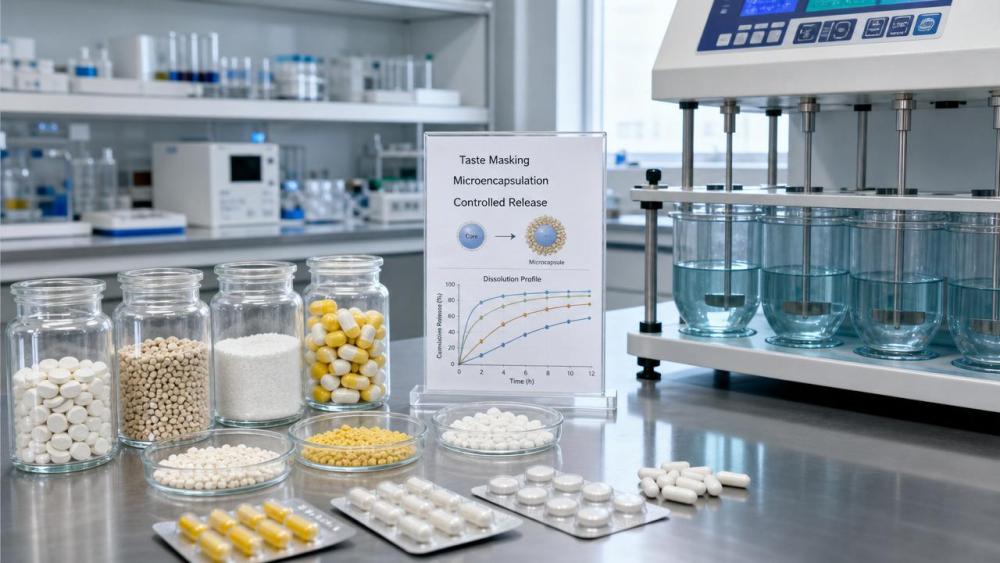
Bitterness matters because poor palatability reduces willingness to start, continue, or complete treatment. This is especially visible in pediatrics, geriatrics, orally disintegrating tablets, chewables, syrups, and high-dose nutraceutical-style products, but the issue extends to any oral format with prolonged oral residence time.
However, compliance is not improved by bitterness reduction alone. A formulation may score better in a trained panel and still fail commercially if it leaves a metallic aftertaste, delays onset, creates mouth-coating, or varies batch to batch. Technical evaluation should therefore focus on patient-relevant acceptability, not just immediate taste suppression.
In most programs, the strongest compliance gains come from technologies that either prevent API-taste receptor contact during oral residence or reduce the rate at which bitter molecules are released in saliva. This is why physical and physicochemical masking often outperforms simple flavor systems when bitterness is strong or persistent.
That said, flavor and sweetness systems still matter. They are highly effective when bitterness is moderate, when the API load is limited, or when a well-controlled primary masking layer already reduces exposure. Compliance improves most when sensory design supports a robust barrier strategy rather than trying to compensate for a weak one.
Why Some Bitter Drugs Are Much Harder to Mask Than Others
Technical assessment begins with the API, because “bitter” is not a single formulation problem. Bitterness intensity, onset speed, persistence, saliva solubility, dose level, particle size, pKa, hygroscopicity, and required release profile all shape the right masking route.
Highly soluble APIs are often difficult because they dissolve rapidly in saliva and reach taste receptors before the dosage form is swallowed. High-dose compounds create a different challenge: even if the first burst is controlled, the total bitter mass may overwhelm flavor systems or breach coating integrity.
Some molecules also generate multiple sensory negatives at once, such as bitterness with metallic, sulfurous, cooling, or astringent notes. In these cases, evaluators should avoid assuming that one masking input can solve all perception issues. The sensory architecture must address the dominant note and the secondary aftertaste profile.
Residence time is equally important. A syrup, suspension, chewable, and orally disintegrating tablet expose the API to the mouth very differently. A technology that performs well in a quickly swallowed coated tablet may fail in a suspension that remains in the oral cavity for several seconds.
Comparing the Main Flavor Masking Technology for Bitter Drugs
From an evaluation standpoint, the main technology groups are flavor and sweetener systems, bitterness blockers or modulators, complexation approaches, polymer film coating, microencapsulation, ion-exchange resins, and multiparticulate barrier systems. Each has a different balance of sensory benefit, development risk, and operational complexity.
Flavor and sweetener systems are the most accessible tools, and often the first tried. They can effectively shift perception, fill top notes, and suppress mild bitterness, especially in liquids and chewables. Their limitation is that they usually do not stop dissolved API from contacting taste receptors. For strongly bitter APIs, they rarely solve the problem alone.
Bitterness blockers and modulators are attractive in concept because they target receptor response rather than only adding competing tastes. But practical use can be uneven. Effectiveness may depend on the molecule, concentration window, matrix composition, and geographic regulatory status. Evaluators should treat them as targeted tools, not universal solutions.
Cyclodextrins and other complexation systems can reduce free API in saliva and improve taste while also affecting solubility behavior. They are especially useful where inclusion complex formation is strong and stable. Their limits include loading efficiency, dose-related cost, moisture sensitivity in some systems, and possible impact on downstream release.
Polymer coating and microencapsulation are among the most reliable solutions for strong bitterness because they create a physical barrier during oral exposure. When designed correctly, they can preserve immediate release in the stomach while sharply limiting release in saliva. Their trade-offs are process complexity, equipment needs, coat uniformity control, and risk of delayed dissolution.
Ion-exchange resins are often effective for basic drugs and can be excellent in suspensions, chewables, and reconstitutable systems. They reduce free drug concentration in saliva and may offer robust sensory improvement. But they require careful attention to loading, particle feel, ionic environment, and release behavior under gastric conditions.
Multiparticulate systems, including coated granules, pellets, and taste-masked beads, often perform well because they distribute dose while preserving swallowability and flexible release design. For evaluators, they can offer a strong middle ground between sensory control and manufacturability, though they introduce complexity in content uniformity and downstream tableting or suspension stability.
Which Technologies Usually Deliver the Best Balance of Performance and Feasibility
If the goal is real compliance improvement rather than cosmetic sensory adjustment, the most dependable options for highly bitter APIs are usually polymer-based taste barriers, microencapsulation, coated multiparticulates, and ion-exchange systems where the chemistry fits. These approaches reduce receptor exposure instead of only distracting from it.
For moderate bitterness, especially in lower-dose products, a layered system can be more efficient than a heavy engineering solution. This may combine sweeteners, a bitterness-suppressing flavor profile, acidulants where appropriate, and a limited physical barrier. Such systems can be cost-effective and fast to develop when the oral exposure window is short.
Cyclodextrin complexation often occupies a useful middle position. It may not be sufficient for every high-load molecule, but it can materially improve acceptability while simplifying the sensory burden on flavor systems. It is particularly attractive where solubility, stability, or mouthfeel benefits align with taste masking needs.
What tends to work least well as a standalone answer is simply increasing flavor intensity. Stronger fruit, mint, or sweet notes may make a formula smell better or taste better in the first second, yet patients still reject it if bitterness blooms late or lingers after swallowing. Technical teams should always test aftertaste and time-intensity, not just first impact.
How to Evaluate Sensory Success the Way Patients Experience It
Many weak masking programs look acceptable in early screening because teams measure the wrong endpoint. The important question is not whether bitterness is reduced under ideal tasting conditions. It is whether the user can comfortably take the product at the intended dose, in the intended format, over the intended treatment period.
That means sensory evaluation should include onset, peak bitterness, aftertaste duration, mouthfeel, grittiness, coating residue, cooling or metallic carryover, and swallow ease. Time-intensity methods are often more informative than single-point ratings because many bitter drugs become objectionable after the initial flavor note fades.
Population matters as well. Adult trained panels can miss issues that strongly affect children or older adults. Pediatric acceptance is influenced by sweetness balance and flavor familiarity, while geriatric acceptability may be more sensitive to dry mouth, swallowing difficulty, and lingering residues. Compliance claims should reflect the actual user group.
Technical evaluators should also align sensory tests with administration reality. A suspension should be tested at realistic shake conditions and sip volume. An orally disintegrating tablet should be tested for the full oral disintegration window. A chewable should be assessed under actual chewing time rather than rapid bench dissolution assumptions.
Stability, Release, and Manufacturing Risks That Commonly Undermine Good Ideas
A taste masking technology may look excellent in prototype work and still fail at later stages. The most common reason is that the barrier system interacts with stability, moisture uptake, dissolution, or process stress in ways that were not fully challenged early enough.
For coated and microencapsulated systems, coat integrity is critical. Attrition during blending, compression, filling, transport, or suspension handling can expose the API and collapse sensory performance. Evaluators should look closely at particle robustness, coat thickness distribution, and process windows, not just the mean dissolution profile.
Immediate-release requirements create another frequent tension. A formulation that suppresses bitterness very effectively in the mouth may slow gastric release beyond target. This is especially important for analgesics, anti-infectives, and other products where prompt onset matters. Taste masking should never be evaluated in isolation from pharmacotechnical performance.
Liquids and reconstitutable formats add separate risks. Viscosity, sedimentation, ionic strength, and pH can all affect free drug levels in the mouth. In resin systems, exchange behavior may shift over shelf life or after dilution. In flavor-heavy systems, top-note loss can expose bitterness that was initially hidden.
Regulatory and Practical Considerations That Matter in Technology Selection
For technical evaluators, regulatory practicality is often the deciding factor between a promising concept and a viable program. The most sophisticated flavor masking technology for bitter drugs still needs acceptable excipient status, market-specific compliance, supply continuity, documentation quality, and compatibility with the product category.
Bitterness blockers and novel sensory modulators deserve particular attention here. Some have compelling performance, but their approval path, label implications, or regional acceptance may be less straightforward than standard coating polymers, resins, or established flavor carriers. Early regulatory mapping can prevent expensive reformulation later.
Cost should also be viewed correctly. A low-cost flavor system that fails in use testing is more expensive than a moderately higher-cost barrier technology that secures launch viability. Evaluators should model total formulation economics, including sensory iterations, process adaptation, yield loss, analytical burden, and complaint risk after commercialization.
Supplier capability is another key variable. Taste masking performance depends heavily on consistency in particle engineering, coating quality, flavor reproducibility, and technical support. Strong documentation, application data, and scale-up experience are often worth more than a marginally lower raw material price.
A Practical Decision Framework for Technical Evaluators
When comparing options, begin with four screening questions. First, how fast and how intensely does the API express bitterness in saliva? Second, what oral residence time does the dosage form create? Third, how much freedom exists around release, particle size, and excipient loading? Fourth, what regulatory and manufacturing constraints are fixed?
If bitterness is mild to moderate and the product is swallowed quickly, start with flavor architecture, sweetness optimization, and selective modulators. If bitterness is strong, persistent, or high-dose, prioritize physical or physicochemical barriers early. This shift can save months otherwise lost trying to force flavors to solve a structural problem.
Where release must remain immediate, ask whether the barrier can survive oral exposure but break reliably under gastric conditions. Where mouthfeel is a risk, compare fine-particle systems with multiparticulate designs. Where pediatric use is central, weigh sensory familiarity and swallowability as heavily as laboratory bitterness scores.
The best evaluation pathway is iterative but disciplined: characterize the API, shortlist technologies by mechanism fit, test sensory performance under realistic use conditions, confirm dissolution and stability, then pressure-test manufacturability and compliance documentation. This approach reveals which options can improve patient behavior, not just prototype data.
Conclusion: What Usually Makes the Difference
What actually improves compliance is not the most fashionable masking technology, nor the strongest flavor profile. It is the formulation strategy that prevents meaningful bitter exposure in the mouth while preserving release, stability, usability, and regulatory viability.
For many strongly bitter APIs, the winning answer is a barrier-based system such as coating, microencapsulation, resin complexation, or multiparticulate engineering, supported by a well-designed flavor layer. For moderate cases, a simpler layered sensory system may be enough. The right choice depends on molecule behavior, dosage form, and patient use conditions.
For technical evaluators, the central lesson is clear: assess flavor masking technology for bitter drugs by real compliance potential, not by sensory theory alone. When teams judge technologies through patient experience, formulation robustness, and commercialization practicality together, they make better decisions and build products people will actually take.
Related News
- When heat stable flavor formulations are needed for UHT beveragesOct 04, 2026Aromatics & Perfumery Fellow
- How heat stable flavor formulations prevent aroma loss in baked goodsOct 03, 2026Aromatics & Perfumery Fellow
- Using 4-vinyl guaiacol flavour standard to calibrate sensory panelsOct 02, 2026Aromatics & Perfumery Fellow
- Garlic Powder Flavor Profiles and Their Role in Seasoning BlendsSep 28, 2026Aromatics & Perfumery Fellow
Related News
- 00
0000-00
Can biomimetic peptides in cosmetics reduce the look of wrinkles? - 00
0000-00
How to assess a bio-based thickener manufacturer's batch consistency - 00
0000-00
Verifying halal status of hydrocolloid ingredients in the Middle East - 00
0000-00
How to interpret active matter on a surfactant specification sheet - 00
0000-00
How Do You Test Hydrocolloid Viscosity After Changing a Thickener?
Aromatics & Perfumery Fellow
Weekly Insights
Stay ahead with our curated technology reports delivered every Monday.