





On June 29, 2026, the FDA updated its GRAS notice framework to create a simplified exemption route for water-soluble flavors that use heat-sensitive carriers through microencapsulation or liposomal delivery. For food and beverage brands, ingredient developers, compliance teams, and supply chain partners, the change is worth close attention because it alters how certain formulations may be reviewed, reduces the need for repeat toxicology work under specified conditions, and can materially affect launch timing and compliance cost.
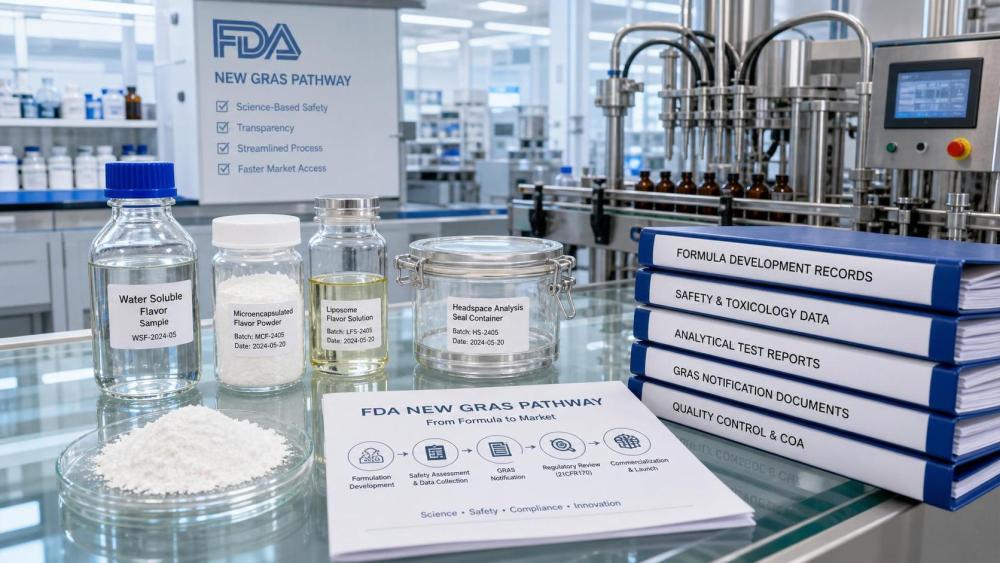
What the FDA Changed on June 29
The confirmed update is that the FDA established a heat-sensitive carrier exemption pathway within the GRAS notification process for water-soluble flavors formulated with microencapsulation or liposomal encapsulation technologies. According to the provided event summary, formulations that meet specified standards for purity, residual solvents, and release kinetics may be submitted through a simplified GRAS notification route. The same summary states that these qualifying products do not need to repeat a 28-day subchronic toxicity study. It also indicates that the change can shorten the new product launch cycle for overseas food and beverage brands by three to five months while reducing compliance costs.
Where the Immediate Business Effects May Appear
For flavor developers and ingredient suppliers
Analysis shows that the most direct effect falls on companies designing water-soluble flavor systems that rely on heat-sensitive carriers. Their main operational change is likely to appear in dossier preparation, because eligibility for the simplified route depends on whether the formulation can satisfy the stated purity, residual solvent, and release-kinetics conditions. What deserves closer attention is not only the formulation itself, but also the technical evidence package needed to support that eligibility position.
For food and beverage brands planning launches
From an industry perspective, brand owners may feel the impact in product development calendars and commercialization sequencing. The provided summary explicitly links the update to a three- to five-month reduction in launch timing for overseas brands, which means regulatory planning, procurement timing, and launch coordination may need to be recalibrated. Companies in this position should pay attention to whether their selected flavor systems actually fit the conditions for simplified submission before adjusting launch commitments.
For procurement and supply chain teams
Observably, procurement teams may need to look more closely at supplier qualification and technical documentation rather than treating all water-soluble flavor systems as equivalent. If a supplier claims that a formulation can use the simplified GRAS route, buyers will likely need supporting records tied to purity, residual solvents, and release behavior. The practical effect may show up in sourcing decisions, specification alignment, and delivery planning, especially where faster launch timing is being built into production schedules.
For testing, compliance, and documentation functions
Testing and compliance-related service providers may also see a shift in the mix of work. Analysis shows that the change does not remove the need for technical substantiation; instead, it changes the emphasis toward proving that the formulation meets the qualifying conditions for the exemption route. That makes supporting reports, technical files, and review-ready compliance documentation more important in the submission process and in downstream customer audits.
What Companies Should Review Now
Check whether current formulations really match the exemption conditions
Analysis shows that companies should first distinguish between products that clearly fall within the described microencapsulated or liposomal category and those that do not. The practical issue is whether the relevant formulation can be supported against the stated purity, residual solvent, and release-kinetics standards. Without that alignment, treating the pathway as automatically available would create avoidable compliance risk.
Reassess technical files and submission materials
What deserves closer attention is the completeness of the technical package behind the flavor system. Because the provided information describes a simplified GRAS notification route rather than a no-document route, businesses should review whether specifications, testing records, and formulation support materials are organized in a way that can withstand regulatory and customer scrutiny. This is especially relevant where procurement, contract manufacturing, or cross-border delivery depends on documented compliance positions.
Adjust launch and purchasing timelines with caution
Observably, the stated three- to five-month reduction in launch timing may encourage faster commercialization planning. Even so, companies should treat that timeline benefit as conditional on a product actually qualifying for the simplified pathway. For procurement and supply planning, this means accelerating schedules only after the technical and compliance basis has been checked internally and with suppliers.
Watch for follow-on interpretation in market practice
From an industry perspective, the update is important, but the provided information does not include further execution detail on review practice, downstream customer requirements, or how commercial documentation may evolve. Companies should therefore monitor how the new route is described in compliance reviews, technical communications, customer qualification requests, and related submission materials before assuming a uniform market interpretation.
Why This Looks Like an Execution Signal, Not Just a Headline
Analysis shows that this development is more than a routine regulatory notice because it changes the compliance path for a defined class of formulations and directly affects time-to-market. At the same time, it is more appropriate to understand this as a targeted execution signal rather than a blanket easing of requirements across all flavor products. The rule change appears meaningful where a formulation can document that it meets the stated conditions, but the market still needs to observe how consistently that standard is applied in practice.
How This Update Is Best Understood at This Stage
From an industry perspective, the main significance of the June 29 update is that it introduces a more efficient GRAS route for certain water-soluble flavors using heat-sensitive carriers, with clear implications for launch timing and compliance cost. The most reasonable current reading is that this is an implemented procedural change with practical value for qualifying products, while the broader execution impact still depends on how companies document eligibility and how the market responds in actual compliance workflows.
Basis of This Article and What Still Needs Verification
This article is based on the user-provided news title, event date, and event summary. For developments of this kind, commonly relevant source categories may include official notices, regulatory agency publications, trade authority updates, industry association materials, standards documents, and reporting by established professional media. No specific official source link was provided in the input, so that link still needs to be verified on an ongoing basis. Continued observation is also needed around detailed interpretation, compliance execution standards, technical document expectations, procurement requirements, and industry feedback as companies begin applying the updated pathway.
Related News
- When heat stable flavor formulations are needed for UHT beveragesOct 04, 2026Aromatics & Perfumery Fellow
- How heat stable flavor formulations prevent aroma loss in baked goodsOct 03, 2026Aromatics & Perfumery Fellow
- Using 4-vinyl guaiacol flavour standard to calibrate sensory panelsOct 02, 2026Aromatics & Perfumery Fellow
- Garlic Powder Flavor Profiles and Their Role in Seasoning BlendsSep 28, 2026Aromatics & Perfumery Fellow
Related News
- 00
0000-00
What drives fragrance ingredients price changes in bulk orders? - 00
0000-00
How to assess a food antioxidants distributor’s traceability practices - 00
0000-00
How minimum order quantities shape private label ingredient sourcing costs - 00
0000-00
What drives personal care ingredient price volatility in sourcing - 00
0000-00
What drives micelles price differences in cosmetic formulations?
Aromatics & Perfumery Fellow
Weekly Insights
Stay ahead with our curated technology reports delivered every Monday.