





On July 11, 2026, the withdrawal of US FDA GRAS Notice #GRN 1298 for water-soluble orange and lemon flavor blends signaled a concrete compliance shift for formulations using modified starch carriers in high-moisture baking applications. For suppliers serving US food and beverage brands, the issue is not only the status of one notice, but the immediate need to reassess formulation support, technical documentation, and delivery planning where thermal stability evidence is expected to withstand closer scrutiny.
What has been confirmed in the withdrawal
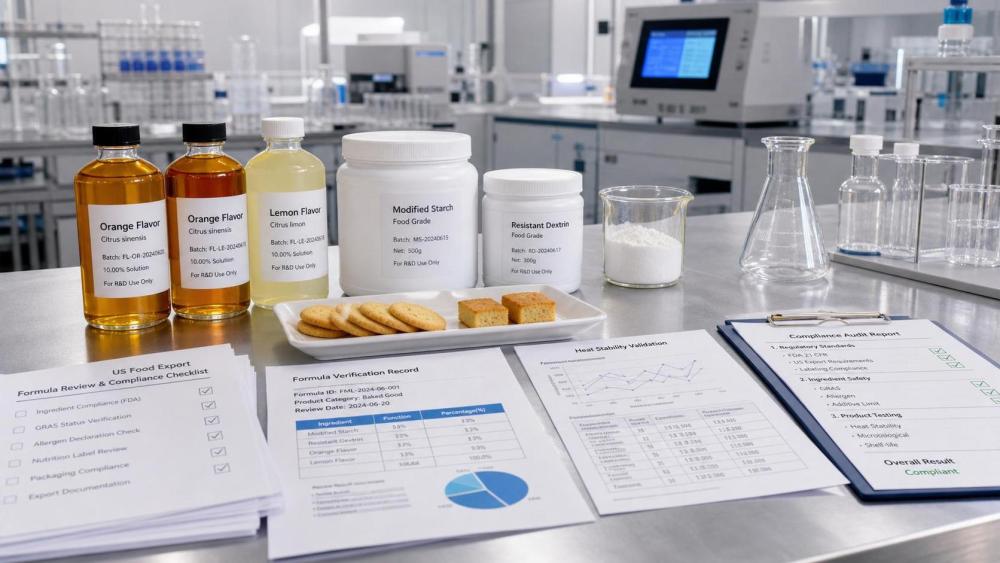
The confirmed facts are limited but commercially significant. FDA revoked GRAS Notice #GRN 1298 with effect from July 11, 2026. The notice concerned water-soluble orange and lemon flavor blends that used modified starch carriers. The stated reason was insufficient thermal stability data for high-moisture baking applications. The event summary also indicates that formulators exporting to US food and beverage brands now need either to validate alternative carriers, including resistant dextrins as an example, or to prepare new GRAS dossiers. The same summary states that this change affects lead times and cost structure for flavored functional foods.
Where the pressure is likely to appear first
Export-oriented formulators face an immediate documentation gap
From an industry perspective, formulators supplying US-facing customers are the first group likely to feel the effect. Their exposure is direct because the withdrawn notice was tied to specific water-soluble citrus flavor systems and a defined application concern. The practical impact is likely to appear in formula review, customer technical queries, and decisions on whether an existing carrier system remains commercially usable for the intended application. What deserves closer attention is the need to support any replacement carrier with defensible validation materials rather than relying on prior assumptions.
Procurement teams may need to revisit carrier selection
Buyers of flavor systems and related ingredients may also see changes in sourcing decisions. If alternative carriers are being considered, procurement teams will need to review whether supplier specifications, technical files, and compliance statements remain aligned with customer requirements. The impact is less about a general shortage signal and more about whether a previously accepted ingredient system still fits the intended US-bound product pathway without additional substantiation.
Manufacturing and delivery planning could absorb longer approval cycles
For processors and manufacturers of flavored functional foods, the operational issue is timing. If reformulation or a new GRAS submission becomes necessary, product development, customer approval, and delivery scheduling may all lengthen. Supply chain service providers and commercial teams should therefore pay attention to how compliance review affects launch sequencing, batch planning, and contractual delivery expectations, especially for products tied to baking applications with higher moisture conditions.
What companies should review now
Check whether current applications depend on the withdrawn notice
Analysis shows that companies should first identify whether any orange or lemon water-soluble flavor blends in their portfolio rely on the withdrawn GRAS position and whether those products are used in high-moisture baking applications. This is a product-by-product review rather than a broad category assumption.
Reassess technical support for carrier systems
Where modified starch carriers are involved, businesses should review the adequacy of thermal stability support in their existing technical files. If an alternative carrier is being evaluated, the compliance question is not simply substitution, but whether the new system can be validated for the intended use conditions in a way that customers and regulatory reviewers will accept.
Prepare for document requests and longer commercial lead times
Commercial and regulatory teams should be ready for closer customer review of dossiers, specifications, and supporting test materials. Observably, the event summary already points to pressure on lead times and cost structure, so companies should factor possible delays into quotation cycles, supply commitments, and project timelines instead of treating the change as a purely regulatory note.
Watch for shifts in customer approval language
If buyers serving US brands tighten internal review language after this withdrawal, the effect may appear in purchase specifications, technical approval checkpoints, or bid documentation. Because no further execution detail is provided here, this should be treated as a monitoring priority rather than an established market-wide outcome.
Why this looks more like an execution signal than a broad rule rewrite
Analysis shows that this development is better understood as an execution-level compliance signal tied to evidence standards for a defined formulation context, rather than as a general rewrite of all flavor rules. The withdrawal points attention to the adequacy of thermal stability substantiation in a specific application setting. At the same time, it is not yet a basis for sweeping conclusions beyond the facts provided. What deserves closer attention is how customers, dossier preparers, and compliance reviewers respond in practice when similar carrier systems are used for US-bound products.
How to read the current market meaning
At this stage, the event is most appropriately understood as an already effective change with immediate practical relevance for affected formulations, but with broader commercial consequences that still need observation. The direct signal is clear: where the withdrawn notice was part of the compliance foundation, companies may need new validation work or a new GRAS dossier path. The wider market effect on sourcing behavior, approval timelines, and product costs should be viewed cautiously until more execution feedback becomes visible.
Basis of this article and what still needs verification
This article is based on the user-provided title, event date, and event summary for US FDA GRAS Notice #GRN 1298 withdrawn for water-soluble citrus flavor blends. For developments of this kind, market participants would usually continue checking official notices, regulatory agency releases, trade or customs information where relevant, industry association updates, standard-setting documents, and reporting from established sector media. No specific official source link was provided in the input, so the underlying source trail still requires follow-up verification. It remains necessary to watch for any later clarification on execution approach, compliance interpretation, customer documentation requirements, tender language changes, industry feedback, and how affected companies implement reformulation or new dossier preparation.
Related News
- When heat stable flavor formulations are needed for UHT beveragesOct 04, 2026Aromatics & Perfumery Fellow
- How heat stable flavor formulations prevent aroma loss in baked goodsOct 03, 2026Aromatics & Perfumery Fellow
- Using 4-vinyl guaiacol flavour standard to calibrate sensory panelsOct 02, 2026Aromatics & Perfumery Fellow
- Garlic Powder Flavor Profiles and Their Role in Seasoning BlendsSep 28, 2026Aromatics & Perfumery Fellow
Related News
- 00
0000-00
Verifying halal status of hydrocolloid ingredients in the Middle East - 00
0000-00
How to interpret active matter on a surfactant specification sheet - 00
0000-00
What Quality Checks Should You Run on Fragrance Ingredient Suppliers? - 00
0000-00
How to assess a flavor chemistry manufacturer's batch consistency - 00
0000-00
What drives fragrance ingredients price changes in bulk orders?
Aromatics & Perfumery Fellow
Weekly Insights
Stay ahead with our curated technology reports delivered every Monday.