





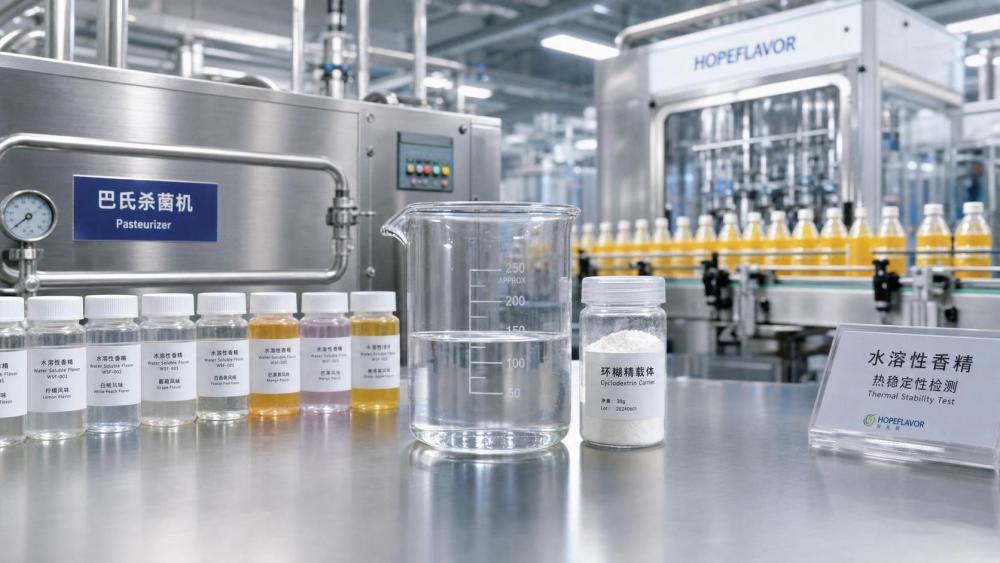
On July 13, 2026, the US FDA updated its GRAS Notice guidance to explicitly recognize cyclodextrin-based encapsulation systems for water-soluble flavors used in beverages and functional foods, with a clear condition that thermal stability data under pasteurization at 95°C for 30 seconds be submitted. For flavor suppliers, beverage brands, procurement teams, and compliance functions connected to US-bound products, this is worth attention because it changes the practical entry conditions for a specific carrier approach rather than simply adding another technical discussion point.
What the guidance now makes explicit
The confirmed change is limited but clear. According to the provided event summary, the FDA revised its GRAS Notice guidance on July 13, 2026 to explicitly accept cyclodextrin-based encapsulation systems for water-soluble flavors used in beverages and functional foods. That acceptance is conditional: thermal stability data under pasteurization at 95°C for 30 seconds must be submitted. The same summary indicates that this lowers regulatory barriers for Asian and Latin American flavor suppliers targeting US beverage brands.
Where the operational effects are likely to appear
Flavor suppliers preparing US-facing dossiers
From an industry perspective, suppliers using cyclodextrin-based systems may be affected first because the guidance change touches the acceptability of a specific technical route. The most immediate impact is likely to appear in compliance preparation, technical documentation, and customer-facing regulatory support. What deserves closer attention is whether existing product files, specification sheets, and supporting data packages are sufficient to address the stated pasteurization stability condition.
Beverage and functional food buyers reviewing ingredient options
Procurement and formulation teams at beverage brands may see a broader pool of potential suppliers for water-soluble flavors intended for the US market. Analysis shows that the practical effect is less about automatic substitution and more about supplier screening: buyers may need to confirm whether submitted materials include the required thermal stability evidence and whether internal approval workflows or supplier qualification documents need to be updated accordingly.
Export and supply chain teams managing delivery readiness
For exporters and supply chain service providers, the change may influence documentation readiness, onboarding timelines, and coordination between technical, regulatory, and commercial teams. Observably, where a supplier targets US beverage customers, the ability to present the required stability information could become part of pre-shipment or pre-contract review, especially when customer approval depends on complete technical files rather than on product samples alone.
Testing and compliance support functions
Testing service providers and regulatory support teams may also be drawn in because the updated guidance refers to a specific thermal condition. The impact here is likely to center on how supporting evidence is organized, presented, and matched to customer or dossier requirements. The confirmed fact is the data condition itself; any broader shift in service demand remains an observation rather than an established result.
What companies should watch now
Check whether current files address the stated heat condition
Companies involved with water-soluble flavors for beverages and functional foods should review whether their existing technical files already cover thermal stability under pasteurization at 95°C for 30 seconds. Analysis shows this is a practical checkpoint because the guidance does not describe general acceptability alone; it attaches a stated submission condition.
Align commercial offers with compliance language
Sales, regulatory, and procurement teams should pay attention to whether quotations, supplier questionnaires, product specifications, and customer approval documents describe the carrier system consistently with the updated guidance. This is not the same as saying market practice has fully shifted already, but it is a sensible area for early alignment where US beverage customers are involved.
Watch for follow-on execution signals
Observably, the current information points to a rule interpretation and acceptance pathway that has become more explicit. It does not, by itself, confirm how every buyer, reviewer, or downstream document set will respond. Companies should therefore monitor later official wording, customer compliance requests, and any changes in qualification checklists tied to GRAS-related submissions.
Plan procurement and delivery around documentation completeness
Where supply contracts depend on regulatory readiness, teams may need to treat thermal stability support as part of delivery preparation rather than as a late-stage add-on. From an industry perspective, this matters particularly for suppliers trying to shorten onboarding time with US beverage brands, because incomplete technical support could still delay commercial execution even if the regulatory barrier is lower than before.
How this change is best understood at this stage
Analysis shows that this development is better understood as an execution-level signal than as a broad market conclusion. The guidance update is specific: it explicitly accepts a defined encapsulation approach for a defined application context, subject to a defined data condition. That gives the market a clearer compliance route, but it still leaves room for observation regarding how consistently the requirement will be reflected in customer documentation, internal approval systems, and practical submission expectations.
Why the market will still need a measured reading
The industry significance lies in the narrowing of uncertainty around one carrier technology in one regulatory pathway. For suppliers targeting US beverage brands, especially those from Asia and Latin America as noted in the provided summary, the immediate value is clearer access conditions rather than a guaranteed commercial outcome. It is more appropriate to understand this as a rule change with practical onboarding implications, while reserving judgment on the pace and breadth of market adoption until more execution feedback emerges.
Basis of this report and what remains to be verified
This article is based on the user-provided title, event date, and event summary concerning the FDA's July 13, 2026 update to GRAS Notice guidance for water-soluble flavor carriers. For developments of this kind, relevant source types typically include official regulatory releases, agency guidance documents, trade and customs information, industry association updates, standard-setting materials, and reporting by authoritative sector media. A specific official source link was not provided in the input, so the exact original publication path still needs to be verified. What also merits continued checking is any later detail on implementation wording, compliance interpretation, procurement document updates, market feedback, and how companies translate this guidance change into actual submission and supply practices.
Related News
- When heat stable flavor formulations are needed for UHT beveragesOct 04, 2026Aromatics & Perfumery Fellow
- How heat stable flavor formulations prevent aroma loss in baked goodsOct 03, 2026Aromatics & Perfumery Fellow
- Using 4-vinyl guaiacol flavour standard to calibrate sensory panelsOct 02, 2026Aromatics & Perfumery Fellow
- Garlic Powder Flavor Profiles and Their Role in Seasoning BlendsSep 28, 2026Aromatics & Perfumery Fellow
Related News
- 00
0000-00
How to assess color stability from a natural food colors manufacturer - 00
0000-00
When does amino acid surfactant powder improve cleanser mildness? - 00
0000-00
How to verify a cosmetic nanotechnology supplier's safety documentation - 00
0000-00
How rheological thickeners for shampoo affect suspension stability - 00
0000-00
How to assess recombinant collagen ingredients for cream stability
Aromatics & Perfumery Fellow
Weekly Insights
Stay ahead with our curated technology reports delivered every Monday.