





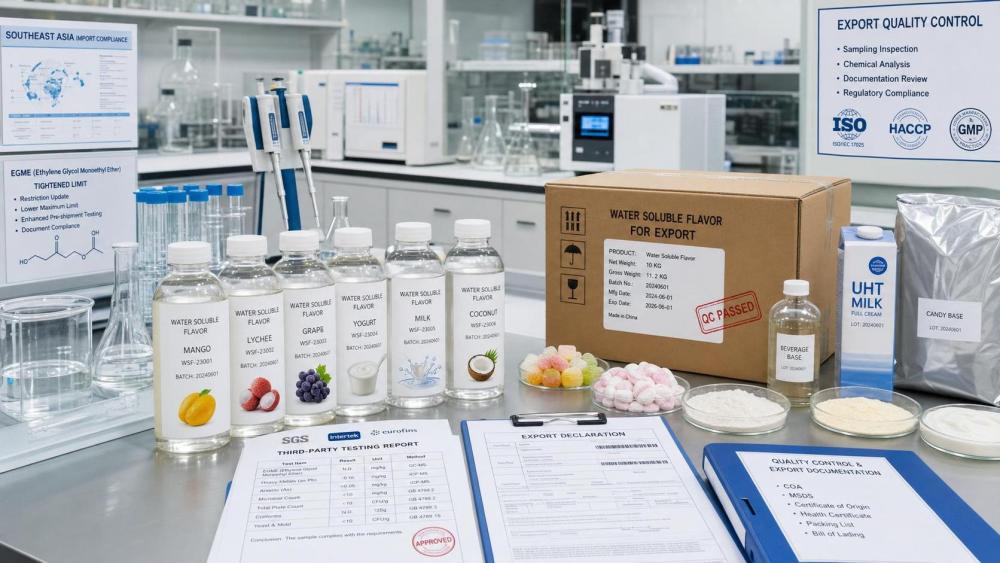
On June 23, 2026, Thailand, Vietnam, Malaysia, Indonesia, and the Philippines jointly issued a revised safety specification for water-soluble flavors through the ASEAN Food Coordination Committee (AFCC), cutting the allowable EGME residue limit for imported products to 0.1 ppm from 1.0 ppm with immediate effect. For companies involved in flavor exports, customs clearance, ingredient sourcing, and downstream use in beverages, dairy products, and confectionery, the update deserves close attention because it changes both compliance thresholds and documentation requirements at the point of entry.
What the revised requirement confirms
The confirmed change is specific and immediate. According to the information provided, the five Southeast Asian countries adopted a revision to the Technical Safety Specification for Water-soluble Flavors on June 23, 2026 through AFCC. Under the revision, imported water-soluble flavors must contain no more than 0.1 ppm of ethylene glycol monomethyl ether (EGME), compared with the previous limit of 1.0 ppm, and the rule took effect immediately.
The stated scope covers end-use applications including beverages, dairy products, and confectionery. The same information also confirms that Chinese exporters must provide a third-party test report from SGS or BV in order to complete customs clearance.
Where the pressure will likely be felt first
Export transactions face a tighter compliance gate
From an industry perspective, direct trading companies are likely to feel the change first because the new limit applies to imported water-soluble flavors and is already in force. The immediate business impact is less about long-term strategy and more about whether existing shipments, product specifications, and supporting documents can meet the new threshold at the time of customs clearance.
Ingredient sourcing and production planning may need adjustment
For procurement teams and manufacturers using water-soluble flavors, the change matters because the affected products are linked to beverage, dairy, and confectionery applications. Analysis shows that any business depending on imported flavor systems for these categories will need to pay closer attention to residue compliance in upstream sourcing and to whether current supply arrangements can continue without delay.
Customs and supply chain service providers will need cleaner documentation flow
Supply chain service providers, including customs-facing coordination roles, may also be affected because the information provided makes third-party SGS or BV reports a clearance requirement for Chinese exporters. In practical terms, documentation readiness becomes part of delivery execution rather than a secondary compliance step.
What companies should watch now
Separate the limit change from the paperwork requirement
What deserves closer attention is the fact that this update contains two operational layers: a stricter EGME residue cap and a defined third-party testing requirement for Chinese exporters. Companies should avoid treating the policy as only a technical parameter change, because customs documentation now appears directly tied to market access.
Review affected product lines by end use
Businesses supplying flavors into beverages, dairy products, and confectionery should first identify which water-soluble flavor items are exposed to the new rule. This is especially relevant for firms with multiple formulations or mixed destination markets, since the issue may not affect every product in the same way.
Check report readiness against shipment timing
Observably, the immediate-effect clause raises a practical question for exporters and logistics teams: whether test reports are ready in time for shipment and clearance. Companies may need to review current order schedules, customs files, and client communication processes to reduce the risk of disruption at handover points.
Continue tracking official wording and implementation details
Although the core requirement is clear in the information provided, companies should still watch for any further official clarification on implementation language, document handling, or interpretation in the five markets. This is not a statement of new facts, but a practical observation based on how immediate regulatory changes can create execution questions even when the headline rule is already defined.
Why this looks like more than a routine parameter change
Analysis shows that the reduction from 1.0 ppm to 0.1 ppm is easier to understand as a concrete compliance tightening rather than a symbolic announcement. The fact that five markets moved together through AFCC and that the rule is already effective suggests that affected companies should treat it as an active trade and compliance issue now, not as a distant policy signal.
At the same time, it is more appropriate to understand this as a development that still warrants observation rather than a fully settled long-term pattern. The confirmed facts show a clear rule change, but the broader implications for supplier selection, order lead times, and cross-border execution will depend on how companies and market authorities apply the requirement in practice.
How the market should read this update
In sum, this development should be read as an immediate regulatory adjustment with direct operational consequences for imported water-soluble flavors entering five Southeast Asian markets. The strongest near-term relevance is for exporters, sourcing teams, manufacturers in beverage, dairy, and confectionery applications, and service providers handling clearance documents. A balanced reading is that the rule itself is already definite, while its wider business effects should continue to be monitored through actual implementation.
Basis of this article
This article is based on the user-provided news title, event date, and event summary. For this type of development, commonly relevant source categories may include official notices, industry association releases, company statements, authoritative media coverage, and standard-setting documents. No specific official source link was provided in the input, so the exact originating document link still needs to be verified on an ongoing basis. Continued attention should focus on any further official clarification related to enforcement wording, document requirements, and market-level implementation in the five countries concerned.
Related News
- When heat stable flavor formulations are needed for UHT beveragesOct 04, 2026Aromatics & Perfumery Fellow
- How heat stable flavor formulations prevent aroma loss in baked goodsOct 03, 2026Aromatics & Perfumery Fellow
- Using 4-vinyl guaiacol flavour standard to calibrate sensory panelsOct 02, 2026Aromatics & Perfumery Fellow
- Garlic Powder Flavor Profiles and Their Role in Seasoning BlendsSep 28, 2026Aromatics & Perfumery Fellow
Related News
- 00
0000-00
How to assess color stability from a natural food colors manufacturer - 00
0000-00
When does amino acid surfactant powder improve cleanser mildness? - 00
0000-00
How to verify a cosmetic nanotechnology supplier's safety documentation - 00
0000-00
How rheological thickeners for shampoo affect suspension stability - 00
0000-00
How to assess recombinant collagen ingredients for cream stability
Aromatics & Perfumery Fellow
Weekly Insights
Stay ahead with our curated technology reports delivered every Monday.