





Why small formulation mistakes become expensive in confectionery
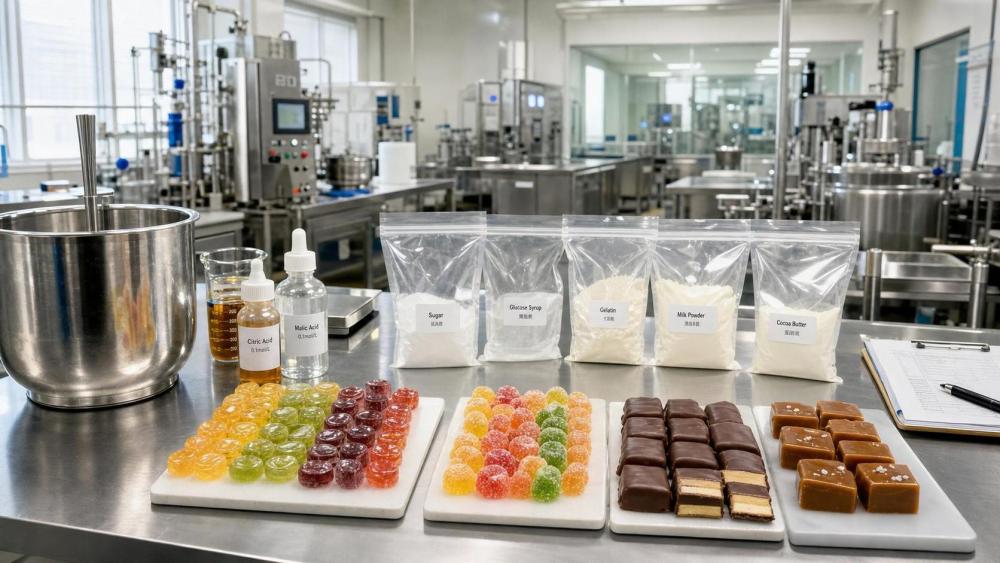
Flavor chemistry for confectionery looks precise on paper, yet minor formulation choices often shift the entire eating experience.
A candy may smell bright in the lab, then flatten after cooking, storage, or packaging.
Sweetness can feel weaker than expected, even when sugar solids remain unchanged.
Off-notes may appear only after several weeks, especially in fat-based or acidified systems.
That is why flavor chemistry for confectionery must be judged as a practical formulation discipline, not only an aroma selection exercise.
In real FMCG development, the same flavor profile behaves differently in gummies, hard candy, fondant, fillings, and coated centers.
Heat load, water activity, fat phase, pH, sweetener system, and shelf-life target all change aroma release.
This is also where FFAI’s intelligence mindset becomes useful.
Its cross-category view of preservatives, thickeners, flavor systems, and compliance reflects how confectionery formulas really fail or succeed.
The key question is rarely whether a flavor smells attractive in isolation.
The better question is whether the full matrix protects that sensory intent from processing to final consumption.
Different confectionery formats create different flavor chemistry risks
One common mistake is treating confectionery as one broad application.
In practice, flavor chemistry for confectionery changes with structure, not just flavor direction.
A boiled candy punishes volatile top notes through high heat and low moisture.
A gummy creates different problems, because hydrocolloids, acids, and water retention reshape perception over time.
Chocolate centers introduce fat partitioning, which can trap some notes and exaggerate others.
Chewy caramels complicate matters further through Maillard tones, dairy notes, and oxidation exposure.
The table below shows why similar flavor briefs often need different formulation logic.
A robust flavor chemistry for confectionery program starts by separating these matrices early, before sensory screening begins.
Heat, acid, and water activity often distort the original flavor brief
Thermal loss is the mistake most teams expect, but they often underestimate its pattern.
Not every volatile disappears at the same rate.
Some bright esters vanish quickly, while heavier background notes remain and make the profile feel dull or syrupy.
In hard candy or aerated sugar systems, late flavor addition may help, but only if the matrix can still distribute evenly.
Acid brings another layer of risk.
A fruit flavor designed for a neutral syrup can taste harsh in a sour gummy.
The issue is not acidity alone.
It is the interaction between acidulants, sweeteners, and aroma compounds that changes perceived juiciness and finish.
Water activity is frequently overlooked because the formula seems microbiologically stable.
Yet moisture movement still alters flavor release, especially in layered products and filled systems.
FFAI often emphasizes that shelf-life chemistry is never separate from sensory chemistry.
That perspective matters here.
Preservative strategy, antioxidant protection, and hydrocolloid behavior can all support or weaken flavor chemistry for confectionery during storage.
A better way to judge process stability
- Test flavor before and after thermal exposure, not only in the finished sample.
- Track pH after cooling and after storage, because drift changes flavor balance.
- Review water migration in multi-texture products, especially coated or filled pieces.
- Check whether antioxidant support is needed for citrus, dairy, or nut-adjacent profiles.
Sweetness perception is not the same as sugar level
Another repeated error in flavor chemistry for confectionery is treating sweetness as a fixed solids number.
Consumers do not experience sweetness that way.
They respond to onset speed, aroma lift, acid contrast, cooling effects, and lingering notes.
A formula can contain enough sugar and still taste flat.
This is especially common in reduced-sugar gummies, pectin jellies, and products using polyols or high-intensity sweeteners.
The mistake is usually overcompensation.
Extra flavor load is added to recover intensity, but the result becomes sticky, perfumey, or unbalanced.
A more reliable approach is to rebuild the perception curve.
That may mean adjusting acid profile, using modulators carefully, or changing the top-note architecture.
In practical terms, flavor chemistry for confectionery should be evaluated against temporal perception, not just peak intensity.
Where misjudgment happens most often
Fruit chews need immediate impact, so delayed sweetness feels weak even at high solids.
Creamy fillings are different.
There, a long sweet finish may be useful, but only if fat notes stay clean.
Sour candy poses another challenge.
If the acid front is too sharp, fruit identity collapses and everything tastes generically tart.
Compatibility problems usually appear after scale-up, not at bench stage
Bench success can hide weak compatibility.
That is one of the most expensive mistakes in flavor chemistry for confectionery.
Small trials rarely reproduce shear, residence time, oxygen exposure, or depositor behavior accurately.
An emulsion that looks stable in a beaker may separate during full-line holding.
Essential oil components can interact with packaging, coatings, or barrier layers and reduce top-note retention.
Color is another indirect signal.
If a fruit candy loses visual brightness, perceived freshness often drops before flavor complaints become obvious.
This is why FFAI’s broader ingredient lens matters.
Thickeners, pigments, antioxidants, and flavor carriers should be reviewed together, not in separate technical silos.
- Confirm whether the carrier system matches the final moisture and fat balance.
- Review packaging absorption risk for citrus, mint, and spice-driven profiles.
- Check whether processing aids or release oils create unintended aroma interference.
- Re-evaluate dosage after line trials instead of locking bench values too early.
Regulatory and cost decisions can also weaken flavor design
Some formulation mistakes begin as compliance or cost shortcuts.
A natural positioning may require ingredient substitutions that alter stability or note clarity.
A lower-cost flavor carrier may save money per kilogram, yet increase dosage enough to erase the gain.
For export-oriented confectionery, documentation quality matters as much as flavor quality.
GRAS status, regional restrictions, labeling language, and residue expectations all affect practical usability.
This is where many teams misread the brief.
They optimize for sensory impact in one market, then face reformulation because the compliance path was not checked early enough.
Good flavor chemistry for confectionery therefore includes a commercial filter.
The right formula is not the strongest aroma profile.
It is the profile that survives process, shelf life, regulation, and price architecture together.
Before finalizing, build a sharper adaptation checklist
The most reliable confectionery programs use a structured review before flavor lock.
That review should stay practical.
It must connect sensory goals with process reality and post-production behavior.
In the end, flavor chemistry for confectionery works best when every flavor decision is anchored to the real product environment.
That means mapping format differences, checking ingredient compatibility, and testing sensory change across storage, not only at day one.
The next sensible step is to define the exact confectionery matrix, compare likely risk points, and set acceptance criteria for heat stability, sweetness perception, compliance, and shelf-life retention before scaling further.
Related News
- When heat stable flavor formulations are needed for UHT beveragesOct 04, 2026Aromatics & Perfumery Fellow
- How heat stable flavor formulations prevent aroma loss in baked goodsOct 03, 2026Aromatics & Perfumery Fellow
- Using 4-vinyl guaiacol flavour standard to calibrate sensory panelsOct 02, 2026Aromatics & Perfumery Fellow
- Garlic Powder Flavor Profiles and Their Role in Seasoning BlendsSep 28, 2026Aromatics & Perfumery Fellow
Related News
- 00
0000-00
Can biomimetic peptides in cosmetics reduce the look of wrinkles? - 00
0000-00
How to assess a bio-based thickener manufacturer's batch consistency - 00
0000-00
Verifying halal status of hydrocolloid ingredients in the Middle East - 00
0000-00
How to interpret active matter on a surfactant specification sheet - 00
0000-00
How Do You Test Hydrocolloid Viscosity After Changing a Thickener?
Aromatics & Perfumery Fellow
Weekly Insights
Stay ahead with our curated technology reports delivered every Monday.