





Choosing the right flavor masking agent for supplements is no longer just a sensory decision—it is a quality, compliance, and consumer-safety challenge. For QA and safety managers, bitter actives, metallic minerals, botanical extracts, and high-dose nutrients must be masked without compromising stability, label claims, allergen control, or regulatory acceptance. This guide outlines the key selection factors behind effective masking systems, helping teams balance taste performance, ingredient safety, clean-label expectations, and scalable manufacturing requirements.
In modern supplement manufacturing, taste correction sits at the intersection of sensory chemistry, risk control, process validation, and supplier qualification.
Why Supplement Flavor Masking Requires QA-Level Control
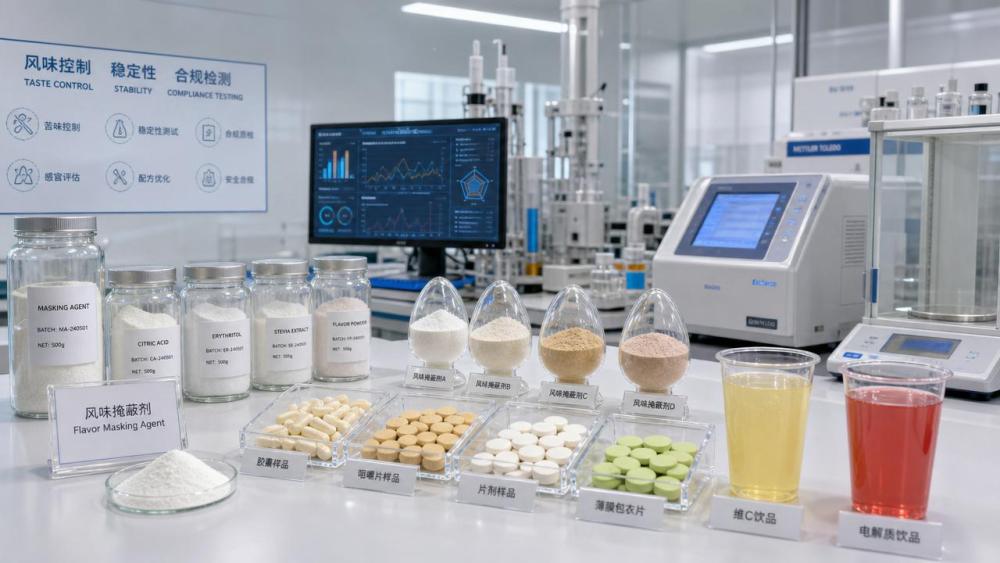
A flavor masking agent for supplements must do more than cover bitterness for a 5-second tasting panel. It must perform through storage, dosing, digestion, and consumer use.
QA teams often evaluate masking systems across at least 4 checkpoints: raw material release, blending behavior, finished product stability, and complaint tracking.
Common taste challenges in supplement formats
High-potency actives create different sensory risks. Minerals may taste metallic, amino acids may be sharply bitter, and botanicals can carry earthy or astringent notes.
The issue becomes harder in powders and gummies, where contact time in the mouth may exceed 20–60 seconds before swallowing.
- Effervescent tablets expose off-notes quickly because carbon dioxide lifts volatile compounds within 10–30 seconds.
- Chewables require delayed bitterness control because actives are released during mastication.
- Ready-to-drink supplements need stability under pH, heat treatment, and shelf-life stress.
- Capsule fills still need odor control during opening, filling, and consumer handling.
Why taste masking becomes a safety issue
Poor masking can drive over-flavoring, excessive sweetener use, or repeated reformulation. Each change may affect allergen declarations, nutrition panels, and stability data.
For safety managers, the preferred flavor masking agent for supplements is traceable, consistently dosed, and supported by clear toxicological and regulatory documentation.
Key risk signals to monitor
- Unexplained changes in aroma after 2–4 weeks of accelerated stability testing.
- Masking ingredients that shift pH beyond the approved product specification.
- Carrier systems containing undeclared allergens, solvents, or animal-derived materials.
- Supplier documents older than 24 months without current regulatory review.
Selection Criteria for a Flavor Masking Agent for Supplements
The best selection process starts with a risk-based matrix, not a flavor preference. QA should define the active profile, format, dose, process, and market region.
A practical screening program usually compares 3–5 candidate systems before pilot production. Each candidate should be evaluated against measurable release and acceptance criteria.
Core technical criteria
Before approving a flavor masking agent for supplements, quality teams should review performance, safety, compatibility, and manufacturing impact together.
The table shows why a single tasting result is insufficient. A flavor masking agent for supplements should pass both sensory validation and document-based release controls.
Masking technologies to compare
Different technologies solve different problems. Encapsulation, receptor blocking, sweetness modulation, acid balancing, and aroma layering may be used alone or in combination.
For bitter botanical extracts, aroma layering may improve first impression. For metallic minerals, chelation-compatible masking and mouthfeel management can be more effective.
- Encapsulation: useful when the active should release after swallowing or later in digestion.
- Receptor modulation: suitable for bitter amino acids, caffeine, certain vitamins, and plant alkaloids.
- Aroma masking: effective when off-odor is stronger than taste perception.
- Texture correction: important for powders above 5 g serving size or high-mineral formulas.
Compatibility checks before approval
QA should test pH, water activity, particle size distribution, flowability, dissolution time, and active assay before and after masking introduction.
A change of only 0.2–0.5 pH units can affect color stability, preservative performance, or botanical polyphenol behavior in liquid supplements.
Validation Workflow for QA and Safety Managers
A controlled workflow reduces reformulation risk. It also creates evidence for audits, complaint investigation, and future scale-up from laboratory to commercial batches.
For most supplement projects, a 5-step validation path can be completed within 6–12 weeks, depending on stability protocol and supplier response time.
Step-by-step implementation plan
- Map the active off-note profile using sensory descriptors, dose level, pH, and serving size.
- Shortlist 3–5 masking options based on regulatory status, allergen profile, and processing route.
- Run bench trials with at least 2 inclusion rates for each flavor masking agent for supplements.
- Confirm stability under real-time and accelerated conditions, commonly 25°C and 40°C.
- Lock specifications, release tests, supplier documents, and change-control requirements.
Documentation that should be requested
A supplier’s technical file should support both product quality and compliance review. Missing documents should be resolved before purchase order release.
This document set helps QA distinguish a promising sample from a commercially reliable ingredient. It also supports supplier approval and annual review.
Pilot-scale checks
Pilot batches should verify blend uniformity, sensory consistency, equipment residue, and cleaning impact. A 10–50 kg pilot is often sufficient for early risk screening.
For tablets, monitor hardness, friability, disintegration, and coating adhesion. For powders, confirm flow, dusting, color uniformity, and scoop-to-scoop consistency.
Compliance, Labeling, and Clean-Label Trade-Offs
A flavor masking agent for supplements may affect label wording, claim support, dietary positioning, and import documentation. These factors should be evaluated before commercialization.
Clean-label expectations do not eliminate the need for technical masking. They require better selection of carriers, solvents, sweeteners, and flavor declarations.
Regulatory questions before purchasing
- Is the masking material permitted for the intended supplement category and dosage form?
- Are natural flavor, artificial flavor, or processing aid declarations required in the target market?
- Does the supplier provide lot-specific certificates within 24–72 hours when requested?
- Can the ingredient support vegan, halal, kosher, gluten-free, or sugar-reduction positioning if needed?
When clean-label goals conflict with performance
Some natural systems perform well but require higher use levels, sometimes 0.2%–1.5% of the finished formula depending on active intensity.
Higher inclusion may alter sweetness, viscosity, moisture uptake, or cost. QA should treat clean-label decisions as formulation changes, not marketing-only updates.
Allergen and cross-contact management
Carriers such as maltodextrin, gum acacia, modified starch, or protein-based matrices should be assessed against facility allergen plans and customer requirements.
If the same production line handles 8 major allergen categories, cleaning validation and supplier segregation evidence become essential parts of approval.
Purchasing Strategy and Supplier Qualification
Procurement should not select a flavor masking agent for supplements only by price per kilogram. The true cost includes dosage, failures, complaints, and reformulation delays.
A more useful comparison is cost per 10,000 servings, adjusted for use level, stability performance, documentation quality, and technical support responsiveness.
Supplier qualification checklist
- Confirm production site controls, traceability, recall procedure, and batch retention policy.
- Request 2–3 recent certificates of analysis to compare specification consistency.
- Assess whether technical support can respond within 2 business days during reformulation.
- Check lead time, minimum order quantity, packaging size, and storage requirements.
- Set written change-notification expectations, commonly 60–90 days before material or process changes.
Commercial scale-up considerations
A flavor masking agent for supplements that works in a 500 g lab blend may behave differently in a 500 kg production batch.
Particle segregation, mixing order, coating temperature, and humidity exposure can change the perceived masking result even when the formula is unchanged.
Avoiding common purchasing mistakes
- Do not approve samples without checking full ingredient composition and label impact.
- Do not assume a beverage masking system will work in compressed tablets.
- Do not skip accelerated stability when minerals, oils, or botanical extracts are present.
- Do not ignore cleaning validation when powdered masking systems contain sticky or aromatic carriers.
How FFAI Supports Safer Masking Decisions
FFAI evaluates sensory ingredients through the connected lens of flavor chemistry, food-grade safety, preservative stability, rheology, and global FMCG compliance expectations.
For QA and safety managers, this means a flavor masking agent for supplements can be assessed with both molecular performance and operational risk in mind.
Decision support for technical teams
FFAI’s intelligence approach helps teams compare masking systems, understand ingredient interactions, and prepare sharper questions for suppliers before a purchase decision.
The focus is practical: reducing failed trials, improving documentation readiness, and helping supplement manufacturers protect taste quality without weakening safety controls.
Recommended next actions
Start with a structured brief covering active list, serving size, dosage form, target regions, claim requirements, and known sensory defects.
Then compare candidate masking systems through bench testing, supplier documentation review, pilot validation, and controlled scale-up before final release.
Selecting the right flavor masking agent for supplements improves consumer acceptance, protects compliance, and reduces reformulation risk across commercial production.
For tailored ingredient intelligence, supplier evaluation support, or formulation risk review, contact FFAI to get a customized solution for your supplement project.
Related News
- When heat stable flavor formulations are needed for UHT beveragesOct 04, 2026Aromatics & Perfumery Fellow
- How heat stable flavor formulations prevent aroma loss in baked goodsOct 03, 2026Aromatics & Perfumery Fellow
- Using 4-vinyl guaiacol flavour standard to calibrate sensory panelsOct 02, 2026Aromatics & Perfumery Fellow
- Garlic Powder Flavor Profiles and Their Role in Seasoning BlendsSep 28, 2026Aromatics & Perfumery Fellow
Related News
- 00
0000-00
How to assess color stability from a natural food colors manufacturer - 00
0000-00
When does amino acid surfactant powder improve cleanser mildness? - 00
0000-00
How to verify a cosmetic nanotechnology supplier's safety documentation - 00
0000-00
How rheological thickeners for shampoo affect suspension stability - 00
0000-00
How to assess recombinant collagen ingredients for cream stability
Aromatics & Perfumery Fellow
Weekly Insights
Stay ahead with our curated technology reports delivered every Monday.