





Flavor Masking Solutions for Pharmaceuticals: What Actually Works
Choosing effective flavor masking solutions for pharmaceuticals is rarely a cosmetic decision. It directly affects patient acceptance, repeat dosing, and practical manufacturing success.
When an API tastes bitter, metallic, sulfurous, or simply lingers too long, even a promising formula can struggle in real use.
That is why flavor masking solutions for pharmaceuticals must do more than add sweetness. They need to reduce exposure, shorten perception, and protect stability.
In practice, what works depends on dosage form, API profile, target age group, excipient limits, and process capability.
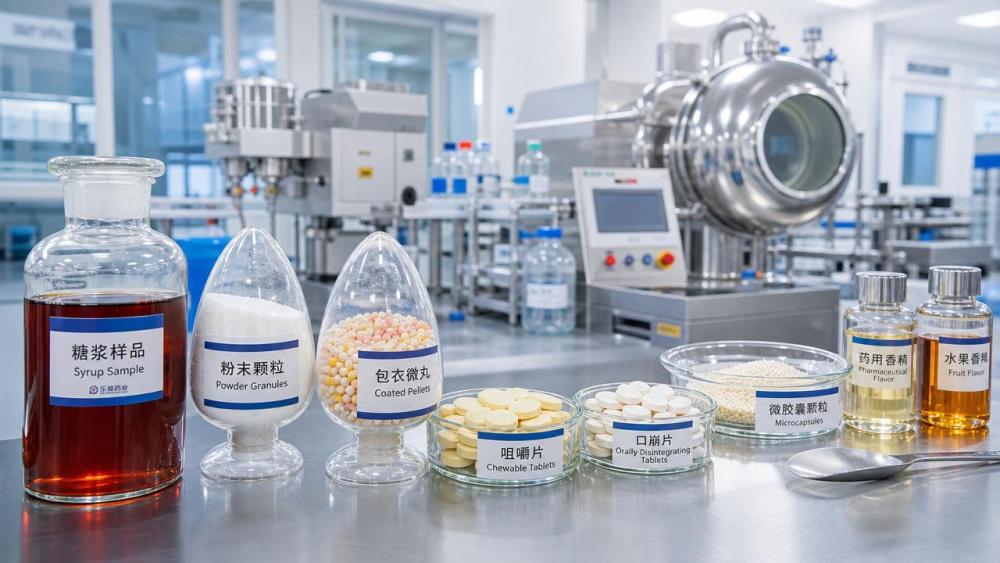
A syrup, chewable tablet, orally disintegrating tablet, and powder sachet may all need different flavor masking solutions for pharmaceuticals, even with the same active ingredient.
The good news is that several methods consistently perform well when matched to the right problem. The key is knowing what each tool can and cannot do.
Why Bad Taste Is Harder to Fix Than It Looks
Many teams start with flavors and sweeteners. Sometimes that works. Often, it only softens the first second of perception.
The real issue is that bitterness and off-notes come from molecular interaction with taste receptors, saliva release, and aftertaste persistence.
This means flavor masking solutions for pharmaceuticals must address both intensity and timing. If the API keeps dissolving in the mouth, taste returns quickly.
More importantly, some unpleasant notes are not classic bitterness. They may be metallic, astringent, chalky, cooling, medicinal, or fatty.
A single masking strategy rarely solves all of them. That is why layered design usually performs better than a one-step fix.
What Actually Works in Flavor Masking Solutions for Pharmaceuticals
The most reliable flavor masking solutions for pharmaceuticals usually combine sensory design with physical barrier control.
1. Sweeteners and flavor systems
Sweeteners are the fastest starting point. Sucrose, sucralose, acesulfame-K, sorbitol, xylitol, and stevia blends are commonly evaluated.
But sweetness alone is rarely enough. It needs support from a flavor profile that redirects attention and fills sensory gaps.
Citrus, berry, mint, chocolate, and vanilla systems often work, but only when matched to the API’s dominant off-note.
For example, metallic notes may respond better to citrus acid brightness, while heavy medicinal bitterness may need creamier, rounder profiles.
2. pH adjustment and taste modulation
Sometimes the most useful flavor masking solutions for pharmaceuticals are not flavors at all. Small pH shifts can change taste perception significantly.
Acids, buffers, and salt balancing agents may reduce harshness or shorten the bitter peak. However, this must align with API stability.
A better taste profile is not useful if potency drops or degradation rises during shelf life.
3. Coating systems
Coating is one of the most proven flavor masking solutions for pharmaceuticals, especially for powders, granules, chewables, and multiparticulates.
A good coating delays API release in the mouth but allows proper release after swallowing. That timing difference matters a lot.
Polymers, lipids, and functional film systems can all help, depending on moisture sensitivity, process temperature, and target release behavior.
4. Microencapsulation
When bitterness is intense or persistent, microencapsulation often delivers stronger results than simple flavor addition.
This approach physically isolates the API, reducing direct contact with taste receptors during oral residence time.
Among advanced flavor masking solutions for pharmaceuticals, this is especially valuable for pediatric products and orally disintegrating formats.
5. Ion exchange resins and complexation
For suitable APIs, ion exchange resins can reduce immediate taste exposure very effectively. Complexation approaches may also lower bitterness expression.
These flavor masking solutions for pharmaceuticals require careful compatibility screening, but they can outperform standard flavor systems.
How to Choose the Right Solution by Dosage Form
Selection becomes easier when the dosage form drives the decision. Different formats expose the mouth differently, so the masking logic changes.
- For syrups and suspensions, combine sweeteners, acid balance, and top-note flavors with viscosity control.
- For chewable tablets, use coating, particle engineering, and rounded flavor systems to manage long mouth contact.
- For orally disintegrating tablets, prioritize fast disintegration with minimal exposed bitterness and short aftertaste.
- For dry powders and sachets, focus on particle coating and fast flavor impact at first sip.
- For capsules, masking pressure is lower, but shell leakage or burp-back notes still need attention.
In other words, the best flavor masking solutions for pharmaceuticals are format-specific. There is no universal sensory shortcut.
A Practical Screening Framework That Saves Time
A practical process prevents teams from wasting months on weak combinations. It also improves communication between formulation, procurement, and manufacturing.
- Map the API taste profile precisely: bitter, metallic, sulfurous, chalky, astringent, or mixed.
- Measure oral exposure time based on dosage form and expected use behavior.
- Start with simple flavor masking solutions for pharmaceuticals before moving to higher-cost physical barriers.
- Test sweetener and flavor blends against placebo and active formula, not placebo alone.
- Check stability, dissolution, and content uniformity after each masking change.
- Confirm process scalability early, especially for coating and encapsulation routes.
This stepwise method sounds simple, but it avoids a common trap. Many formulas taste good in bench trials and fail during scale-up.
Common Mistakes That Undermine Flavor Masking Solutions for Pharmaceuticals
Several errors appear again and again in sensory development.
- Using more flavor when the real issue is API exposure time.
- Relying on sweetness to cover metallic or medicinal notes.
- Ignoring aftertaste and focusing only on first impact.
- Skipping compatibility checks between masking agents and active ingredients.
- Choosing elegant lab solutions that cannot be manufactured consistently.
The strongest flavor masking solutions for pharmaceuticals usually look balanced, not flashy. They solve the sensory problem without creating a process problem.
What Matters Most in Real-World Operations
In actual production, taste is only one part of the equation. Operators also care about flowability, mixing behavior, dust, moisture sensitivity, and cleaning impact.
That is why flavor masking solutions for pharmaceuticals should be judged on four questions at once.
If one of these four fails, the masking strategy is weaker than it first appears.
The Bottom Line on What Works
The most effective flavor masking solutions for pharmaceuticals are usually layered. They combine sensory tools with physical control of API release.
For mild issues, sweeteners, flavors, and pH adjustment may be enough. For tougher APIs, coating, microencapsulation, or resin-based approaches often make the difference.
The best decision is rarely the most complex one. It is the option that delivers better taste, stable performance, and smooth operation at scale.
When evaluating flavor masking solutions for pharmaceuticals, start with the real sensory defect, match it to dosage form, and validate with manufacturability in mind.
That approach consistently leads to formulas that are easier to accept, easier to produce, and far more likely to succeed beyond the lab.
Related News
- When heat stable flavor formulations are needed for UHT beveragesOct 04, 2026Aromatics & Perfumery Fellow
- How heat stable flavor formulations prevent aroma loss in baked goodsOct 03, 2026Aromatics & Perfumery Fellow
- Using 4-vinyl guaiacol flavour standard to calibrate sensory panelsOct 02, 2026Aromatics & Perfumery Fellow
- Garlic Powder Flavor Profiles and Their Role in Seasoning BlendsSep 28, 2026Aromatics & Perfumery Fellow
Related News
- 00
0000-00
Verifying halal status of hydrocolloid ingredients in the Middle East - 00
0000-00
How to interpret active matter on a surfactant specification sheet - 00
0000-00
What Quality Checks Should You Run on Fragrance Ingredient Suppliers? - 00
0000-00
How to assess a flavor chemistry manufacturer's batch consistency - 00
0000-00
What drives fragrance ingredients price changes in bulk orders?
Aromatics & Perfumery Fellow
Weekly Insights
Stay ahead with our curated technology reports delivered every Monday.