





Flavor Masking Solutions for Pharmaceuticals: What Works Best by Dosage Form
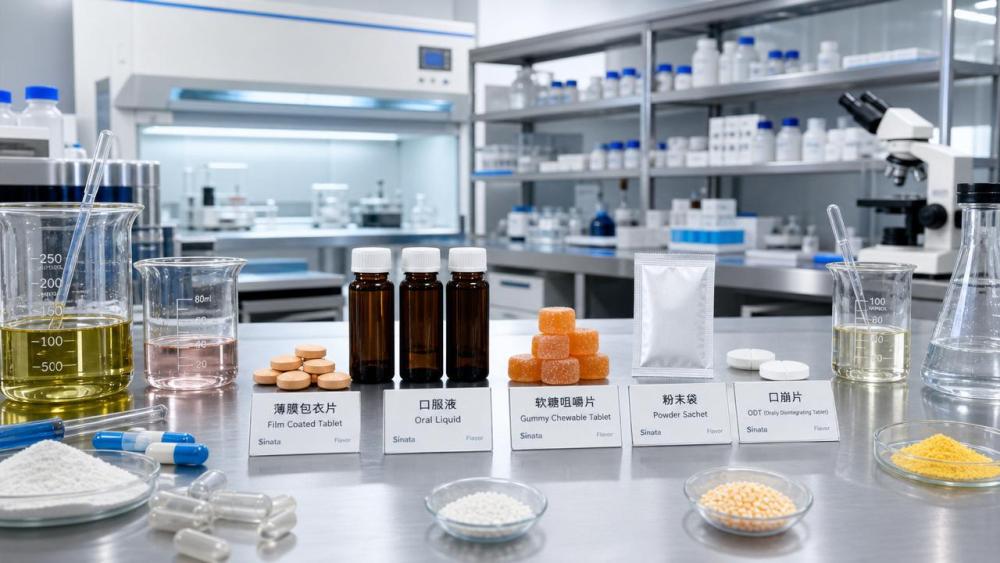
Choosing flavor masking solutions for pharmaceuticals is rarely a one-variable decision.
Dosage form changes everything, from contact time in the mouth to excipient limits and process stress.
A syrup that performs well may fail completely in an orally disintegrating tablet.
That is why technical selection should start with the sensory mechanism, not only the ingredient list.
In practice, bitterness, metallic notes, sulfur character, and lingering aftertaste need different control strategies.
The best flavor masking solutions for pharmaceuticals combine taste modulation, physical barriers, and system compatibility.
This matters even more as patient-centric formulations become a stronger purchasing and development priority.
From a selection standpoint, the real question is simple: what works best for each dosage form without creating new formulation risks?
What Good Flavor Masking Solutions for Pharmaceuticals Must Deliver
Before comparing formats, it helps to define what “works” actually means.
A strong aroma alone does not equal effective masking.
The chosen system should reduce immediate impact, shorten unpleasant persistence, and stay stable through manufacturing and storage.
For technical evaluation, the most useful criteria usually include:
- Off-note coverage for bitterness, metallic taste, sulfur notes, or alkaloid harshness.
- Release behavior matched to swallow time, chew time, or oral disintegration speed.
- Compatibility with sweeteners, buffers, polymers, and active ingredients.
- Process tolerance under heat, shear, granulation moisture, or compression force.
- Regulatory practicality across target markets and age-positioned products.
This also explains why a single universal masking system is uncommon.
More often, effective flavor masking solutions for pharmaceuticals are dosage-form-specific blends.
Tablets and Film-Coated Tablets: Barrier First, Flavor Second
For conventional tablets, the easiest win is often reduced oral exposure.
If the patient swallows quickly, coating becomes more important than strong flavoring.
In this category, flavor masking solutions for pharmaceuticals usually work best when built around film coating, polymer barriers, and low-level top-note support.
Peppermint, vanilla, citrus, and cooling systems can help, but they should not carry the whole burden.
The main risk is assuming flavor will hide a highly soluble bitter active during swallowing.
That usually leads to unstable sensory performance.
A practical selection approach includes:
- Use coating to delay API contact in the mouth.
- Add flavor only to soften first impression and residual notes.
- Check whether the coating polymer changes dissolution or moisture sensitivity.
- Confirm compression and coating conditions do not damage volatile flavor components.
For standard tablets, simple systems often outperform complicated sensory blends.
Liquids and Syrups: Flavor Profile Must Match the Active
Liquid products are less forgiving because the active is already exposed.
Here, flavor masking solutions for pharmaceuticals depend on full system design.
Sweetness, acidity, aroma direction, viscosity, and aftertaste control all interact.
A bitter antibiotic may respond well to berry or grape profiles.
A mineral or metallic note may need citrus, cooling, or acid modulation.
Sulfur notes often need more targeted aromatic cover, not just extra sweetness.
In actual formulation work, the most common mistake is overdosing flavor and creating a medicinal-fruity clash.
Better results usually come from balanced layering:
- Top notes for first aroma acceptance.
- Mid-palate sweetness and acid balance.
- Taste modulators for bitterness suppression.
- Mouthfeel agents to shorten rough or dry perception.
This is where intelligence-driven sensory selection matters.
Teams with deeper flavor and active-ingredient knowledge can screen combinations faster and more accurately.
Chewables and Gummies: Mouthfeel Is Part of Masking
Chewable tablets and gummy formats stay in the mouth much longer.
That changes the selection logic completely.
The best flavor masking solutions for pharmaceuticals in this format combine sweetness architecture, texture design, and controlled active exposure.
Because chewing spreads the matrix across the tongue, lingering bitterness can quickly break through weak flavor systems.
Fruit flavors remain common, but profile choice should follow the API signature.
For example, tropical profiles can cover sulfur notes better than simple strawberry systems.
Meanwhile, creamy or vanilla directions may help with mineral harshness.
Selection should also test:
- How taste changes from first bite to final swallow.
- Whether the active migrates during storage.
- Whether sweeteners amplify or expose off-notes.
- How pectin, gelatin, or compressible bases affect flavor release.
For this format, mouthfeel is not secondary.
It is a core part of successful flavor masking solutions for pharmaceuticals.
Powders and Sachets: Dry State Stability, Wet State Impact
Powders create a two-stage challenge.
They must stay stable during storage, then perform instantly after dispersion or direct oral use.
This means flavor masking solutions for pharmaceuticals should be evaluated both in dry blend form and in-use conditions.
Encapsulated flavors are often useful here.
They improve handling, reduce volatility loss, and can delay note release.
However, they are not always enough for highly bitter or metallic APIs.
A complete assessment should include reconstitution time, final pH, beverage cloud, and sediment effects.
If those variables shift, sensory perception changes too.
From a decision angle, shortlisting works best when teams compare:
- Free flavors versus encapsulated flavors.
- Direct bitterness blockers versus profile-only solutions.
- Dry blending versus granulated carrier systems.
- Single-flavor concepts versus layered sensory architecture.
ODTs and Fast-Melt Formats: The Most Demanding Case
Orally disintegrating tablets are often the toughest challenge.
They dissolve quickly, spread widely, and expose the API almost immediately.
As a result, flavor masking solutions for pharmaceuticals in ODTs usually need multiple layers working together.
Aroma alone is rarely enough.
The strongest systems often combine particle coating, high-impact sweeteners, cooling agents, and bitterness modulators.
Even then, disintegration speed and grittiness can expose off-notes.
That is why sensory testing should mimic real residence time in the mouth.
A useful decision rule is simple: if the API has intense bitterness, start with physical masking first.
Then use flavor design to clean up the remaining profile.
Selection Matrix: What Usually Works Best
How to Make a Better Shortlist
When comparing vendors or prototypes, speed matters, but structure matters more.
A better shortlist for flavor masking solutions for pharmaceuticals usually comes from four screening questions.
- What exact off-note must be reduced first: bitter, metallic, sulfur, or medicinal?
- How long does the product stay in the mouth before swallowing?
- Which excipients, process conditions, and market rules limit formulation freedom?
- Does the masking system still work after stability testing and scale-up?
This kind of framework reduces trial-and-error and avoids expensive sensory dead ends.
It also makes supplier discussions more technical and more productive.
The most effective flavor masking solutions for pharmaceuticals are rarely the loudest flavors.
They are the systems that fit dosage form, release behavior, and formulation reality at the same time.
If selection starts with those three factors, better sensory acceptance usually follows with fewer reformulation cycles.
Related News
- When heat stable flavor formulations are needed for UHT beveragesOct 04, 2026Aromatics & Perfumery Fellow
- How heat stable flavor formulations prevent aroma loss in baked goodsOct 03, 2026Aromatics & Perfumery Fellow
- Using 4-vinyl guaiacol flavour standard to calibrate sensory panelsOct 02, 2026Aromatics & Perfumery Fellow
- Garlic Powder Flavor Profiles and Their Role in Seasoning BlendsSep 28, 2026Aromatics & Perfumery Fellow
Related News
- 00
0000-00
How to assess color stability from a natural food colors manufacturer - 00
0000-00
When does amino acid surfactant powder improve cleanser mildness? - 00
0000-00
How to verify a cosmetic nanotechnology supplier's safety documentation - 00
0000-00
How rheological thickeners for shampoo affect suspension stability - 00
0000-00
How to assess recombinant collagen ingredients for cream stability
Aromatics & Perfumery Fellow
Weekly Insights
Stay ahead with our curated technology reports delivered every Monday.