





Flavor masking for pediatric medicines sits at the intersection of sensory science, formulation engineering, and treatment adherence. A medicine may be clinically effective, yet still fail commercially or therapeutically if bitterness, metallic notes, or unpleasant aftertaste lead to rejection. In today’s health and FMCG environment, where ingredient intelligence increasingly shapes product success, the question is not whether masking is necessary, but which approach works best for a specific molecule, dosage form, and age group.
Why taste masking has become a formulation priority
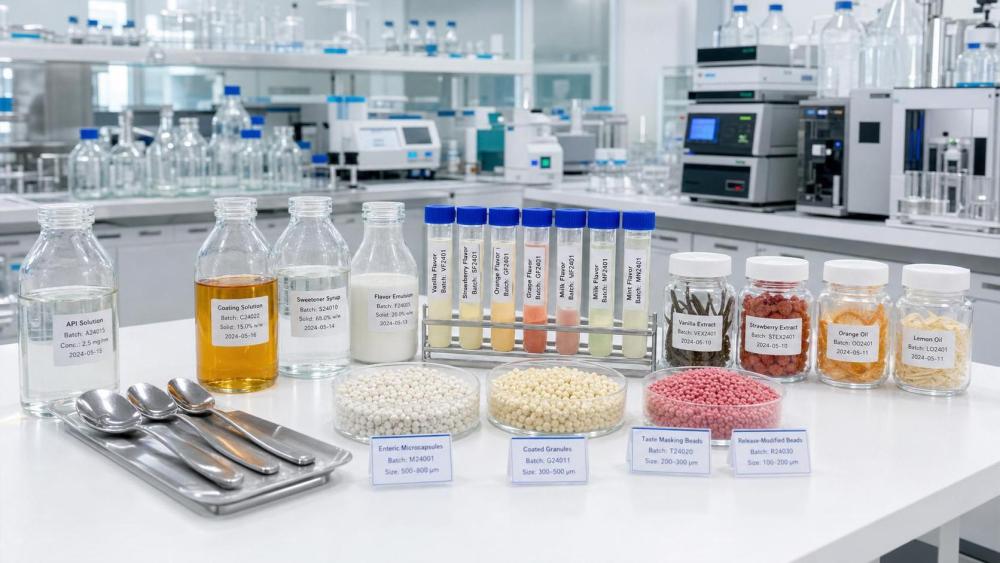
Children detect bitterness differently from adults. Many active pharmaceutical ingredients trigger strong aversive responses even at low concentrations.
That matters because refusal, spitting, incomplete dosing, and caregiver workarounds directly reduce treatment consistency. In antibiotics, analgesics, and chronic therapies, this can quickly undermine outcomes.
Flavor masking for pediatric medicines also affects manufacturing choices. A promising API may require reformulation, alternative excipients, or different delivery formats before it becomes viable in practice.
This is where cross-industry knowledge becomes valuable. FFAI’s focus on flavors, thickeners, preservatives, and molecular sensory interactions offers a useful lens, because pediatric taste masking is rarely solved by sweetness alone.
What flavor masking for pediatric medicines actually involves
At a technical level, taste masking aims to reduce the API’s contact with taste receptors, modify sensory perception, or both.
Some molecules are mainly bitter. Others bring sulfur notes, astringency, numbing effects, or lingering medicinal character. Each profile needs a different response.
In practical terms, flavor masking for pediatric medicines usually combines several levers:
- Sweetness modulation to soften bitterness onset
- Flavor selection to redirect perception
- Viscosity control to alter mouthfeel and reduce diffusion
- Physical barriers such as coatings or encapsulation
- Chemical approaches like ion exchange or complexation
The best systems are designed around sensory timing. Initial taste, mid-palate profile, and aftertaste all need attention.
Where simple approaches work well
For moderately bitter APIs in syrups, suspensions, or chewables, conventional masking can still be effective when it is carefully tuned.
Sweeteners and taste modifiers
Sucrose, sorbitol, xylitol, sucralose, acesulfame K, and stevia derivatives are common tools. Their value depends on onset speed, linger, cooling effect, and interaction with other excipients.
A sweetener with a slow build may miss the first bitterness spike. One with excessive linger may amplify unpleasant aftertaste instead of hiding it.
Flavors and aroma design
Fruit profiles often work in pediatric formats, but not every bitter drug pairs well with berry or citrus notes. Some APIs respond better to grape, vanilla, or mixed cream-fruit systems.
This is familiar territory for FFAI’s flavor intelligence model. The same sensory logic used in food and fragrance development applies here: top notes attract, base notes soften, and balance matters more than intensity.
Thickeners and mouthfeel control
Hydrocolloids such as xanthan gum, cellulose derivatives, or blended gums can reduce bitterness perception by changing rheology and coating the oral cavity.
This is especially useful in oral suspensions, where smoother mouthfeel can improve acceptance even before flavor is fully optimized.
When advanced masking technologies perform better
Some APIs are too bitter, too soluble, or too chemically reactive for surface-level sensory fixes. In those cases, advanced physical or physicochemical methods usually deliver better results.
Polymer coating
Coating particles or granules can block API release in the mouth while allowing release in the stomach. This is widely used in powders, mini-tablets, and orally disintegrating systems.
The main challenge is balancing masking efficiency with dissolution performance. Overcoating can delay absorption or alter bioavailability.
Encapsulation and microencapsulation
Microencapsulation can isolate a bitter API inside lipid, polymer, or hybrid matrices. It often improves stability and handling in addition to taste.
This route is particularly relevant when flavor masking for pediatric medicines must survive moisture exposure, transport stress, or multi-step processing.
Ion exchange resins and complexation
These systems bind the API and limit free drug concentration in saliva. Release then occurs under different pH or ionic conditions after swallowing.
They can be highly effective, but resin compatibility, loading efficiency, and dose uniformity require careful evaluation.
A practical comparison of the main options
No single platform wins in every case. Selection depends on API properties, dosage form, target age, cost target, and regulatory pathway.
The evaluation points that matter most
Effective flavor masking for pediatric medicines should be judged as a system, not as an isolated sensory add-on.
- Map the API bitterness profile, solubility, and release behavior early
- Check excipient compatibility with preservatives, colors, and viscosity modifiers
- Review stability under storage, heat, moisture, and packaging conditions
- Assess whether masking changes dissolution or dose delivery
- Consider regional rules on sweeteners, flavors, and pediatric excipients
- Validate with sensory methods appropriate for ethical and regulatory expectations
This broader view aligns with FFAI’s intelligence approach, where compliance, molecular behavior, and market fit are evaluated together rather than in isolation.
What tends to work best in real development programs
In many projects, the strongest results come from layered design. A flavor alone rarely solves a very bitter API. A coating alone may leave mouthfeel problems. A thickener alone may not control aftertaste.
Better outcomes often come from combining a physical barrier with sensory optimization and rheology control. That might mean coated particles in a flavored suspension, or a resin complex paired with a carefully built sweetness curve.
Flavor masking for pediatric medicines therefore works best when it is framed as a multi-parameter decision. The right answer depends less on trend-driven ingredients and more on fit between molecule, matrix, and patient experience.
The most productive next step is usually a structured comparison: define the API risk profile, shortlist two or three masking routes, and test them against sensory performance, stability, release, and regulatory practicality. That creates a clearer basis for formulation decisions than relying on flavor intensity or precedent alone.
Related News
- When heat stable flavor formulations are needed for UHT beveragesOct 04, 2026Aromatics & Perfumery Fellow
- How heat stable flavor formulations prevent aroma loss in baked goodsOct 03, 2026Aromatics & Perfumery Fellow
- Using 4-vinyl guaiacol flavour standard to calibrate sensory panelsOct 02, 2026Aromatics & Perfumery Fellow
- Garlic Powder Flavor Profiles and Their Role in Seasoning BlendsSep 28, 2026Aromatics & Perfumery Fellow
Related News
- 00
0000-00
Verifying halal status of hydrocolloid ingredients in the Middle East - 00
0000-00
How to interpret active matter on a surfactant specification sheet - 00
0000-00
What Quality Checks Should You Run on Fragrance Ingredient Suppliers? - 00
0000-00
How to assess a flavor chemistry manufacturer's batch consistency - 00
0000-00
What drives fragrance ingredients price changes in bulk orders?
Aromatics & Perfumery Fellow
Weekly Insights
Stay ahead with our curated technology reports delivered every Monday.