





A seasoning blend can contain the same listed ingredients as a competitor’s product and still taste noticeably different. Garlic-derived ingredients are a common reason. Their contribution is not limited to “garlic flavor”: depending on processing, particle size, dosage, fat content, and cooking conditions, they can read as sharp, roasted, savory, sulfurous, sweet, or muted. For formulators and buyers, understanding those differences helps prevent a familiar problem—an acceptable dry blend that becomes unbalanced, flat, or harsh in the finished food.
Garlic is used across snack seasonings, instant noodles, meat rubs, soup bases, sauces, dressings, frozen prepared foods, and plant-based products. Yet its role varies considerably. In a dry barbecue rub, it may provide a warm savory base beneath paprika and smoke notes. In a creamy dip powder, it may need to remain clean and rounded without dominating dairy flavors. In a high-temperature extruded snack coating, the ingredient must still provide recognizable character after exposure to heat, oil, salt, and surface application equipment.
Why garlic flavor is more complex than a single ingredient label
Fresh garlic develops its characteristic pungency when its tissues are cut or crushed. Enzymatic reactions generate sulfur-containing compounds that create the familiar sharp aroma. Drying and further processing change that profile. Some of the sharpest fresh notes diminish, while cooked, toasted, sweet, or savory characteristics may become more prominent. The resulting powder is not necessarily weaker; it is simply different in flavor direction.
For seasoning developers, the useful question is rarely whether an ingredient tastes “strong.” A more practical question is: what type of garlic character is being added, and how will that character behave in the final application? A potent powder with a raw, sulfury edge may be appropriate for a spicy noodle sachet or a bold meat marinade. The same profile may clash with cheese, cream, delicate herbs, or lightly salted vegetable snacks.
Several sensory dimensions should be assessed together:
- Pungency: the immediate sharp, sulfurous impression, often associated with raw or freshly cut garlic.
- Roasted or cooked character: warmer, sweeter, fuller notes that can support grilled, baked, fried, or savory applications.
- Body and persistence: how long the flavor remains after tasting and whether it supports the blend’s overall savory depth.
- Bitterness or dryness: undesirable effects that may become more apparent at higher use levels or in low-fat products.
- Aroma lift: the degree to which garlic is noticeable through the nose before and during eating, rather than only on the palate.
A powder may perform well in a bench-top smell test yet fail in a finished product because salt, acid, sugar, oil, protein, starch, and heat all change flavor perception. This is why sensory evaluation should involve the intended food matrix whenever possible, rather than relying only on the supplier’s dry sample.
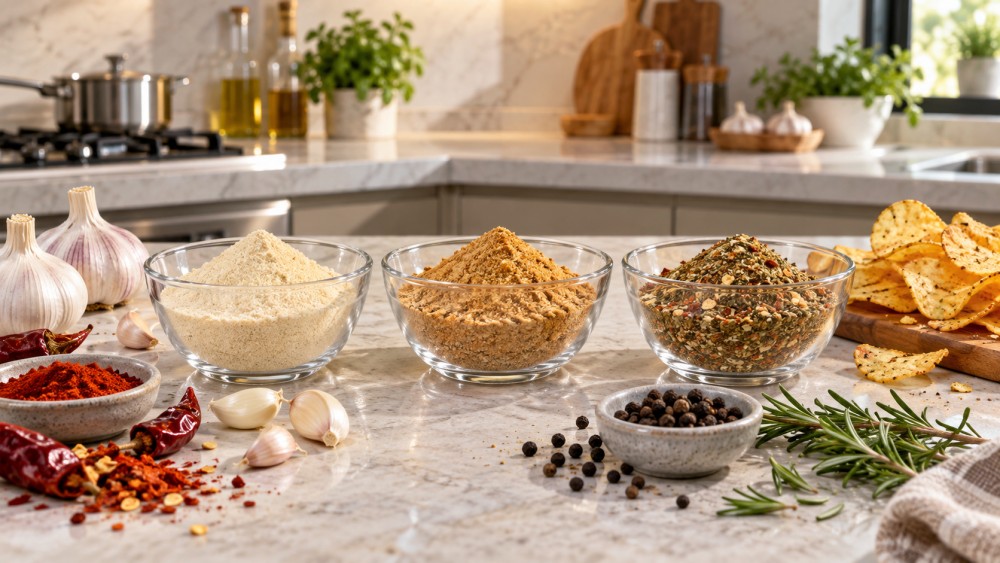
How processing shapes flavor direction
The term garlic powder can cover materials with different processing histories and sensory outcomes. Dehydrated garlic is generally made by drying garlic pieces and milling them to a specified particle size. Conditions during slicing, drying, milling, and storage can influence volatile retention, color, and aroma. A finer powder may disperse more easily but can also present a more immediate flavor release. Coarser materials may hydrate differently in sauces, soups, or marinades.
Roasted garlic powders and similar cooked-style ingredients are intended to shift flavor away from raw pungency and toward browned, mellow notes. They can be useful where a product needs a cooked-kitchen impression without adding fresh garlic handling steps. However, their softer profile may not provide enough top-note impact in applications with strong chili, smoke, soy, cheese, or meat flavors. A formula may require a combination of roasted and conventional profiles rather than a simple substitution.
Some seasoning systems use garlic extracts, oils, encapsulated flavors, or reaction flavors alongside dehydrated material. These components can adjust aroma impact, improve flavor consistency, or help achieve a particular cooked or savory direction. They also introduce different handling considerations. Oils can be sensitive to oxidation and may distribute unevenly in dry systems unless properly carried. Encapsulated materials may release differently under heat or moisture. Reaction flavors may add depth but should be evaluated carefully for compatibility with the desired ingredient statement and market requirements.
Matching the profile to the application
Application conditions determine what “good garlic flavor” means. A powder selected for a dry seasoning may not be suitable for a wet sauce, and a profile that works in a chilled product may change after retort processing or frying. Product teams should identify the product’s dominant flavor system before choosing the garlic component.
In high-salt snack seasonings, for example, garlic may need enough aromatic lift to remain recognizable after sodium chloride suppresses subtle flavors. In a soup base, water dilution can make a dry blend seem less intense than expected, so the evaluation should be conducted at the intended reconstitution level. In an oil-based coating, fat can soften pungency and extend flavor release, which may favor a different profile than a water-based seasoning slurry.
A broader understanding of how garlic powder fits alongside onion, pepper, herbs, cheese, smoke, and umami ingredients can help teams avoid treating every savory component as interchangeable. Flavor profile mapping is especially useful when reformulating for cost, ingredient availability, regional taste preferences, or a cleaner product label.
Blend architecture: garlic as a bridge ingredient
Garlic often functions as a bridge between high-impact flavors and background savory notes. Chili provides heat, black pepper provides bite, smoke supplies character, and sugar rounds sharp edges. Garlic can connect these elements by adding recognizable savory identity. But the blend can become heavy if garlic, onion, yeast extract, hydrolyzed vegetable protein, and meat-like flavors are all used without a clear hierarchy.
One practical approach is to define the role before setting the dosage. Garlic may be intended to act as:
- a front-note that is immediately noticeable when a package is opened;
- a mid-palate savory note that gives fullness after the first taste;
- a supporting note that makes herb, cheese, tomato, or meat flavors feel more complete; or
- a masking tool used in moderation to reduce the perception of vegetal, beany, metallic, or protein-derived off-notes.
These roles require different ingredients and test methods. A highly aromatic option may work as a front-note but become distracting in a mild herb blend. A roasted profile may strengthen body in a plant-based burger seasoning yet not provide enough immediate recognition in a garlic bread topping. When several garlic ingredients are combined, the result should be assessed after the expected processing step, not only in the pre-production blend.
Quality factors that affect repeatability
For procurement teams, the main risk is not simply receiving a product that is “off-spec.” More often, the material may meet a broad written description while creating a noticeable shift in the finished blend. Sensory variation can arise from raw material seasonality, drying conditions, volatile loss during storage, particle-size changes, or lot-to-lot differences in pungency and color.
A useful specification should go beyond a general ingredient name. Depending on the product category and supplier relationship, buyers may evaluate appearance, color range, particle-size distribution, odor, flavor direction, moisture, microbiological requirements, foreign-material controls, packaging format, and shelf-life conditions. The intended use should guide the emphasis. Fine particle control may matter more for dry sachets and homogeneous coatings; microbiological requirements may be more demanding for products with limited subsequent heat treatment.
Odor assessment should be handled carefully. A strong dry aroma is not automatically a positive indicator. Some lots may smell intense because of sharp sulfur notes but deliver an unbalanced taste after hydration. Others may appear restrained in dry form yet provide good cooked flavor in a finished sauce. Retained reference samples, controlled preparation procedures, and side-by-side comparison against an approved lot can make supplier conversations more objective.
Storage and packaging are part of flavor control
Garlic-containing ingredients are vulnerable to flavor deterioration when exposed to moisture, oxygen, excessive heat, or strong surrounding odors. Powder that picks up moisture can cake, lose flowability, and distribute less evenly in a seasoning blend. Oxidative changes can reduce fresh aromatic character and contribute stale notes over time. Warehouses should consider temperature stability, humidity exposure during opening and dosing, packaging reseal practices, and the speed at which partially used bags move through production.
Packaging should protect the ingredient through the actual supply chain, not merely during a short laboratory trial. A material may be suitable in a sealed sample pouch but less stable after repeated opening in a humid production area. For this reason, plant trials should include realistic handling conditions where feasible.
OEM seasoning powder supplier evaluation notes
When evaluating an OEM seasoning powder supplier, garlic should be discussed as part of the total formulation process rather than as a commodity line item. A supplier may be able to provide a sample that matches an initial flavor target, yet repeatability depends on how raw materials are controlled, how batches are blended, and how changes are communicated. The purchasing brief should state the intended application, process temperature, dosage range, target market, allergen constraints, label expectations, and whether the product will be used in a dry, hydrated, oil-coated, or heat-processed format.
Questions that help clarify capability include whether the supplier can provide a defined sensory reference, how substitutions are managed, whether incoming lots are checked against agreed criteria, and what notification process applies when a material source or processing approach changes. These are not merely administrative details. A small shift in garlic character can alter the balance of a finished seasoning more visibly than a modest change in a less aromatic carrier ingredient.
Trial design also matters. Compare candidate blends at the same use rate, in the actual product base, after the expected cooking or holding step. Include shelf-life observation where the product is likely to sit for extended periods. If a seasoning will be packed in a high-barrier sachet, evaluate it in that format; if it will be applied to warm fried snacks, test it under realistic coating conditions. A technically compliant sample can still be the wrong choice if its flavor fades, turns harsh, or separates from the rest of the blend during normal production.
Common selection mistakes
One frequent mistake is replacing a garlic ingredient based only on cost per kilogram. A lower-priced powder may require a higher inclusion level, create a different aroma direction, or require additional flavors to restore balance. The relevant comparison is the cost and sensory performance of the finished seasoning at its actual use rate.
Another mistake is overcorrecting for pungency. If a blend lacks impact, increasing the dosage may introduce bitterness or a raw edge rather than solving the underlying problem. The issue may instead be poor aroma retention, insufficient salt balance, an overly dominant smoke flavor, or inadequate dispersion in the food matrix. Small bench adjustments using more than one profile often reveal whether the formula needs intensity, warmth, top notes, or better integration.
Garlic flavor works best when it has a defined sensory job. Selecting the appropriate profile, testing it in the real application, and controlling the variables that affect lot consistency allow seasoning developers to use it with more precision. That discipline is particularly valuable when a blend must remain recognizable across changing production conditions, packaging formats, and ingredient supply cycles.
Related News
- When heat stable flavor formulations are needed for UHT beveragesOct 04, 2026Aromatics & Perfumery Fellow
- How heat stable flavor formulations prevent aroma loss in baked goodsOct 03, 2026Aromatics & Perfumery Fellow
- Using 4-vinyl guaiacol flavour standard to calibrate sensory panelsOct 02, 2026Aromatics & Perfumery Fellow
- Garlic Powder Flavor Profiles and Their Role in Seasoning BlendsSep 28, 2026Aromatics & Perfumery Fellow
Related News
- 00
0000-00
What drives fragrance ingredients price changes in bulk orders? - 00
0000-00
How to assess a food antioxidants distributor’s traceability practices - 00
0000-00
How minimum order quantities shape private label ingredient sourcing costs - 00
0000-00
What drives personal care ingredient price volatility in sourcing - 00
0000-00
What drives micelles price differences in cosmetic formulations?
Aromatics & Perfumery Fellow
Weekly Insights
Stay ahead with our curated technology reports delivered every Monday.