





Garlic character is often treated as a simple intensity variable: add more for a stronger savory note, add less for a milder one. That assumption creates problems when a blend moves from bench formulation to factory production. Two garlic ingredients with similar apparent strength can behave differently in a dry rub, snack coating, soup base, instant noodle sachet, or meat marinade. Their pungency, sweetness, roasted notes, sulfur profile, particle size, moisture response, and compatibility with salt or fat can alter the finished seasoning in ways that are difficult to correct late in development.
For technical evaluators, the relevant question is not whether a garlic ingredient tastes “good” in isolation. It is whether its flavor profile remains appropriate after blending, processing, storage, and use in the target food system. A seasoning designed for direct application to fried snacks faces different constraints from one intended for reconstitution in hot water. The same nominal dosage may produce a clean garlic aroma in one application and an aggressively sulfurous, dusty, or delayed flavor in another.
Garlic Flavor Is a Profile, Not a Single Attribute
Garlic-derived seasoning ingredients contain a broad range of flavor-active compounds. Processing conditions influence how these compounds are retained, transformed, or lost. Heat treatment may shift the profile away from fresh, sharp pungency toward cooked, sweet, toasted, or savory notes. Drying conditions, raw material maturity, storage time, and exposure to oxygen can also affect the balance between aroma impact and lingering aftertaste.
In practical blend development, technical teams commonly distinguish several sensory dimensions:
- Initial aroma: The first impression released from the dry blend or during cooking. It may be fresh, green, roasted, onion-like, sulfurous, or muted.
- Flavor onset: How rapidly garlic character becomes perceptible after the food is tasted or reconstituted.
- Mid-palate body: Whether the ingredient contributes rounded savory depth, sharp pungency, sweetness, or a hollow powdery note.
- Aftertaste: The persistence of sulfur notes, bitterness, dryness, or roasted sweetness after swallowing.
- Interaction behavior: The way the profile changes in the presence of salt, acids, sugars, chili, hydrolyzed proteins, yeast extracts, fats, or other allium ingredients.
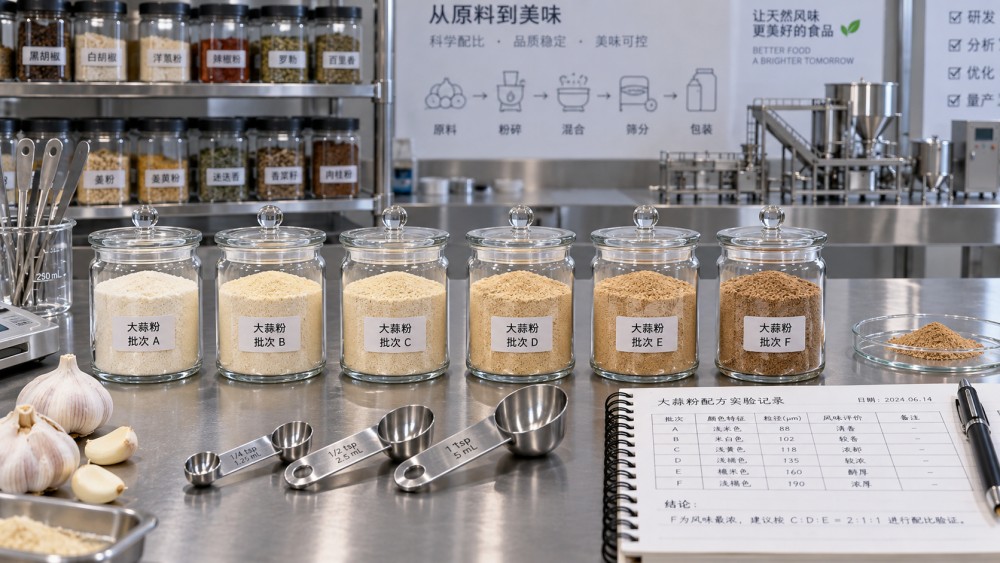
A profile with strong fresh pungency may suit a refrigerated dip or a seasoning intended to suggest freshly chopped garlic. In a baked cracker coating, however, that same profile can become weak after thermal exposure or clash with browned cereal notes. A more cooked or roasted profile may better support cheese, barbecue, poultry, creamy sauce, and savory snack formulations, though it can appear too sweet or caramelized in products seeking a bright, raw-garlic impression.
Why the Blend Matrix Changes the Perceived Result
Seasoning powders are multi-component systems. A garlic ingredient is rarely evaluated alone in final use, because carrier materials, flavor enhancers, spices, acids, and processing aids all influence how it is perceived. The formulation matrix can suppress desirable notes, magnify defects, or shift the timing of flavor release.
Salt is a common example. At moderate levels, salt can sharpen savory perception and make garlic seem more defined. At higher concentrations, it may make a weak garlic profile appear thinner because the salt impact dominates the initial taste. Acidulants can brighten certain garlic notes but may also expose metallic, bitter, or sulfur-heavy characteristics in poorly matched formulations. Sugar, maltodextrin, starches, and fat powders can soften pungency, while chili and black pepper may mask aroma but leave a garlic aftertaste more apparent later.
Fat content matters as well. Lipid-rich foods can retain hydrophobic aroma compounds and release them differently during chewing or heating. A garlic note that appears restrained in a dry seasoning sample may become fuller in a fried snack coating or oil-based marinade. Conversely, a low-fat broth powder may need a different profile because its aroma is released quickly in hot water and receives little masking from fat.
Processing History Affects More Than Aroma Strength
Technical specifications frequently focus on moisture, microbiological limits, color, and particle size. Those controls are necessary, but they do not fully describe flavor performance. A material can meet routine physical specifications while producing a noticeably different sensory outcome because its processing history has altered the balance of volatile and non-volatile compounds.
For example, a darker material may indicate a more heat-developed profile, but color alone cannot confirm whether the finished taste will be pleasantly roasted or overly cooked. Likewise, a light-colored powder may appear fresh but deliver insufficient depth after it is diluted into a high-salt seasoning. Sensory assessment needs to be linked to a defined application rather than treated as a generic pass-or-fail exercise.
The term garlic powder can cover ingredients with materially different flavor behavior, depending on raw material selection and drying approach. Development teams should avoid assuming that equivalence in mesh size or basic compositional documentation guarantees equivalent seasoning performance. A controlled comparison in the intended blend is usually more informative than a direct odor comparison of the dry ingredients.
Particle Size and Dispersion
Particle size affects distribution, visual appearance, hydration, and local flavor concentration. Coarser particles can create visible specks and intermittent flavor bursts, which may be desirable in rustic-style rubs but problematic in fine snack seasonings. Fine powders generally disperse more evenly, yet very fine fractions may dust during handling, absorb moisture more readily, or contribute a dry mouthfeel if the formula lacks sufficient oil or other adhesion support.
Dispersion is especially relevant where dosage is low. If a minor ingredient is not uniformly distributed through a large batch, sensory variability can appear from one package to another even when the total batch addition is correct. Blending time, order of addition, bulk density differences, electrostatic effects, and segregation during transfer should be considered alongside the ingredient’s stated particle specification.
Moisture, Water Activity, and Caking Risk
Garlic ingredients are hygroscopic to varying degrees, and the practical risk is not limited to visible clumping. Moisture uptake can reduce flowability, make dosing less consistent, and encourage agglomerates that fail to disperse properly in a blend. In seasoning systems containing salt, sugar, organic acids, or hygroscopic flavor carriers, the finished powder may have a higher caking tendency than any component tested alone.
Factory evaluation should include storage under packaging conditions that reflect the expected supply chain. A sample assessed immediately after opening may perform well, while the same material can develop odor loss, compacted lumps, or flow problems after repeated exposure to humid production air. Packaging barrier properties, resealing practices, warehouse humidity, and the time between opening and use all affect the practical stability of a seasoning ingredient.
Building a Flavor Target Before Selecting a Material
A clear flavor brief prevents procurement from relying on vague descriptions such as “strong garlic” or “premium quality.” Those descriptions do not identify whether the target is fresh and sharp, cooked and rounded, toasted, sweet, pungent, or background savory. Technical teams can define the expected profile through a short sensory target statement linked to the finished product.
For a creamy pasta sauce powder, the target might be a rounded cooked-garlic body with low bitterness and no harsh sulfur tail. For a spicy fried chicken coating, the target may be a noticeable roasted garlic top note that survives frying and integrates with pepper and paprika. For an instant ramen seasoning, the objective could be quick release in hot water with enough depth to remain detectable after sodium reduction.
The target statement should also identify unacceptable characteristics. This is often where development becomes more efficient. Examples include raw cabbage-like notes, burnt sweetness, metallic aftertaste, excessive dryness, inconsistent visible particles, or aroma that disappears after a defined process step. Rejection criteria give quality and purchasing teams a basis for discussing substitutions without reducing the decision to price alone.
Quality Checks for Food Factory Evaluation
A receiving program should verify both food safety requirements and functional suitability. Documentation review may include identity, lot traceability, allergen status where relevant, country-of-origin requirements, shelf-life information, and agreed microbiological limits. These checks should be matched to the manufacturer’s hazard analysis and the intended product category. Requirements for an ingredient used in a ready-to-eat seasoning may differ from those for an ingredient subjected to a validated subsequent heat process.
Physical inspection remains useful because it can reveal changes not obvious in certificates. Teams can assess package integrity, foreign matter risk, abnormal odor, clumps, color deviation, and consistency of powder texture. If incoming material is sampled, the sampling plan should account for the possibility of variation within a lot, especially where bulk packaging and extended transport are involved.
Sensory screening is most reliable when it uses a repeatable method. Smelling an open bag provides an early indication, but it does not replicate final use. A more useful protocol may include evaluation of the dry material, a simple standardized salt-water dispersion, and a representative pilot blend. The panel does not need to be large to detect gross deviation, provided that reference samples, preparation conditions, and vocabulary are consistent.
- Retain an approved reference lot or a defined reference blend for comparison.
- Prepare samples at a fixed concentration and temperature.
- Evaluate aroma, onset, savory body, pungency, bitterness, and aftertaste separately.
- Record observations using agreed descriptors rather than general comments such as “weak” or “off.”
- Confirm any significant sensory difference in the actual product matrix before approving a formulation change.
Where a formulation is sensitive to lot-to-lot variation, technical teams may set an internal sensory acceptance range in addition to routine analytical criteria. The purpose is not to demand artificial uniformity from an agricultural raw material. It is to identify variation large enough to require dosage adjustment, blend reformulation, segregation of lots by application, or supplier follow-up.
Substitution Risk During Cost or Supply Reviews
Ingredient substitution often begins with a price comparison, but a lower-cost garlic material can shift the economics of the entire formula. A powder with lower aroma impact may require a higher use rate, which changes salt balance, carrier load, particle appearance, and total batch cost. A stronger material may reduce dosage but introduce harshness that demands compensating sugar, fat, masking flavors, or additional processing adjustments.
Supply continuity also has a sensory dimension. If approved lots vary widely in cooked versus fresh character, manufacturers may face frequent minor reformulations or inconsistent finished-product flavor. Procurement specifications should distinguish non-critical cosmetic variation from differences that affect product identity. That distinction helps prevent a compliant but unsuitable alternative from reaching production.
Before approving a replacement, compare materials at equal dosage and at adjusted dosage. Equal-dose testing reveals direct profile differences; adjusted-dose testing shows whether intensity can be corrected without creating new defects. Both tests should be performed in the relevant product matrix, after the applicable heating, drying, or holding stage.
Using Flavor Profiles as a Development Control
Garlic selection becomes more predictable when flavor is treated as a controlled design input rather than a late-stage seasoning adjustment. The strongest candidate is not always the best candidate. A suitable material is one whose aroma, pungency, body, and finish fit the target food, tolerate the expected process, and remain consistent enough for the factory’s quality system.
For technical evaluators, the most practical approach is to connect ingredient approval with a defined sensory target, application-specific trials, routine physical checks, and realistic storage assessment. That framework makes it easier to identify whether a flavor deviation originates in the ingredient, the blend matrix, the manufacturing process, or post-production handling—and to address the actual source rather than simply increasing dosage.
Related News
- When heat stable flavor formulations are needed for UHT beveragesOct 04, 2026Aromatics & Perfumery Fellow
- How heat stable flavor formulations prevent aroma loss in baked goodsOct 03, 2026Aromatics & Perfumery Fellow
- Using 4-vinyl guaiacol flavour standard to calibrate sensory panelsOct 02, 2026Aromatics & Perfumery Fellow
- Garlic Powder Flavor Profiles and Their Role in Seasoning BlendsSep 28, 2026Aromatics & Perfumery Fellow
Related News
- 00
0000-00
Verifying halal status of hydrocolloid ingredients in the Middle East - 00
0000-00
How to interpret active matter on a surfactant specification sheet - 00
0000-00
What Quality Checks Should You Run on Fragrance Ingredient Suppliers? - 00
0000-00
How to assess a flavor chemistry manufacturer's batch consistency - 00
0000-00
What drives fragrance ingredients price changes in bulk orders?
Aromatics & Perfumery Fellow
Weekly Insights
Stay ahead with our curated technology reports delivered every Monday.