





Start by defining what “stable flavor” actually means in your product
For technical evaluators, flavor stability has moved well beyond a sensory panel comment like “still tastes fine after storage.” In processed foods, the real question is whether the aroma profile survives heat, shear, oxygen exposure, water activity shifts, fat migration, packaging contact, and distribution time without drifting away from the product brief. That is where olfactory engineering in food flavoring matters. It gives you a way to connect volatile behavior with process conditions, instead of treating flavor loss as a vague post-production problem.
Before reviewing any flavor system, write down the failure mode you are trying to prevent. Is the issue early top-note collapse in a beverage? Sulfur note flattening in savory snacks? Oxidized citrus character in baked fillings? Vanilla carry-through disappearing after retort? If that failure mode is not defined, the evaluation usually turns into subjective tasting and supplier preference. That wastes time and hides the real risk.
A practical starting checklist looks like this:
- Identify the target aroma notes that must remain recognizable at end of shelf life.
- Separate processing loss from storage loss.
- Define the critical point of judgment: immediately after production, after transport simulation, or at the declared shelf-life endpoint.
- Set the comparison basis: fresh control, current benchmark, or competitive reference.
Many reviews fail here because “flavor stability” is treated as one broad property. It is not. Different notes break down for different reasons, and the mitigation strategy only works when the mechanism is identified first.
Check the volatile profile before you check the flavor name
A flavor labeled “grilled beef,” “mango,” or “cream vanilla” tells you almost nothing about stability risk. Technical evaluation should focus on the volatile architecture behind the label. High-impact compounds with low boiling points, high vapor pressure, or strong oxidation sensitivity often drive the first visible aroma drift. In practice, the note consumers notice first is not always the note present at the highest concentration.
Ask for composition information at the level that supports technical judgment. You do not always need the full formula, but you do need enough to understand whether the system depends heavily on fragile aldehydes, terpenes, sulfur compounds, esters, or heat-sensitive reaction flavors. If the system relies on a small number of highly expressive top notes, expect sharp sensory decline when the matrix or process is aggressive.
This is also the stage to ask whether the flavor balance has been built for immediate impact or for delayed release. Those are not the same design goals. A flavor that performs impressively in a bench sample can still collapse after pasteurization or long ambient storage if the aromatic build is too front-loaded.
Map the process stress points, not just the final product category
Processed foods with the same category label can impose very different flavor stresses. A yogurt drink, a spoonable yogurt, and a high-protein fermented dairy beverage may all carry “fruit flavor,” but their thermal history, pH profile, protein interactions, and oxygen pickup can be completely different.
Build a simple process map and mark every step that can alter volatile performance:
- Premix holding time before heat treatment
- Thermal exposure, including peak temperature and residence time
- Homogenization or other high-shear steps
- Vacuum concentration or drying
- Cooling profile and post-process flavor addition point
- Headspace formation during filling
- Light and oxygen exposure during distribution
This sounds basic, but it catches a common error: evaluating flavor stability only against the finished SKU description. The process often destroys more aroma value than the ingredient itself. If the plant adds flavor before the harshest thermal step for convenience, olfactory engineering will not rescue the result unless the formula was designed for that exact sequence.
Review matrix interactions early, especially fat, protein, and water activity
Flavor molecules do not behave the same way in water, oil, starch, protein, and hydrocolloid systems. Some compounds partition into fat and release more slowly. Others bind with proteins, dulling aroma perception even when analytical recovery still looks acceptable. In low-moisture products, oxygen-driven degradation may dominate. In high-moisture acidic products, hydrolysis or volatilization can become the bigger concern.
If you are evaluating a flavor for processed foods, do not sign off after testing it in a neutral lab base. Test it in the real matrix, or at least in a matrix that matches pH, fat level, solids, sweetener system, and preservative environment closely enough to expose interaction risk. Technical teams regularly underestimate how much rheology modifiers, emulsifiers, and proteins shift aroma release timing.
One useful question: is the goal aroma retention in-package, or aroma release in-mouth? A system can look stable analytically but still feel weak to the consumer if the matrix traps key notes too effectively.
Separate oxidation control from volatility control
These two problems are often bundled together, and that leads to poor corrective action. Volatile loss is about evaporation, partitioning, or stripping during processing and storage. Oxidation is about chemical transformation into new compounds that may be dull, harsh, stale, or simply wrong for the intended profile.
Your checklist should ask different questions for each:
When people say a flavor is “not stable,” they often mean both at once. That is too imprecise for process decisions. If the problem is oxidation, moving the addition point may do little. If the problem is stripping, adding more antioxidant support may also do little.
Look closely at encapsulation, carrier choice, and release timing
A lot of olfactory engineering in food flavoring comes down to managing when and where aroma compounds are protected, released, or exposed. Encapsulation, emulsified flavor systems, spray-dried formats, and carrier selection can all improve performance, but only if they match the process and eating occasion.
For dry applications, ask whether the encapsulate can survive blending and storage without premature breakage or moisture pickup. For liquids, check emulsion stability and whether the dispersed phase remains intact through shear and thermal stress. For bakery or retort applications, the key question is whether the protective system holds during processing but still releases enough aroma during consumption.
A common mistake is assuming more protection automatically means better flavor. Overprotected systems can mute aroma delivery, especially in products where quick bloom at opening or first bite matters.
Do not evaluate flavor in isolation from packaging
If your review stops at the formula and process, you are missing one of the biggest reasons stable flavors become unstable in market conditions. Packaging affects oxygen ingress, light exposure, headspace composition, aroma scalping, and migration behavior. Some volatile compounds are particularly vulnerable to absorption into polymer structures or loss into headspace during storage.
The practical review is simple. Compare the intended package with the one used in development. If the pilot sample was stored in glass and the commercial product will go into flexible multilayer film or a plastic bottle, re-run the evaluation. If shelf-life work used low-headspace fills but plant conditions leave wider headspace, re-run again. These are not small procedural details. They can change the flavor outcome enough to invalidate bench conclusions.
Build the test plan around decision points, not around available instruments
Technical teams sometimes gather a lot of analytical data and still fail to answer the business question. The test plan should reflect the approval decision you need to make. Are you screening candidate systems, validating one production-ready flavor, or investigating a shelf-life complaint?
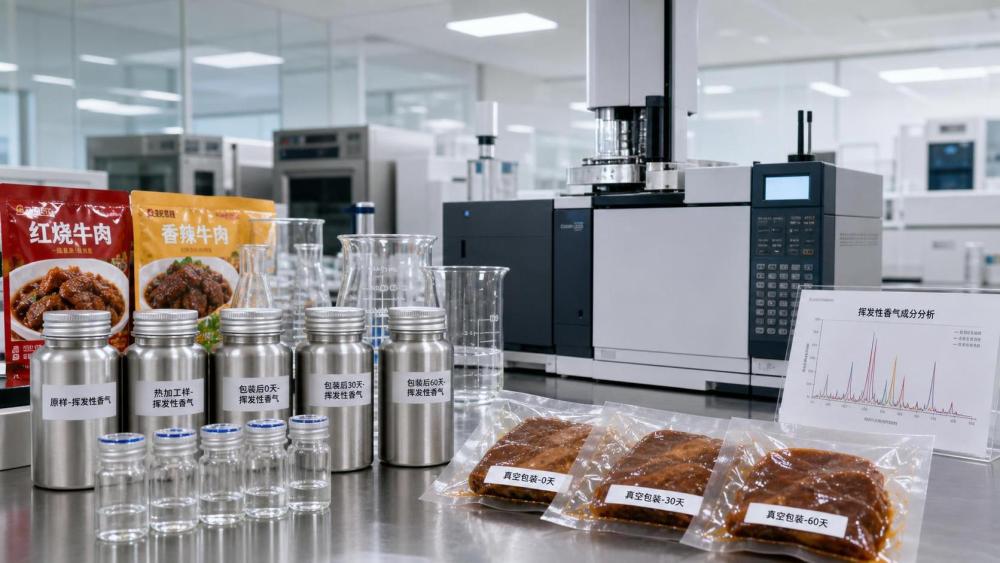
Use sensory and instrumental work together. GC-based volatile analysis can show which compounds are changing, but it does not replace trained sensory review because aroma impact is nonlinear. A small change in a key character note may matter more than a larger change in a background component. On the other hand, sensory alone can miss early degradation patterns that later become serious.
A stronger evaluation plan usually includes:
- Fresh sample baseline after full processing
- Time-point checks under intended storage conditions
- Abuse-condition samples when transport or warm storage is realistic
- Headspace or volatile analysis tied to named marker compounds
- Sensory checkpoints focused on pre-defined failure notes
The point is not to generate more data. It is to create evidence that tells you whether the flavor system is robust enough for the actual manufacturing and distribution environment.
Check regulatory fit at the same time as technical fit
For evaluators working across markets, flavor stability cannot be reviewed separately from use conditions and labeling implications. The same aroma system may be technically effective but commercially awkward if its carrier, solvent, processing aid status, or declaration outcome conflicts with the product brief or target market position.
The practical move is to inspect the specification set early: flavor composition summary, allergen-related statements where relevant, carrier system, intended use category, and market-specific documentation required by your internal compliance workflow. Do this before running extended trials. Teams lose time when they optimize a system that later clashes with the project’s clean-label direction or category constraints.
This is especially relevant when the stability solution depends on encapsulation materials, antioxidants, or solvents that affect declaration or category suitability.
Watch for these repeat mistakes during supplier and internal reviews
- Approving a flavor based on aroma impact in a room-temperature bench sample.
- Using accelerated storage only, without checking whether the degradation pathway matches real shelf conditions.
- Assuming a stronger initial dose solves poor carry-through.
- Ignoring the fill, seal, and headspace conditions of the actual production line.
- Reviewing flavor performance without the final fat, protein, or hydrocolloid system in place.
- Treating supplier stability claims as transferable across all matrices and process types.
None of these mistakes are unusual. They happen because teams are under pressure to move quickly. But each one disconnects the aroma design from the production reality, which is exactly the gap olfactory engineering is supposed to close.
Use a tighter approval sequence
If the goal is reliable flavor stability in processed foods, the order of evaluation matters. Start with the target aroma notes and known failure modes. Then review volatile architecture, process stress, matrix interaction, oxidation versus stripping risk, protective delivery system, packaging, and test design. Compliance fit should sit alongside that work, not after it.
That sequence keeps the decision grounded in how flavor actually behaves from tank to shelf. It also helps technical evaluators avoid the most expensive error in this area: choosing a flavor that tastes right on day one but was never engineered to survive the product system it was placed in.
When you review olfactory engineering in food flavoring this way, flavor stability stops being a vague quality target and becomes a set of controllable design and process variables. That is where better decisions usually begin.
Related News
- When heat stable flavor formulations are needed for UHT beveragesOct 04, 2026Aromatics & Perfumery Fellow
- How heat stable flavor formulations prevent aroma loss in baked goodsOct 03, 2026Aromatics & Perfumery Fellow
- Using 4-vinyl guaiacol flavour standard to calibrate sensory panelsOct 02, 2026Aromatics & Perfumery Fellow
- Garlic Powder Flavor Profiles and Their Role in Seasoning BlendsSep 28, 2026Aromatics & Perfumery Fellow
Related News
- 00
0000-00
Verifying halal status of hydrocolloid ingredients in the Middle East - 00
0000-00
How to interpret active matter on a surfactant specification sheet - 00
0000-00
What Quality Checks Should You Run on Fragrance Ingredient Suppliers? - 00
0000-00
How to assess a flavor chemistry manufacturer's batch consistency - 00
0000-00
What drives fragrance ingredients price changes in bulk orders?
Aromatics & Perfumery Fellow
Weekly Insights
Stay ahead with our curated technology reports delivered every Monday.