





A beverage can look and taste correct at the end of a pilot run, then develop an oil ring, a cloudy layer, floating droplets, or flavor loss after filling and storage. The issue is often described simply as “flavor separation,” but the visible defect may arise from several different failures: an unstable oil-in-water emulsion, flavor oil adsorption onto packaging, hydrocolloid incompatibility, precipitation triggered by pH or minerals, or a processing sequence that never created sufficiently small droplets.
The most useful formulation tips start with a direct principle: flavor separation is prevented by matching the flavor system, emulsifier package, hydrocolloid system, process energy, and storage conditions as one design problem. Adding more gum or more emulsifier without identifying the separation mechanism can make the beverage thicker, hazier, foamy, or harder to process without improving stability. Technical evaluation should therefore begin with the symptom and the point in the process at which it appears.
First, identify what is actually separating
Not every visual change is an oil separation problem. A floating ring at the neck of a bottle usually points toward low-density flavor oil droplets rising by creaming or coalescing. Sediment at the bottom may be insoluble flavor components, clouding agents, minerals, protein, or hydrocolloid aggregates. A beverage that becomes clear over time can be losing a cloud emulsion, while a beverage with apparently stable appearance may still lose top-note intensity because volatile components are escaping or migrating into the closure or bottle wall.
Before changing ingredients, compare retained samples from several stages: immediately after homogenization, after hot filling or pasteurization, after cooling, and after storage at both intended and elevated temperatures. Record the location of the defect, its timing, odor, color, and whether gentle inversion temporarily redistributes the phase. This simple sequence helps distinguish reversible creaming from irreversible coalescence or precipitation.
A common mistake is to treat all surface separation as evidence that the flavor itself is “too oily.” Flavor oils are naturally hydrophobic. The relevant question is whether the finished system can keep those oil droplets dispersed at the required concentration, particle size, temperature range, and shelf-life target.
Start with the flavor format, not only the flavor name
Two flavors described by the same sensory profile may behave very differently in a beverage. One may be supplied as a water-dispersible emulsion, another as an oil-soluble blend, and another on a carrier that changes the balance of the formula. Citrus, botanical, spice, and creamy notes can contain substantial hydrophobic fractions. Certain natural extracts also bring waxes, resins, pigments, or poorly soluble constituents that are more likely to create haze or deposits.
Request technical information that is relevant to the finished beverage rather than relying only on dosage guidance. Useful information includes oil content, recommended use medium, carrier composition, density, known pH limitations, heat sensitivity, cloud contribution, and whether the flavor already contains an emulsifier. When a supplied flavor is pre-emulsified, adding a second emulsifier package without checking compatibility can destabilize the original interface rather than reinforce it.
For a clear beverage, the formulation must be especially disciplined. A flavor that is acceptable in a cloudy drink may create objectionable haze in a water-like product. Solubilization approaches can work at low oil load, but they may have sensory trade-offs, including bitterness, altered flavor release, or excess foaming. At higher oil load, a controlled emulsion is generally more realistic than attempting to force complete molecular solubility.
Build the interface around the oil phase
An emulsion remains stable only when the interface around each oil droplet resists droplet collision and merger. The correct emulsifier depends on the oil composition, total oil phase, beverage pH, sugar or sweetener system, ionic strength, processing temperature, and desired label position. A material that performs well in a neutral dairy-style beverage may not maintain the same behavior in a highly acidic fruit drink.
Emulsifier selection should be evaluated as a system rather than as a single “best” ingredient. Some emulsifiers create small droplets efficiently during homogenization but are sensitive to salts or acidic conditions. Others provide robust interfacial coverage yet may alter mouthfeel or turbidity. Hydrocolloids can increase serum-phase viscosity and slow upward movement of droplets, but they do not automatically stop coalescence. If droplets are merging because the interface is weak, viscosity alone is not a complete fix.
Use hydrocolloids for the job they can actually do
Xanthan gum, pectin, cellulose-based materials, starches, and other rheology modifiers may help suspend dispersed droplets by reducing their movement through the continuous water phase. Their performance depends on hydration, shear history, pH, electrolytes, and interactions with sweeteners or proteins. A small viscosity increase can be useful; excessive viscosity may interfere with sensory targets, pumping, filling, or flavor release.
Hydrocolloids also need to be screened for compatibility with the emulsifier system. In some formulations, polymer–surfactant interaction reduces the amount of emulsifier available at the oil-water interface. In others, local overconcentration during addition creates “fish eyes,” gel particles, or uneven hydration that later appear as sediment. The goal is not maximum viscosity. It is sufficient kinetic stability without creating new defects.
Order of addition often decides whether a stable formula can be reproduced
A bench formula may be chemically sound but operationally unstable because ingredients are introduced in the wrong sequence. Hydration, dissolution, pH adjustment, and emulsification each require time and appropriate mixing conditions. Throwing flavor oil into a fully finished beverage under low shear can leave large droplets that never receive adequate emulsifier coverage.
- Prepare the water phase. Use water quality representative of production. Dissolve sweeteners, acids, buffers, and water-soluble ingredients as appropriate, while monitoring temperature and pH.
- Hydrate stabilizers correctly. Follow the dispersion requirements of the selected hydrocolloid. Some powders need premixing with sugar or another dry carrier; others require controlled heating or high-shear dispersion.
- Prepare the oil phase separately when needed. Combine flavor oil, weighting components where permitted and required, and the oil-compatible part of the emulsifier system before it contacts the main batch.
- Form a coarse pre-emulsion. Add the oil phase gradually into the aqueous phase under sufficient shear. Avoid adding the entire oil phase into a stagnant or weakly agitated tank.
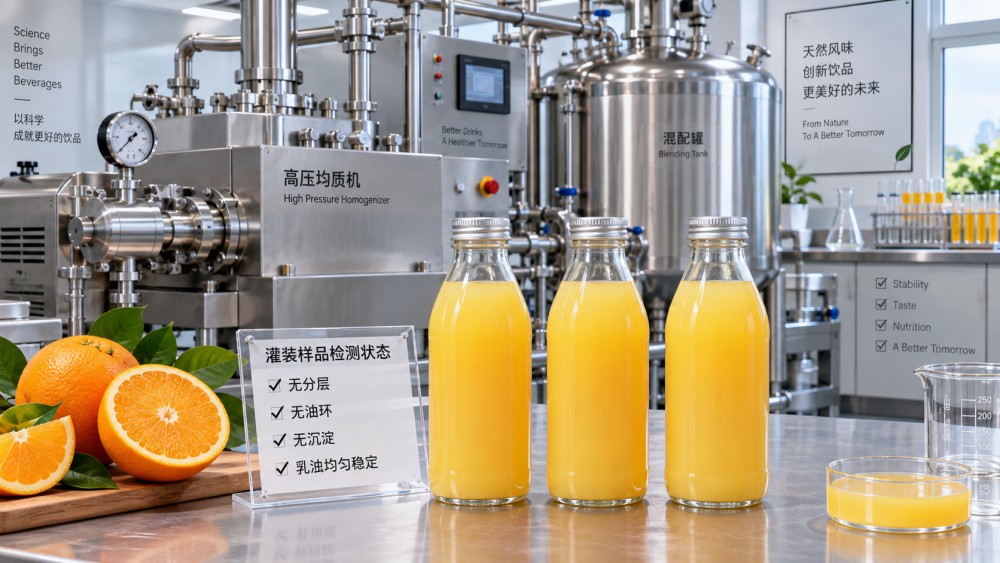
- Homogenize under defined conditions. The target is a reproducible droplet-size distribution, not merely a uniform-looking liquid. Record pressure, passes, feed temperature, and flow conditions.
- Make final adjustments after the emulsion is formed. Late acidification, mineral addition, or dilution can change interfacial conditions. Recheck pH and appearance after every meaningful adjustment.
This sequence is especially important when the beverage contains acids and hydrocolloids. Acidifying too early may reduce hydration performance for some stabilizers or create a difficult environment for certain emulsifiers. Conversely, delaying acid addition can be inappropriate when the system relies on final pH to establish the intended protein or preservative environment. The correct sequence must be validated for the exact ingredient package, not copied from an unrelated beverage.
Homogenization is not interchangeable with mixing
High-speed mixing can create a coarse dispersion, but stable beverage emulsions often require controlled high-pressure homogenization or another process capable of reducing droplet size consistently. Smaller droplets cream more slowly and offer less opportunity for visible oil separation, provided the emulsifier can rapidly cover the new surface area created during processing.
More energy is not automatically better. Excessive shear or repeated passes may heat the batch, drive off sensitive volatile notes, introduce air, or alter hydrocolloid structure. Insufficient energy leaves a broad droplet-size distribution in which the largest droplets rise and merge first. Process evaluation should therefore link homogenization settings to measurable product behavior: visual stability, particle-size trend, viscosity, foam, aroma retention, and behavior after thermal treatment.
Temperature matters because it changes oil viscosity, emulsifier mobility, and flavor volatility. A batch that homogenizes cleanly at one feed temperature may perform differently when production temperature drifts. Keep the process window narrow enough that scale-up can reproduce it. Documenting only a nominal pressure setting is rarely enough; the pre-emulsion quality, inlet temperature, and equipment condition influence the outcome as well.
pH, minerals, and preservatives can disrupt a previously stable system
Acid beverages are particularly prone to formulation surprises because pH affects charge, solubility, and hydrocolloid behavior. A flavor emulsion can remain visually stable near one pH and destabilize after a modest acid adjustment. Mineral-rich water, calcium fortification, electrolyte additions, and some preservation systems can further alter the continuous phase or compress electrostatic repulsion between droplets.
When separation appears only after a plant-water change, a new mineral premix, or a flavor reformulation, do not assume the emulsifier has failed on its own. Recreate the production water profile in the lab and test the actual addition point of minerals and acids. A formula based on deionized water may give misleadingly clean results compared with a production line using variable hardness.
pH measurement should be done after equilibration, not only immediately after acid addition. Buffered ingredients, hydrocolloid hydration, and dissolved solids can shift the final reading. Track pH alongside appearance rather than treating it as a separate quality-control number.
Storage stress reveals failures that a fresh sample hides
Freshly homogenized beverages often look stable because the emulsion has not had time to separate. Storage testing should reproduce the stresses that matter to the product: warm conditions, cooling cycles, expected shelf duration, shipping vibration where relevant, light exposure for transparent packaging, and post-opening use. Samples should be compared in their intended package whenever possible, since closures and bottle materials may absorb flavor components or create different oxygen exposure than laboratory containers.
Assess more than visible oil rings. Examine headspace aroma, color, cloud uniformity, sediment resuspendability, viscosity, and changes after inversion. A sediment that redistributes with a few gentle inversions may be acceptable in some beverage categories but unacceptable in others; that decision should be based on product positioning and consumer use conditions, not solely on whether the material is technically recoverable.
When a clean-label direction narrows the available tools
Clean-label objectives may limit certain emulsifiers, clouding systems, or stabilizers, but they do not remove the underlying physics of dispersion. The practical response is to reduce formulation burden before increasing process complexity. That can mean selecting a flavor with lower insoluble load, lowering oil-phase concentration, using a flavor already designed for the beverage’s pH range, or choosing a compatible natural hydrocolloid with predictable hydration behavior.
Natural-source ingredients may vary in composition more than highly standardized alternatives, so incoming-material specifications become more important. Monitor odor, color, moisture where relevant, viscosity or gel strength for hydrocolloids, and dispersion behavior under the same test conditions used during development. “Natural” should not be treated as a performance category; each material still needs a defined function and an acceptable variability range.
Questions that help narrow the next trial
Can increasing gum solve an oil ring?
It can slow creaming by increasing the viscosity of the water phase, but it cannot reliably repair coalescence caused by poor interfacial stabilization. If droplets are visibly merging, examine emulsifier compatibility, oil-phase composition, and homogenization before raising gum dosage.
Why does separation appear after heat treatment rather than before it?
Heating can change viscosity, accelerate droplet collisions, alter emulsifier behavior, volatilize part of the flavor profile, or expose weaknesses that were hidden in a fresh emulsion. Compare samples before and after the actual thermal process rather than relying on room-temperature bench appearance.
Should flavor be added before or after homogenization?
Oil-based flavor that must remain emulsified generally needs to be present before the homogenization step so droplet size can be reduced and stabilized. Water-soluble or highly volatile components may require a different addition strategy. The supplier’s format guidance and a controlled process trial should determine the final approach.
The strongest formulation tips are therefore diagnostic rather than generic: define the separation pattern, verify the flavor format, establish a compatible interface, control hydration and order of addition, and test the finished beverage through its actual thermal and storage stresses. Once those conditions are connected, separation becomes a traceable formulation and process issue instead of a recurring visual defect discovered after filling.
Related News
- When heat stable flavor formulations are needed for UHT beveragesOct 04, 2026Aromatics & Perfumery Fellow
- How heat stable flavor formulations prevent aroma loss in baked goodsOct 03, 2026Aromatics & Perfumery Fellow
- Using 4-vinyl guaiacol flavour standard to calibrate sensory panelsOct 02, 2026Aromatics & Perfumery Fellow
- Garlic Powder Flavor Profiles and Their Role in Seasoning BlendsSep 28, 2026Aromatics & Perfumery Fellow
Related News
- 00
0000-00
How to assess color stability from a natural food colors manufacturer - 00
0000-00
When does amino acid surfactant powder improve cleanser mildness? - 00
0000-00
How to verify a cosmetic nanotechnology supplier's safety documentation - 00
0000-00
How rheological thickeners for shampoo affect suspension stability - 00
0000-00
How to assess recombinant collagen ingredients for cream stability
Aromatics & Perfumery Fellow
Weekly Insights
Stay ahead with our curated technology reports delivered every Monday.