





How to Choose Flavor Enhancers for Snacks Without Overpowering Taste
Choosing flavor enhancers for snacks is not about making products louder.
It is about creating balanced impact, stability, and repeat appeal.
For snack developers, the real test is precision.
A strong enhancer can improve character at low use rates.
The same enhancer can also flatten base notes or leave an artificial finish.
That is why selecting flavor enhancers for snacks requires a formulation-first approach.
The decision should connect taste goals, matrix behavior, processing stress, label strategy, and cost control.
This matters even more as snack products move toward cleaner labels and tighter sensory expectations.
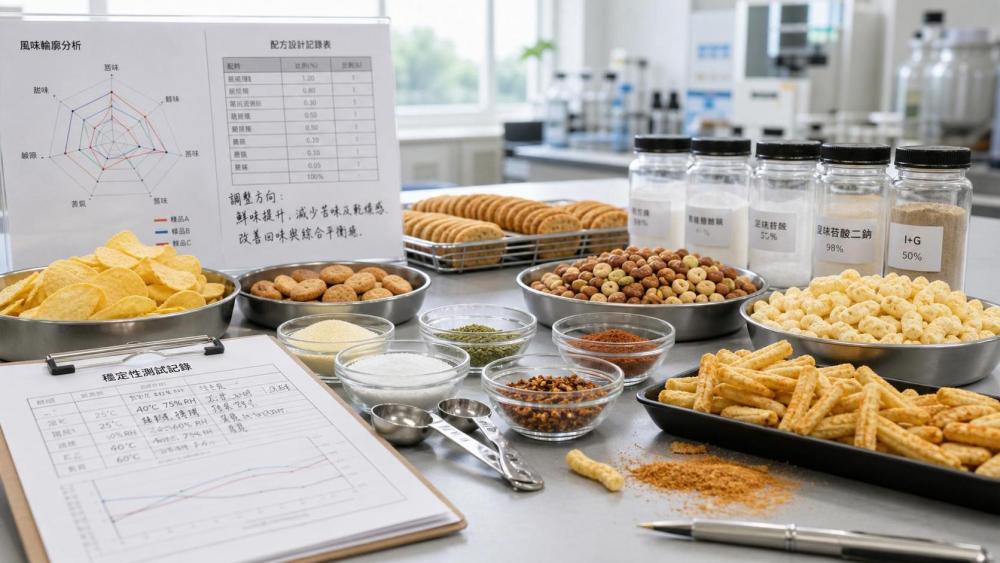
From a market intelligence view, subtle performance now wins over aggressive intensity.
Consumers want flavor that feels full, not forced.
So the best flavor enhancers for snacks should amplify identity, not dominate it.
Start with the Snack Matrix, Not the Ingredient List
A useful evaluation begins with the product format.
Potato chips, extruded corn snacks, baked crackers, coated nuts, and protein puffs behave very differently.
Oil level, salt content, moisture, surface seasoning, and heat exposure all influence enhancer performance.
In practical work, matrix mismatch causes more failure than weak raw materials.
For example, an enhancer that works well in a dry seasoning may fade after baking.
Another may bloom too strongly in a high-fat coating.
That is why flavor enhancers for snacks should be screened inside the final application system.
Bench tasting in water or neutral starch is only a starting point.
- Dry snacks need attention to surface adhesion and top-note release.
- Baked snacks need thermal stability and low off-note formation.
- Protein snacks need bitterness masking and savory balance.
- Reduced-salt snacks need body restoration and lingering taste support.
A strong choice comes from matching enhancer chemistry to product behavior.
Know Which Type of Enhancement You Actually Need
Not all flavor enhancers for snacks solve the same problem.
Some boost umami.
Some extend kokumi, improve mouthfulness, or soften rough edges.
Others lift specific taste directions such as cheese, meat, roasted notes, or sweetness perception.
This distinction matters because the wrong mode of enhancement often creates imbalance.
A useful screening framework looks like this.
- Define the sensory gap. Is the snack thin, dull, bitter, salty, or short-lived?
- Map the gap to function. Boost, round, mask, extend, or restore.
- Select candidates by mechanism, not by supplier claim alone.
- Test at minimum effective dose before exploring higher levels.
Common options include yeast extracts, nucleotide blends, amino acid systems, hydrolyzed vegetable proteins, and proprietary reaction flavors.
Natural extracts may also support snack seasoning depth.
However, a label-friendly option is not automatically a better sensory option.
The real question is whether the enhancer strengthens the intended flavor architecture.
Control Dosage Before You Judge Performance
Many teams reject promising flavor enhancers for snacks too early.
The issue is often overdosing during the first screening round.
Enhancers are rarely designed to perform like a primary flavor system.
They work best when they stay slightly behind the main taste profile.
This is where small increments matter.
A minor increase can shift a snack from rounded to muddy.
It can also increase lingering aftertaste or suppress signature top notes.
A practical protocol is to test three to five dosage points around the expected use level.
Use blind comparative tasting against a control and one commercial benchmark.
Then capture not only liking, but also directionality.
- Did the enhancer improve impact in the first bite?
- Did it support mid-palate fullness?
- Did it create a dry, metallic, or brothy tail?
- Did it reduce product identity?
This approach gives better decision data than simple preference ranking.
Check Processing Stability and Shelf-Life Behavior
An enhancer that tastes good on day one may still fail later.
Flavor enhancers for snacks must survive real manufacturing conditions.
These may include extrusion, frying, baking, seasoning drum exposure, and oxygen contact during storage.
Recent formulation shifts make this even more relevant.
Lower sodium, higher protein, and plant-based matrices can intensify instability and off-notes.
In evaluation, ask suppliers for more than a sample and a brochure.
Request data on heat tolerance, recommended point of addition, and interaction with fats, acids, and reducing sugars.
When possible, include accelerated shelf-life tasting in the selection cycle.
That single step often changes the shortlist.
Balance Label Strategy, Compliance, and Regional Expectations
Selection decisions are no longer based on taste alone.
Flavor enhancers for snacks now sit inside a wider compliance and positioning framework.
This includes ingredient declaration, clean-label claims, export requirements, and customer perception.
A technically effective enhancer may create unnecessary commercial friction if labeling becomes too complex.
That does not mean every project needs the most minimal label.
It means the label outcome should be intentional from the start.
This is especially important for global snack portfolios.
Regional rules and consumer tolerance for technical ingredient names can differ sharply.
A practical checklist should cover these points.
- Regulatory acceptance in target markets
- GRAS or equivalent status where applicable
- Allergen and dietary implications
- Consistency with natural or clean-label positioning
- Supplier traceability and specification control
For many teams, the winning option is not the strongest sensory sample.
It is the ingredient that offers the best balance of taste, compliance, and commercial flexibility.
Use a Shortlist Model That Reflects Real Buying Decisions
A final choice should be made through weighted comparison.
This is where many evaluations become more disciplined.
Instead of debating samples loosely, score the shortlisted flavor enhancers for snacks against fixed criteria.
Typical criteria include sensory fit, dosage efficiency, process stability, label impact, cost-in-use, and supply security.
Cost-in-use is especially important.
A higher-priced enhancer may still deliver better value if it works at a much lower dose.
It may also reduce the need for extra maskers or top-note correction.
In actual procurement cycles, that changes the economics quickly.
A simple scorecard can help.
- Set must-have criteria before supplier tasting.
- Eliminate samples that fail processing or labeling needs.
- Run side-by-side application trials at realistic dosage ranges.
- Compare full system cost, not ingredient price only.
- Validate final candidates in pilot production.
This method reduces the risk of choosing a sample that performs only in controlled lab conditions.
What a Good Final Choice Looks Like
The best flavor enhancers for snacks are usually hard to notice directly.
That is often the strongest signal of good selection.
A strong enhancer should make cheese taste more believable, barbecue more layered, and low-salt snacks less empty.
It should not announce itself as a separate taste event.
That also means the selection process should stay disciplined.
Define the target profile clearly.
Test flavor enhancers for snacks in the true matrix.
Measure dosage sensitivity, stability, labeling impact, and cost-in-use together.
When these factors align, the result is not just stronger taste.
It is a snack that feels complete, repeatable, and commercially ready.
The next practical step is simple: build a shortlist around matrix fit, then let sensory and stability data decide the winner.
Related News
- When heat stable flavor formulations are needed for UHT beveragesOct 04, 2026Aromatics & Perfumery Fellow
- How heat stable flavor formulations prevent aroma loss in baked goodsOct 03, 2026Aromatics & Perfumery Fellow
- Using 4-vinyl guaiacol flavour standard to calibrate sensory panelsOct 02, 2026Aromatics & Perfumery Fellow
- Garlic Powder Flavor Profiles and Their Role in Seasoning BlendsSep 28, 2026Aromatics & Perfumery Fellow
Related News
- 00
0000-00
What drives fragrance ingredients price changes in bulk orders? - 00
0000-00
How to assess a food antioxidants distributor’s traceability practices - 00
0000-00
How minimum order quantities shape private label ingredient sourcing costs - 00
0000-00
What drives personal care ingredient price volatility in sourcing - 00
0000-00
What drives micelles price differences in cosmetic formulations?
Aromatics & Perfumery Fellow
Weekly Insights
Stay ahead with our curated technology reports delivered every Monday.