





Choosing flavor formulation ingredients for bakery products is rarely a matter of aroma preference alone. In commercial baking, flavor must survive mixing, proofing, heat load, fat interaction, moisture migration, packaging, and storage without losing identity or creating off-notes.
That is why flavor formulation ingredients for bakery now sit at the intersection of sensory science, processing performance, compliance, and margin control. A good system supports product character on day one, but also behaves predictably after production, transport, and shelf life.
This matters even more in a market shaped by clean label pressure, global ingredient sourcing, and faster product refresh cycles. Across the broader FMCG landscape, FFAI tracks these formulation shifts closely, especially where flavor chemistry meets preservation, texture, and safety.
What bakery flavor selection really involves
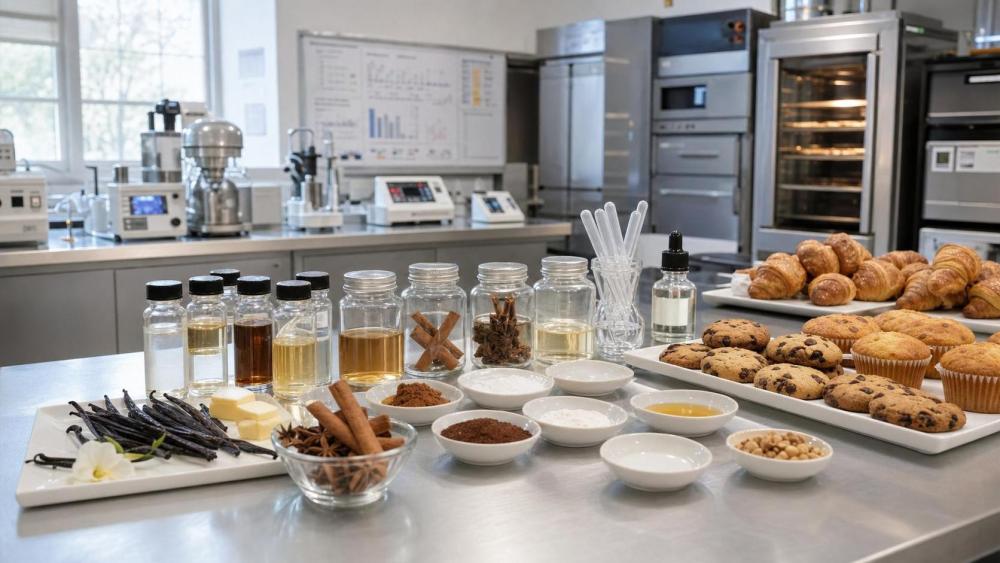
Bakery flavor systems are built for specific processing realities. A vanilla note for sandwich cookies does not behave like the same note in a frozen dough muffin or a low-sugar protein bar.
In practical terms, flavor formulation ingredients for bakery include core aromatic compounds, carriers, encapsulation materials, solvents, modulators, and sometimes supporting antioxidants that protect volatile molecules during thermal stress.
The target is not just aroma intensity. The target is controlled release, stable profile retention, and sensory fit with the product matrix. Sweet bakery, savory bakery, laminated dough, and filled formats all demand different formulation logic.
From an evaluation standpoint, flavor should be treated as part of the total formula architecture. It interacts with sugar, salt, lipids, proteins, leavening, humectants, and hydrocolloids, not as a decorative add-on.
Why the category is under closer scrutiny
The bakery sector is dealing with tighter claims management and higher sensory expectations at the same time. Products are expected to taste richer, label cleaner, and remain stable across longer supply chains.
That creates pressure on flavor formulation ingredients for bakery in several directions. Heat stability matters more. So does oxidation control, especially in fat-rich formats such as croissants, crackers, and filled biscuits.
FFAI’s broader ingredient perspective is useful here. Flavor outcomes are often linked to adjacent systems, including food-grade antioxidants, preservatives, and thickeners that influence moisture retention, aroma release, and shelf stability.
A cinnamon bun profile, for example, may fail not because the aromatic blend is weak, but because volatile top notes dissipate during baking or are masked by lipid oxidation later in storage.
More brands also want natural positioning. That does not automatically simplify formulation. Natural extracts can vary in strength, color, and thermal tolerance, which makes comparative evaluation more demanding.
Key technical criteria before approving a flavor system
The most reliable way to assess flavor formulation ingredients for bakery is to review them against processing, matrix, and market requirements at the same time.
A lower-cost flavor can become expensive if it needs higher dosage, creates variability, or fades early. Cost-in-use is usually the more honest metric.
Different bakery formats demand different ingredient logic
Not all bakery products stress flavor in the same way. Evaluations should be tied to actual product conditions rather than general flavor descriptions from a supplier sheet.
Cakes, muffins, and sweet batters
These systems often allow better flavor dispersion, but they still challenge volatile retention. Aeration, sugar level, and moisture distribution can soften top notes and alter sweetness perception.
Cookies, biscuits, and crackers
Lower moisture and higher fat create a different release profile. Brown notes, dairy notes, spices, and butter flavors may perform well, while delicate fruit notes often need protection or reinforcement.
Yeast-raised products
Proofing introduces time and biological activity. Some flavor compounds can shift during fermentation, while others are masked by yeast-driven aroma development or disappear during extended handling.
Filled and layered formats
Here the question is not only oven survival. Migration between crumb, filling, glaze, and fat phase can blur the intended profile over time, especially in warm distribution environments.
Where formulation choices often go wrong
Several recurring mistakes appear when selecting flavor formulation ingredients for bakery. Most are not dramatic failures at the bench stage. They appear later, during scale-up or shelf-life review.
- Approving a flavor from batter aroma instead of finished product aroma.
- Ignoring carrier effects on flowability, hydration, or dust control.
- Comparing natural and synthetic systems only by first-day sensory strength.
- Overlooking oxidation and preservative strategy in fat-rich baked goods.
- Using supplier dosage guidance without validating process-specific loss.
- Treating clean label positioning as a sensory guarantee.
A stronger review method links flavor trials to process mapping. That means checking performance after mixing, after baking, after packaging, and again at defined shelf-life intervals.
How broader ingredient systems influence bakery flavor performance
Flavor never works alone. In many bakery formulas, adjacent ingredients decide whether the aromatic system stays sharp, muted, warm, creamy, or stale over time.
Antioxidants can help protect sensitive flavor compounds and lipid phases from degradation. Preservatives affect shelf strategy, which indirectly affects how long the intended flavor profile must remain stable in market conditions.
Hydrocolloids and thickeners influence water mobility and mouthfeel, which changes flavor perception. A richer texture can increase perceived indulgence, while excessive gum systems may dull release.
This cross-functional view aligns with the way FFAI approaches ingredient intelligence. Flavor, preservation, rheology, and compliance are separate disciplines on paper, but tightly connected in real formulations.
A practical evaluation path for better decisions
A useful review process for flavor formulation ingredients for bakery usually starts with a narrower brief. Define the product matrix, processing temperatures, target shelf life, desired label position, and acceptable dosage range.
Then compare candidate systems in the finished baked product, not only in concentrate form. Keep variables controlled, and document aroma strength, note balance, aftertaste, and change over time.
It also helps to request deeper technical data from suppliers. Ask about carrier composition, encapsulation approach, thermal test conditions, regional regulatory status, and expected behavior in similar bakery matrices.
Where products move across regions, a compliance screen should happen early. GRAS status, allergen declarations, natural claim definitions, and local labeling rules can reshape the shortlist quickly.
The final decision should combine sensory fit, process robustness, and commercial realism. That is usually the point where bakery flavor selection becomes more repeatable and less dependent on subjective preference.
What to review next
For teams refining flavor formulation ingredients for bakery, the next step is to build a scorecard that reflects real operating priorities. Heat stability, release profile, label fit, shelf-life retention, and cost-in-use should be rated together.
That approach creates a better basis for supplier comparison and reformulation planning. It also makes it easier to connect flavor decisions with preservation, texture, and compliance strategy across the wider product portfolio.
In bakery, the strongest flavor system is rarely the loudest one. It is the one that reaches the consumer exactly as intended, after every step that tries to change it.
Related News
- When heat stable flavor formulations are needed for UHT beveragesOct 04, 2026Aromatics & Perfumery Fellow
- How heat stable flavor formulations prevent aroma loss in baked goodsOct 03, 2026Aromatics & Perfumery Fellow
- Using 4-vinyl guaiacol flavour standard to calibrate sensory panelsOct 02, 2026Aromatics & Perfumery Fellow
- Garlic Powder Flavor Profiles and Their Role in Seasoning BlendsSep 28, 2026Aromatics & Perfumery Fellow
Related News
- 00
0000-00
What drives fragrance ingredients price changes in bulk orders? - 00
0000-00
How to assess a food antioxidants distributor’s traceability practices - 00
0000-00
How minimum order quantities shape private label ingredient sourcing costs - 00
0000-00
What drives personal care ingredient price volatility in sourcing - 00
0000-00
What drives micelles price differences in cosmetic formulations?
Aromatics & Perfumery Fellow
Weekly Insights
Stay ahead with our curated technology reports delivered every Monday.