





Clean-label reformulation often starts with a simple idea: replace artificial flavor support with natural alternatives. In practice, evaluating plant-based flavor enhancers is less about a clean claim and more about performance inside a real formula, under real processing conditions, and within real cost limits.
That is why plant-based flavor enhancers have become a strategic topic across the broader FMCG landscape. They sit at the intersection of sensory science, ingredient compliance, processing stability, and commercial positioning, which also makes them highly relevant to FFAI’s focus on molecular interactions, formulation intelligence, and safe product development.
A useful evaluation framework should connect taste impact with label simplicity, regulatory fit, and manufacturing reality. When those dimensions are screened together, reformulation decisions become faster, more defensible, and less vulnerable to disappointing consumer response after launch.
What plant-based flavor enhancers actually do
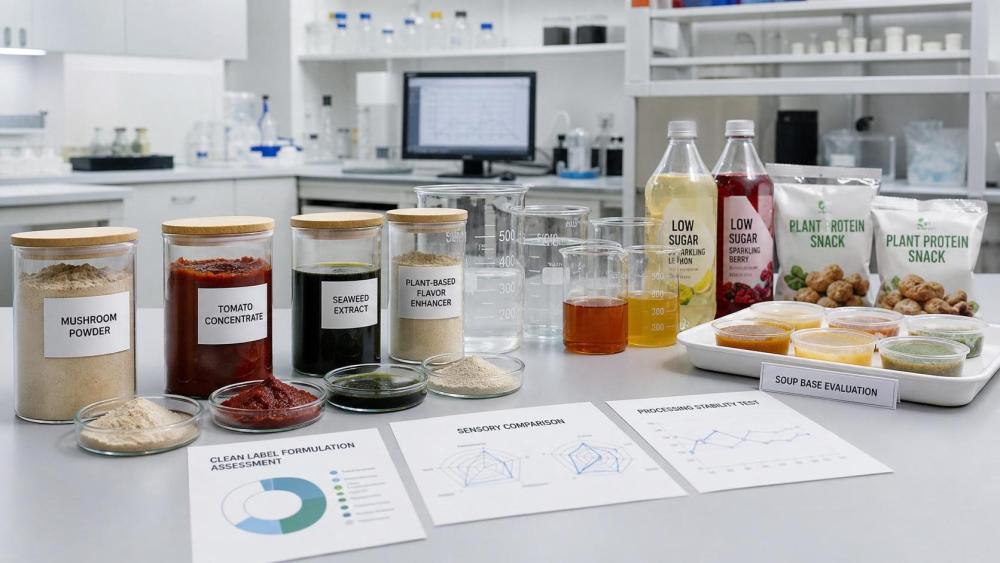
In most formulations, plant-based flavor enhancers do not function like direct flavors. They rarely replace a signature note by themselves.
Instead, they amplify, round, mask, deepen, or extend existing taste perception. Some boost savory depth. Others soften bitterness, reduce harsh edges, or improve the overall flavor release curve.
Common sources include yeast-free vegetable concentrates, mushroom derivatives, tomato fractions, seaweed extracts, fermented botanical materials, spice distillates, and naturally derived amino acid or nucleotide-rich systems from plants.
Their value becomes clearer in sodium reduction, sugar reduction, protein fortification, and preservative adjustment. In those situations, taste balance usually weakens, and a clean-label solution needs support beyond simple top-note flavoring.
Why the category matters now
The pressure behind clean-label reformulation is no longer limited to premium natural brands. Mainstream food and beverage lines now face the same demand for familiar ingredients, shorter labels, and better transparency.
At the same time, reformulators are dealing with more complex matrices. High-protein snacks, plant-based dairy alternatives, functional drinks, and low-sugar products all create off-notes that traditional flavor systems cannot always solve cleanly.
This is where the wider FFAI perspective matters. Flavor performance does not exist in isolation. Preservatives, antioxidants, thickeners, pigments, and process conditions all influence sensory output. A plant-based enhancer that works in a lab bench sample may fail after retort, freeze-thaw cycling, or extended shelf life.
More importantly, clean-label expectations vary by market. A plant-derived ingredient may be accepted in one region and questioned in another, depending on naming conventions, processing history, and local regulatory interpretation.
The first screen: define the sensory job clearly
A common reformulation mistake is evaluating plant-based flavor enhancers without defining the problem precisely. “Improve taste” is too broad to guide meaningful screening.
A better starting point is to identify the exact sensory task. That task usually falls into one or more of these areas:
- restore body after sodium reduction
- mask bitterness from proteins, vitamins, or botanicals
- enhance kokumi, umami, or mouth-coating depth
- reduce grassy, earthy, beany, or metallic notes
- improve flavor persistence in low-fat systems
Once the sensory target is defined, comparative testing becomes more objective. It also prevents strong ingredients from being rejected simply because they were tested against the wrong expectation.
Look beyond intensity
Intensity matters, but it is not enough. A strong enhancer may still perform poorly if onset is delayed, the finish feels muddy, or the aftertaste clashes with the product profile.
For that reason, sensory panels should assess timing, texture interaction, aftertaste length, and flavor authenticity, not just immediate impact.
How to compare candidates in a practical way
A shortlisting process works best when technical, sensory, and commercial criteria are reviewed together. The table below gives a practical structure.
This kind of comparison helps avoid overvaluing attractive supplier claims. Many plant-based flavor enhancers sound promising on paper, yet underperform once tested in the finished matrix.
Compatibility is often where reformulations succeed or fail
Ingredient compatibility is more complex than simple solubility. A plant-based enhancer may be technically dispersible and still create instability in sensory balance.
Hydrocolloids, for example, can change flavor release and linger time. Protein systems may bind volatile components or exaggerate earthy notes. Acidification can sharpen desirable brightness or expose unwanted bitterness.
This is especially important in categories influenced by FFAI’s broader intelligence areas, where texture, preservation, and aroma chemistry all intersect. Thickener choice, antioxidant strategy, and flavor enhancement should be reviewed as one system rather than separate workstreams.
Watch the processing window
Plant-based flavor enhancers can change significantly during manufacturing. Thermal treatment may flatten fresh notes. Oxidation may create cooked or stale impressions. Fermented plant fractions may intensify during storage.
Bench tasting is useful, but pilot validation is essential when products face UHT treatment, retort, spray drying, baking, or long ambient storage.
Regulatory fit and label language need early review
Clean-label reformulation can fail late if ingredient naming is reviewed too slowly. A plant source alone does not guarantee an acceptable declaration in every market.
Extraction method, processing aids, standardization approach, and intended function all affect regulatory interpretation. A candidate positioned as natural in one sales presentation may still create labeling friction during market entry.
This is where intelligence-led assessment becomes valuable. FFAI’s compliance lens reflects a practical reality: successful ingredient selection combines sensory science with documentation discipline, especially when export pathways involve FDA-aligned review, regional natural standards, or market-specific claim restrictions.
- Check whether the declared name supports the desired clean-label narrative.
- Confirm whether usage levels affect category-specific compliance.
- Review allergen, solvent, carrier, and residual processing details early.
- Match documentation quality to the markets targeted for launch.
Typical application patterns across product types
The most effective plant-based flavor enhancers are usually chosen by application logic rather than by broad natural positioning.
These patterns are useful starting points, but formulation context still determines success. The same material may perform well in a soup base and poorly in an acid beverage.
A realistic decision model for shortlisting
In actual development work, the most reliable approach is staged screening rather than one-round selection. That reduces both bias and rework.
A practical sequence often looks like this:
- start with a clear sensory defect map of the current formula
- screen plant-based flavor enhancers at low, mid, and high doses
- eliminate options with poor label fit or unstable supply
- validate survivors under real process conditions
- compare total reformulation economics, not ingredient price alone
The final choice should answer one commercial question: does the ingredient improve acceptance enough to justify its complexity, cost, and declaration outcome?
That question is especially relevant in categories where texture, preservation, aroma, and positioning all interact. A technically elegant solution is not always the best market solution.
Where to focus next
For teams assessing plant-based flavor enhancers, the next step is usually not a wider ingredient search. It is a sharper evaluation brief.
Clarify the target sensory gap, define acceptable label language, map process stress points, and set a cost-in-use threshold before expanding the candidate list.
From there, cross-check sensory findings with stability and compliance data. That integrated view reflects the same intelligence mindset that drives FFAI’s work across flavor systems, preservation chemistry, rheology, and premium formulation strategy.
When plant-based flavor enhancers are assessed through that broader lens, clean-label reformulation becomes less of a trend exercise and more of a disciplined route to better products.
Related News
- When heat stable flavor formulations are needed for UHT beveragesOct 04, 2026Aromatics & Perfumery Fellow
- How heat stable flavor formulations prevent aroma loss in baked goodsOct 03, 2026Aromatics & Perfumery Fellow
- Using 4-vinyl guaiacol flavour standard to calibrate sensory panelsOct 02, 2026Aromatics & Perfumery Fellow
- Garlic Powder Flavor Profiles and Their Role in Seasoning BlendsSep 28, 2026Aromatics & Perfumery Fellow
Related News
- 00
0000-00
Verifying halal status of hydrocolloid ingredients in the Middle East - 00
0000-00
How to interpret active matter on a surfactant specification sheet - 00
0000-00
What Quality Checks Should You Run on Fragrance Ingredient Suppliers? - 00
0000-00
How to assess a flavor chemistry manufacturer's batch consistency - 00
0000-00
What drives fragrance ingredients price changes in bulk orders?
Aromatics & Perfumery Fellow
Weekly Insights
Stay ahead with our curated technology reports delivered every Monday.