





Industrial Ingredient Applications for Beverages: Stability Issues and Fixes
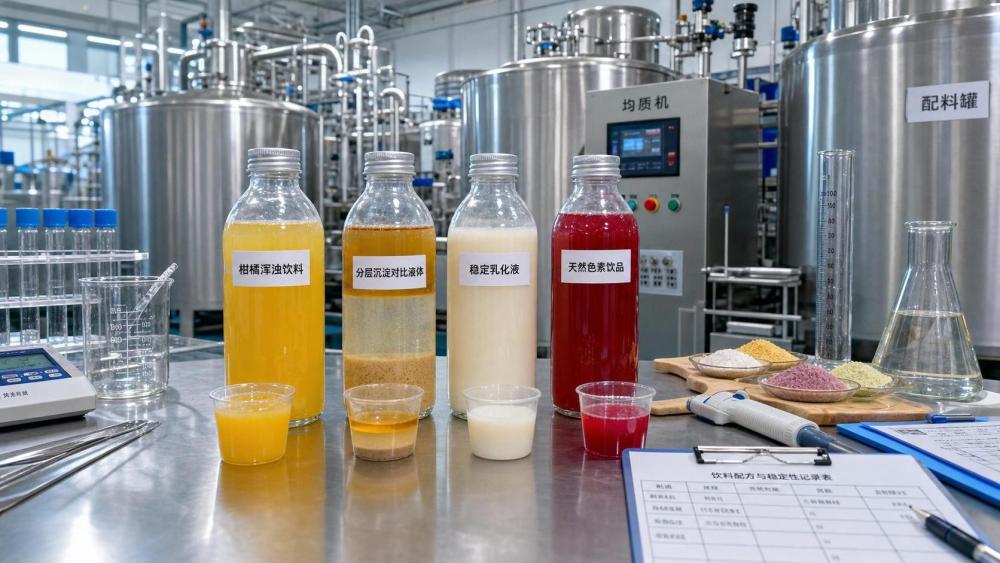
From cloud loss to flavor fade, beverage stability decides whether a formula survives real production and shelf life.
That is why industrial ingredient applications for beverages need more than a good bench sample.
They need ingredients that hold under heat, shear, pH shifts, oxygen, light, and filling conditions.
In practical beverage work, most failures appear slowly, then suddenly become customer complaints.
A drink may look clean on day one, then separate, fade, ring, or throw sediment after transport.
This guide focuses on industrial ingredient applications for beverages that solve those common stability problems.
The emphasis is simple: identify the failure mode, match the ingredient function, and adjust the process around it.
That approach usually delivers better consistency than changing everything at once.
Why Beverage Stability Breaks Down
Most beverage systems are physically simple but chemically busy.
Water, acids, sugars, oils, colors, minerals, flavors, and actives constantly interact during processing and storage.
Even a minor formula change can shift viscosity, emulsion droplet size, or flavor retention.
Recent product trends make this harder.
Clean label positioning reduces ingredient options.
Natural colors bring more light and pH sensitivity.
Plant proteins and fibers add turbidity, settling risk, and off-notes.
This means industrial ingredient applications for beverages must balance label goals with physical performance.
The Main Stress Points
- Thermal processing during pasteurization or hot fill
- Low pH in juices, sports drinks, and flavored waters
- Oxygen pickup during mixing and filling
- Light exposure in clear packaging
- Shear damage from pumps, homogenizers, and recirculation
- Mineral interactions in fortified beverages
Once the dominant stress point is clear, fixing the beverage becomes much faster and cheaper.
Sedimentation and Cloud Loss
Sedimentation is one of the most visible failures in industrial ingredient applications for beverages.
It often appears in juice drinks, botanical beverages, protein refreshers, and fortified functional products.
The root causes vary.
Particles may be too large, density may be too high, or viscosity may be too low.
Sometimes the issue is poor hydration of hydrocolloids rather than the hydrocolloid itself.
Practical Fixes
- Use xanthan gum or pectin at low dosage to build suspension without making the drink heavy.
- Control hydration order carefully. Dry blending with sugar often prevents fisheyes and poor dispersion.
- Reduce particle size through better milling or homogenization.
- Match the stabilizer to pH, calcium level, and expected shelf conditions.
- Check whether the process creates air, because foam can distort cloud evaluation.
In many industrial ingredient applications for beverages, cloud stability improves when viscosity is increased only slightly.
Over-thickening usually creates a second problem: poor drinkability.
A better target is controlled suspension with a clean mouthfeel.
Emulsion Separation in Flavor and Oil Systems
Flavor emulsions fail when droplet size grows, density balance shifts, or the interface becomes unstable.
This is common in citrus drinks, vitamin beverages, energy products, and cloudy soft drinks.
Typical warning signs include ringing, creaming, oiling off, and uneven opacity.
How to Stabilize the Emulsion
Select emulsifiers that fit both the oil phase and the final beverage conditions.
Gum arabic remains widely used because it supports flavor oil dispersion with relatively light texture impact.
Modified starch can help when stronger emulsion protection is needed.
Homogenization also matters.
If pressure is too low, droplets stay large.
If pressure is too aggressive, sensitive systems can destabilize later.
Industrial ingredient applications for beverages work best when ingredient selection and mechanical energy are tuned together.
Operator Checkpoints
- Measure droplet size before and after thermal treatment
- Review oil density and weighting strategy
- Confirm pH stability after flavor addition
- Test filled samples under transport vibration
Flavor Fade and Oxidative Damage
A beverage can remain physically stable and still fail in market because the flavor profile collapses.
Top notes disappear first.
Then oxidation creates stale, cooked, cardboard, or metallic notes.
This is where industrial ingredient applications for beverages rely heavily on antioxidants and process discipline.
What Usually Works
- Limit oxygen pickup during mixing, transfer, and filling.
- Use suitable antioxidants such as ascorbic acid where formula and compliance allow.
- Protect sensitive flavors with emulsion systems or encapsulated formats.
- Choose packaging with better oxygen and light barriers.
- Keep metal contamination low, since trace metals can accelerate oxidation.
In actual beverage operations, oxidation control often starts outside the formula.
Tank headspace, deaeration, and filler setup can matter as much as the antioxidant package.
Natural Color Instability
Natural colors support clean label demand, but they make industrial ingredient applications for beverages more delicate.
Anthocyanins shift with pH.
Curcumin is light sensitive.
Carotenoids can oxidize and fade during storage.
The result is often shade drift, ring formation, or complete color loss.
Fixes That Improve Color Hold
First, match the pigment to the beverage pH window rather than forcing a color to fit.
Second, reduce light exposure with suitable packaging choices.
Third, pair colors with antioxidants when oxidation is the main threat.
Fourth, confirm thermal tolerance during pasteurization trials, not just room-temperature storage.
These steps make industrial ingredient applications for beverages more reliable without overcomplicating the formula.
A Practical Selection Table for Common Beverage Issues
How to Troubleshoot Faster on the Plant Floor
The fastest way to improve industrial ingredient applications for beverages is to isolate variables in sequence.
Start with appearance, then move to flavor, then review process history.
- Check whether the defect is physical, chemical, or sensory.
- Compare fresh samples with heat-treated and aged samples.
- Review ingredient lot changes, hydration time, and mixing order.
- Measure pH, viscosity, particle size, and dissolved oxygen.
- Run a targeted pilot trial with one controlled adjustment.
This method avoids chasing symptoms.
It also creates records that help future beverage launches move faster.
Closing View
Strong industrial ingredient applications for beverages come from matching ingredient function with real process stress.
Stability problems rarely need dramatic reformulation first.
More often, they need sharper selection of thickeners, emulsifiers, antioxidants, or natural colors.
They also need tighter control of hydration, shear, oxygen, heat, and packaging.
When those pieces align, beverage formulas stay attractive, consistent, and commercially dependable across shelf life.
That is the practical value behind smarter industrial ingredient applications for beverages.
Related News
- When heat stable flavor formulations are needed for UHT beveragesOct 04, 2026Aromatics & Perfumery Fellow
- How heat stable flavor formulations prevent aroma loss in baked goodsOct 03, 2026Aromatics & Perfumery Fellow
- Using 4-vinyl guaiacol flavour standard to calibrate sensory panelsOct 02, 2026Aromatics & Perfumery Fellow
- Garlic Powder Flavor Profiles and Their Role in Seasoning BlendsSep 28, 2026Aromatics & Perfumery Fellow
Related News
- 00
0000-00
How to assess color stability from a natural food colors manufacturer - 00
0000-00
When does amino acid surfactant powder improve cleanser mildness? - 00
0000-00
How to verify a cosmetic nanotechnology supplier's safety documentation - 00
0000-00
How rheological thickeners for shampoo affect suspension stability - 00
0000-00
How to assess recombinant collagen ingredients for cream stability
Aromatics & Perfumery Fellow
Weekly Insights
Stay ahead with our curated technology reports delivered every Monday.