





In flavor-sensitive formulations, molecular sensory interactions decide whether aroma stays vivid or turns flat, harsh, or inconsistent during storage. Across food, fragrance, wellness, and beauty-linked products, flavor stability affects compliance, sensory acceptance, and brand credibility.
The biggest changes rarely come from one cause alone. Oxidation, heat, moisture, light, packaging migration, and matrix chemistry interact at the molecular level. Understanding these molecular sensory interactions helps reduce failures before they reach the shelf.
When shelf life is long, which molecular sensory interactions cause flavor collapse first?
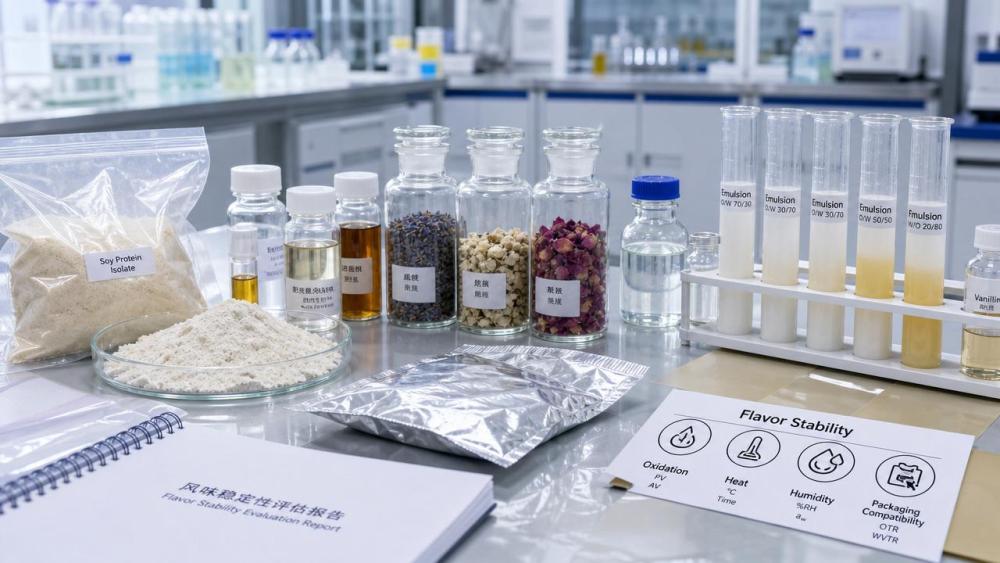
In long-distribution products, oxidation is usually the first destabilizer. Volatile aldehydes, esters, terpenes, and sulfur notes can react with oxygen, forming off-notes or losing top-note brightness.
These molecular sensory interactions become stronger when headspace oxygen, metal ions, and unsaturated lipids are present. A flavor may look chemically acceptable, yet sensory quality can still decline quickly.
Heat is the second major trigger. Processing, hot filling, drying, and transport spikes can accelerate hydrolysis, rearrangement, and evaporation. Delicate citrus, berry, dairy, and herbal profiles are especially vulnerable.
Moisture also shifts molecular sensory interactions. Water activity changes release rates, partition behavior, and hydrolytic stability. In powders, minor moisture gain may cause caking and rapid aroma loss.
In emulsions and complex matrices, what changes flavor stability most?
For beverages, dairy alternatives, sauces, and personal care formats with scent-taste crossover, the matrix often matters more than the flavor dose. Ingredients compete for the same molecules.
Proteins can bind aroma compounds and reduce immediate release. Hydrocolloids alter viscosity and diffusion. Oils retain hydrophobic notes. Sweeteners, acids, and salts reshape perception even when composition barely changes.
These are classic molecular sensory interactions. They explain why the same flavor performs differently in clear drinks, yogurt systems, gummies, baked fillings, and leave-on cosmetic bases.
Typical matrix-driven risk signals
- Top notes disappear after homogenization.
- Creamy notes become muted in high-protein systems.
- Acidified products show harsher aroma edges.
- Powder reconstitution reveals weaker flavor than fresh mix.
- Viscous systems delay release, then create uneven perception.
A useful rule is simple: if texture changes, release behavior changes too. That means rheology, fat content, emulsifier choice, and pH should be reviewed together, not separately.
For heat-processed products, when do molecular sensory interactions become irreversible?
Not all thermal damage appears during processing. Some flavor compounds survive heating but become unstable afterward. This delayed breakdown is common in baked goods, retort foods, and concentrated syrups.
Irreversible shifts usually happen when heat combines with oxygen, low pH, or trace metals. Once reaction pathways start, flavor recovery through late-stage adjustment becomes limited and expensive.
High-risk heat scenarios
- Baking above 180°C with exposed surface oils.
- Steam or retort treatment in acidic matrices.
- Spray drying without optimized carrier protection.
- Repeated warming and cooling during distribution.
In these cases, encapsulation, antioxidant pairing, metal control, and staged addition often outperform simple overflavoring. Adding more flavor rarely solves broken molecular sensory interactions.
When packaging is involved, what hidden factors distort flavor most?
Packaging is not inert. It can absorb aroma compounds, release migrants, or allow oxygen ingress. For high-value formulations, packaging-flavor compatibility must be tested as early as formula screening.
Scalping is a common issue. Polymer materials can absorb terpenes and other volatiles, weakening freshness. At the same time, residual monomers, inks, adhesives, or closures may introduce foreign notes.
These molecular sensory interactions are especially critical in citrus drinks, botanical waters, oral care products, and fragrance-adjacent applications where top-note clarity is essential.
Packaging checks that matter
- Oxygen transmission rate under real storage conditions.
- Light exposure through clear or tinted materials.
- Closure liner compatibility with volatile compounds.
- Migration risk from adhesives, labels, and inks.
- Flavor scalping during accelerated aging.
How do application scenarios change the answer?
The factor that changes flavor stability most depends on use conditions. Molecular sensory interactions behave differently across dry, liquid, fatty, acidic, and high-protein systems.
What practical adaptation strategy works best across scenarios?
A reliable program starts with mapping stress points from process to shelf. Molecular sensory interactions should be evaluated at formulation, processing, packaging, and storage stages.
Recommended stability workflow
- Define the most fragile sensory notes in the profile.
- Test under realistic heat, light, oxygen, and humidity stress.
- Check matrix interactions with proteins, lipids, acids, and thickeners.
- Screen packaging for migration, ingress, and scalping.
- Compare instrumental data with trained sensory results.
- Adjust formula and process together, not in isolation.
This cross-functional approach aligns with FFAI’s focus on linking molecular science, processing behavior, and compliance intelligence. It turns flavor stability from trial-and-error into a controlled design decision.
Which common misjudgments weaken flavor stability programs?
One mistake is blaming the flavor alone. In many failures, the formula matrix or package changed first, and flavor loss was only the visible symptom.
Another mistake is relying only on accelerated chemistry data. Sensory decline can appear before major analytical shifts. Molecular sensory interactions are about perception as much as structure.
A third mistake is treating oxygen control as sufficient. Light, humidity, metal contamination, and pH drift can still trigger instability even in low-oxygen systems.
Finally, late packaging validation creates avoidable risk. If compatibility testing starts after launch preparation, correction windows shrink and reformulation costs rise sharply.
What should happen next for better flavor decisions?
Start by identifying the single scenario where flavor drift causes the greatest commercial or compliance impact. Then rank stress factors by likelihood, not by assumption.
Build a short testing plan that reflects real distribution, real packaging, and real matrix composition. This is where molecular sensory interactions become measurable and actionable.
For organizations tracking food preservation, thickeners, flavors, essential oils, and active ingredients, a molecular view improves both product resilience and decision speed. The main question is not whether flavor changes, but which interaction changes it first.
When that answer is clear, stability design becomes more precise, cleaner-label strategies become more realistic, and shelf-life confidence becomes much easier to defend.
Related News
- When heat stable flavor formulations are needed for UHT beveragesOct 04, 2026Aromatics & Perfumery Fellow
- How heat stable flavor formulations prevent aroma loss in baked goodsOct 03, 2026Aromatics & Perfumery Fellow
- Using 4-vinyl guaiacol flavour standard to calibrate sensory panelsOct 02, 2026Aromatics & Perfumery Fellow
- Garlic Powder Flavor Profiles and Their Role in Seasoning BlendsSep 28, 2026Aromatics & Perfumery Fellow
Related News
- 00
0000-00
Verifying halal status of hydrocolloid ingredients in the Middle East - 00
0000-00
How to interpret active matter on a surfactant specification sheet - 00
0000-00
What Quality Checks Should You Run on Fragrance Ingredient Suppliers? - 00
0000-00
How to assess a flavor chemistry manufacturer's batch consistency - 00
0000-00
What drives fragrance ingredients price changes in bulk orders?
Aromatics & Perfumery Fellow
Weekly Insights
Stay ahead with our curated technology reports delivered every Monday.