





From June 1, 2026, a new import compliance requirement in Pakistan is set to affect exporters, buyers, and supply-chain teams dealing in food ingredients and related categories. The change follows an order issued by Pakistan’s Ministry of Commerce on April 28, 2026, and centers on a written declaration confirming that goods were produced without forced labor. For companies exporting food additives, natural colors, water-soluble flavors, and other ingredient categories to Pakistan, this is worth close attention because the rule reaches beyond customs paperwork and into supplier due diligence, client-facing compliance materials, and delivery preparation.
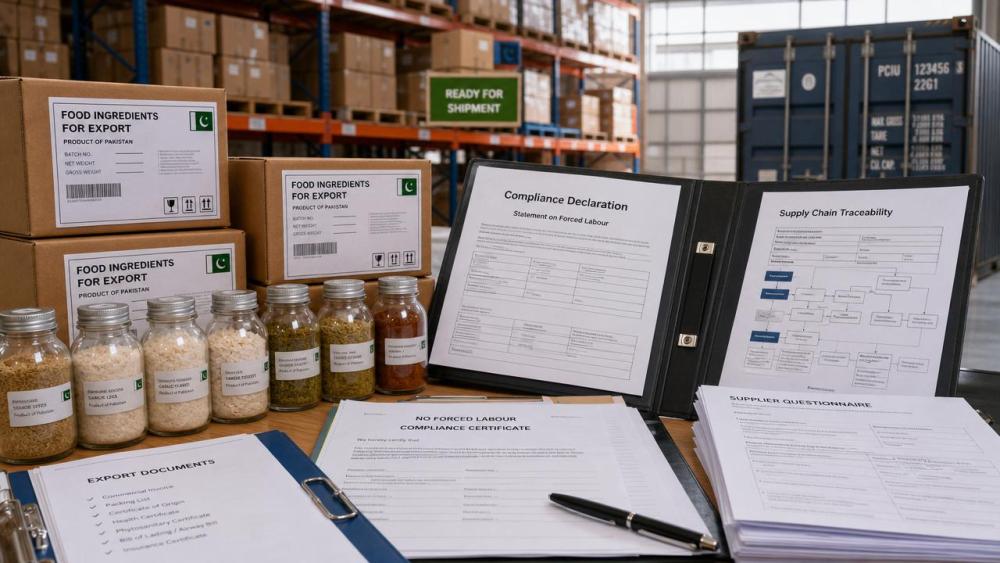
What the new import requirement confirms
According to the provided information, Pakistan’s Ministry of Commerce issued an order on April 28, 2026 requiring all imported goods, effective June 1, 2026, to be accompanied by written proof that no forced labor was involved throughout the production process.
The requirement covers ingredient categories including food additives, natural colors, and water-soluble flavors, and is described as applying across the full range of such ingredients.
For Chinese companies exporting to Pakistan, the provided summary states that supply-chain due diligence documents need to be updated in parallel and that verifiable ESG compliance declaration templates should be provided to overseas customers.
Where the practical pressure is likely to appear
Export documentation moves closer to supply-chain verification
From an industry perspective, exporters are likely to feel the impact first in document preparation rather than in product specification itself. The immediate pressure point is that a shipment-facing statement now has to be supported by internal supply-chain review, especially where multiple upstream suppliers contribute to one finished ingredient product.
Procurement teams may need tighter upstream file control
Analysis shows that procurement functions may be affected because the written proof required for import cannot be treated as a standalone sales document if upstream sourcing records are incomplete. What deserves closer attention is whether supplier declarations, traceability files, and due diligence materials are organized well enough to support a customer or import-side request without delaying shipment readiness.
Overseas buyers and channel partners may ask for clearer ESG materials
For importers, distributors, and customer-facing channel partners, the rule may translate into a higher expectation for verifiable ESG statements. The issue is not only whether a declaration exists, but whether the wording, supporting records, and supplier chain explanation can be reviewed and relied upon during trade and compliance checks.
Supply-chain service providers may face added coordination tasks
Observably, service providers involved in trade execution, document handling, and order coordination may need to pay closer attention to whether compliance statements are aligned with shipment files before cargo moves. Even where the rule itself is clear at a high level, operational friction can arise if exporters and customers use inconsistent document formats or timing.
What companies should review now
Refresh due diligence files for covered ingredient categories
Companies shipping food additives, natural colors, water-soluble flavors, and related ingredients to Pakistan should review whether their current supply-chain due diligence documents can support a written no-forced-labor declaration tied to actual production processes.
Prepare customer-facing declaration templates carefully
The provided information specifically points to the need for verifiable ESG compliance declaration templates for overseas customers. Analysis shows that businesses should focus on consistency between internal records and external statements, rather than treating the template as a generic form.
Track execution language and document expectations
Because the input does not provide more detailed implementation language, it is more appropriate to understand this as a rule change with immediate compliance relevance but with execution details still worth monitoring. Companies should therefore watch for how customers, import-side partners, and transaction documents begin to reflect the requirement.
Check delivery planning against compliance readiness
Where shipments are time-sensitive, exporters may need to confirm earlier in the order cycle that supporting files are available. Observably, the main risk is not necessarily product eligibility itself, but delays caused by incomplete declarations, mismatched supporting documents, or late-stage customer requests.
Why this looks like more than a routine paperwork update
Analysis shows that this development is best read as a compliance signal that links market access to supply-chain accountability. It does not change the product categories described in the input, but it does change the level of documentary assurance expected around how those products are made.
What deserves closer attention is that the requirement applies to all imported goods while also explicitly affecting ingredient exports such as food additives, natural colors, and water-soluble flavors. That makes it relevant not only to exporters, but also to sourcing, compliance, and commercial teams that prepare offers, shipment files, and customer declarations.
At the same time, the input does not provide detailed enforcement examples, review procedures, or standardized filing formats. For that reason, it is more appropriate to understand this as an already effective compliance threshold from June 1, 2026, while still recognizing that market practice and execution interpretation may continue to develop.
How this development is best understood now
In practical terms, this update points to a higher compliance threshold for companies exporting food ingredients and related products to Pakistan. The core issue is no longer limited to product shipment, but extends to whether businesses can substantiate their no-forced-labor statements with supply-chain due diligence materials and verifiable ESG declarations.
A neutral reading is that this is already a landed rule change for affected trade flows as of June 1, 2026, while the exact operating expectations around documentation and review may still require close observation. For industry participants, the most useful response at this stage is disciplined file preparation, clearer supplier-chain support, and continued monitoring of how the requirement is reflected in trade execution.
Basis of this article and points still to verify
This article is based on the user-provided title, event date, and event summary. For developments of this type, commonly relevant source categories may include official government notices, trade or customs authority releases, regulatory publications, industry association updates, standards-related documents, and reporting by established professional media.
No specific official source link was provided in the input, so the exact original publication link still needs to be verified on an ongoing basis. Observably, the areas that remain worth tracking include any further policy detail, implementation wording, certification or declaration expectations, changes in transaction or tender documents, industry feedback, and how exporting companies put the requirement into practice.
Related News
- When heat stable flavor formulations are needed for UHT beveragesOct 04, 2026Aromatics & Perfumery Fellow
- How heat stable flavor formulations prevent aroma loss in baked goodsOct 03, 2026Aromatics & Perfumery Fellow
- Using 4-vinyl guaiacol flavour standard to calibrate sensory panelsOct 02, 2026Aromatics & Perfumery Fellow
- Garlic Powder Flavor Profiles and Their Role in Seasoning BlendsSep 28, 2026Aromatics & Perfumery Fellow
Related News
- 00
0000-00
What drives fragrance ingredients price changes in bulk orders? - 00
0000-00
How to assess a food antioxidants distributor’s traceability practices - 00
0000-00
How minimum order quantities shape private label ingredient sourcing costs - 00
0000-00
What drives personal care ingredient price volatility in sourcing - 00
0000-00
What drives micelles price differences in cosmetic formulations?
Aromatics & Perfumery Fellow
Weekly Insights
Stay ahead with our curated technology reports delivered every Monday.