





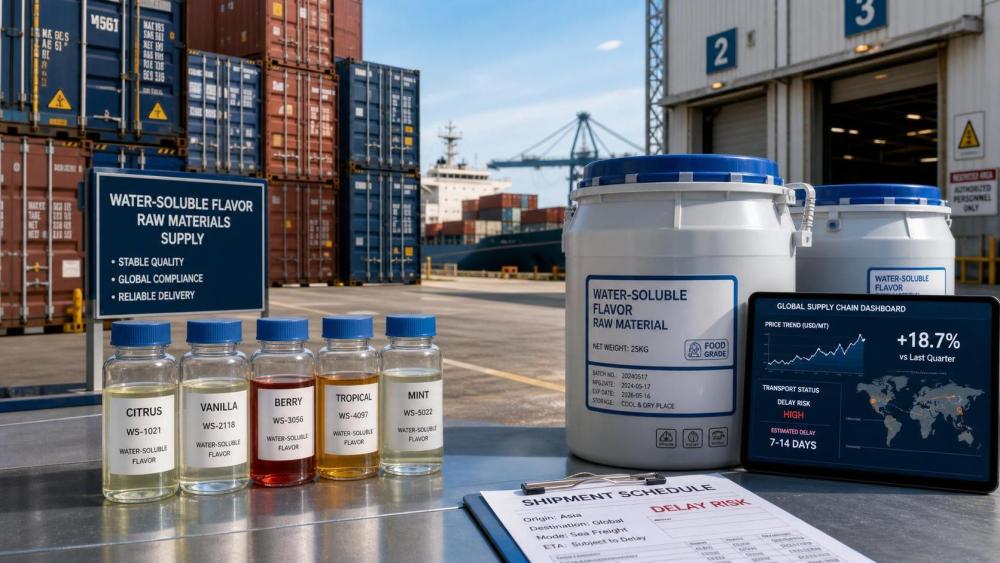
On June 28, 2026, a policy and logistics shift began to reshape the water-soluble flavors market: India started export quota controls on vanillin intermediates, while continued congestion on the Red Sea route pushed average container delays for Asia-Europe flavor shipments to 19 days. Against that backdrop, the ICIS Fragrance Index recorded a 12.3% weekly rise in the global Water-soluble Flavors composite quotation index on June 30. For buyers, exporters, processors, and supply chain operators, the issue is not only price volatility but also how trade controls and delivery disruption may affect procurement timing, supplier review, and fulfillment reliability.
What Has Been Confirmed So Far
According to ICIS Fragrance Index data dated June 30, 2026, the global Water-soluble Flavors composite quotation index rose 12.3% in a single week, marking the largest weekly increase since 2025. The stated drivers were two concurrent developments: India imposed export quota controls on vanillin intermediates starting June 28, and persistent congestion on the Red Sea route extended the average port dwell time for Asia-Europe flavor containers to 19 days. The input also confirms that food and beverage brands in Europe and the United States have already started second-tier supplier replacement assessments.
Where The Pressure May Appear Across The Chain
Buyers facing tighter raw material visibility
From an industry perspective, procurement teams may be affected first because the reported price jump is linked directly to both export controls and shipping delays. The practical pressure point is likely to be raw material planning, especially where vanillin-related inputs influence formulation cost or sourcing continuity. What deserves closer attention is whether existing purchase arrangements, supplier documentation, and delivery commitments remain aligned with the new trade-control environment.
Manufacturers balancing formulation continuity and delivery schedules
For processors and manufacturers using water-soluble flavors, the main exposure may appear in production scheduling and order fulfillment. A longer transit cycle can disrupt inbound timing even before any formal shortage is confirmed. Analysis shows that manufacturers should pay closer attention to lead-time assumptions, batch planning, and any internal quality or technical review needed when evaluating substitute suppliers already being considered by downstream brands.
Export and logistics operators managing documentation and transit risk
Supply chain service providers and export-facing traders may be affected through shipment predictability and document coordination. When export quota controls are part of the market context, the operational focus often shifts to whether cargo allocation, customs documentation, booking timelines, and handover schedules still match customer commitments. In the current case, the confirmed 19-day average dwell time on Asia-Europe flavor containers indicates that delivery risk is now part of the commercial discussion, not only the freight discussion.
Brand owners reviewing supplier structure
The confirmed start of second-tier supplier replacement assessments by food and beverage brands in Europe and the United States suggests that supplier qualification may become a more active issue. Observably, this does not yet prove a broad change in approved supplier lists, but it does indicate that procurement and compliance teams are testing resilience beyond direct suppliers. That can affect technical file review, quality traceability expectations, and the timing of commercial decisions tied to ingredient continuity.
What Companies Should Watch Next
Track the operating scope of the quota measure
Analysis shows that the most immediate point to monitor is how the export quota control on vanillin intermediates is applied in practice. The input confirms the start date of the measure, but it does not provide further execution detail. Companies should therefore keep reviewing subsequent official wording, trade administration updates, and any changes that clarify coverage, documentation requirements, or shipment handling.
Recheck procurement and delivery assumptions
With the reported weekly price increase and longer Asia-Europe dwell times, firms should revisit purchasing cadence, delivery buffers, and contract timing assumptions. This is not yet evidence of a uniform supply interruption, but it is a clear signal that previous lead-time expectations may no longer hold under current routing conditions.
Prepare supplier review materials carefully
Because downstream brands have started second-tier supplier replacement assessments, companies involved in flavor production or supply should be ready for closer review of supplier qualification materials. What deserves closer attention is not only price competitiveness but also whether technical documents, quality records, and traceability materials can support faster substitution discussions if customers accelerate contingency planning.
Watch for changes in customer-side requirements
Observably, when buyers begin replacement assessments during a period of trade control and shipping delay, customer requirements can shift before formal market stabilization appears. Firms should therefore monitor tender documents, purchase specifications, and delivery clauses for signs of tighter timing expectations, broader supplier screening, or additional requests tied to continuity assurance.
How This Signal Should Be Read
Analysis shows that this development is better understood as an active execution signal rather than a purely theoretical market concern. One part of the event is already a rule change: export quota controls on vanillin intermediates started on June 28. The other part is an ongoing logistics constraint that is already affecting transit time. At the same time, it would be premature to treat the event as a fully settled long-term supply pattern, because the input does not yet provide further detail on implementation scope, duration, or downstream compliance responses.
From an industry perspective, the stronger message is that rule changes and logistics disruption are now interacting directly. That interaction matters because it can move risk from headline pricing into day-to-day execution, including supplier review, purchase timing, shipment planning, and customer communication.
What The Market Can Reasonably Take From This
The current price jump in water-soluble flavors should be read as more than a short-term quotation event. It reflects the immediate effect of a confirmed trade-control measure combined with continued transport congestion, both of which can influence procurement discipline and delivery management across the flavor chain. It is more appropriate to understand this as a live market and compliance signal that has already entered execution, while many practical details still require continued observation.
Basis Of This Article And What Still Needs Verification
This article is based on the user-provided news title, event date, and event summary. For developments of this kind, commonly relevant source types may include official announcements, releases from regulatory or trade authorities, customs or trade administration information, industry association updates, standard-setting documents, and reporting from authoritative industry media. A specific official source link was not provided in the input, so the underlying official references still need ongoing verification. Further observation should focus on detailed policy implementation, compliance interpretation, procurement document changes, supplier review practice, market feedback, and actual execution by affected companies.
Related News
- When heat stable flavor formulations are needed for UHT beveragesOct 04, 2026Aromatics & Perfumery Fellow
- How heat stable flavor formulations prevent aroma loss in baked goodsOct 03, 2026Aromatics & Perfumery Fellow
- Using 4-vinyl guaiacol flavour standard to calibrate sensory panelsOct 02, 2026Aromatics & Perfumery Fellow
- Garlic Powder Flavor Profiles and Their Role in Seasoning BlendsSep 28, 2026Aromatics & Perfumery Fellow
Related News
- 00
0000-00
What drives fragrance ingredients price changes in bulk orders? - 00
0000-00
How to assess a food antioxidants distributor’s traceability practices - 00
0000-00
How minimum order quantities shape private label ingredient sourcing costs - 00
0000-00
What drives personal care ingredient price volatility in sourcing - 00
0000-00
What drives micelles price differences in cosmetic formulations?
Aromatics & Perfumery Fellow
Weekly Insights
Stay ahead with our curated technology reports delivered every Monday.