





Start with the failure mode, not the flavor name
In powder flavor delivery systems, aroma loss during mixing is rarely caused by one dramatic mistake. It usually comes from a chain of smaller decisions: a porous carrier that binds the wrong molecules too tightly, a blender that runs longer than needed, a warm plant environment, or a premix that pulls in moisture before it ever reaches final packaging. For technical evaluators, the practical question is not simply “does this powder flavor fade?” It is where the loss begins, what mechanism is driving it, and whether the process can be controlled without damaging throughput or sensory consistency.
When you review a blend line, treat flavor loss as a checklist problem. Volatilization, adsorption, oxidation, moisture pickup, and mechanical damage do not show up the same way in production. Some losses hit the top notes first. Some flatten the whole profile. Others only appear after storage because the mixing step weakened the system and the package had no margin left.
Check whether the carrier is protecting aroma or stealing it
A large share of mixing-related flavor loss starts with the carrier matrix. In powder flavor delivery systems, carriers such as maltodextrin, gum systems, starches, sugars, and modified carbohydrates are supposed to hold volatile compounds in a usable form. But the same structure that protects flavor can also trap certain molecules unevenly or release them too early under shear, heat, or humidity.
What to look for:
- Does the powder contain a high surface area carrier that leaves a lot of aroma exposed rather than embedded?
- Is the flavor loaded onto a carrier with strong affinity for some notes but weak retention for others?
- Does the particle size distribution create too much fines content, increasing exposed surface and dust loss?
A common evaluation mistake is to approve a carrier based on assay or initial aroma impact alone. That misses the real issue. A powder can smell strong out of the bag and still lose its top-note balance during blending because the light volatiles are sitting near the particle surface. If the supplier provides encapsulation or carrier composition details, compare them against the intended mixing intensity and downstream thermal load, not just the flavor type.
Measure heat rise inside the mixer, not just room temperature
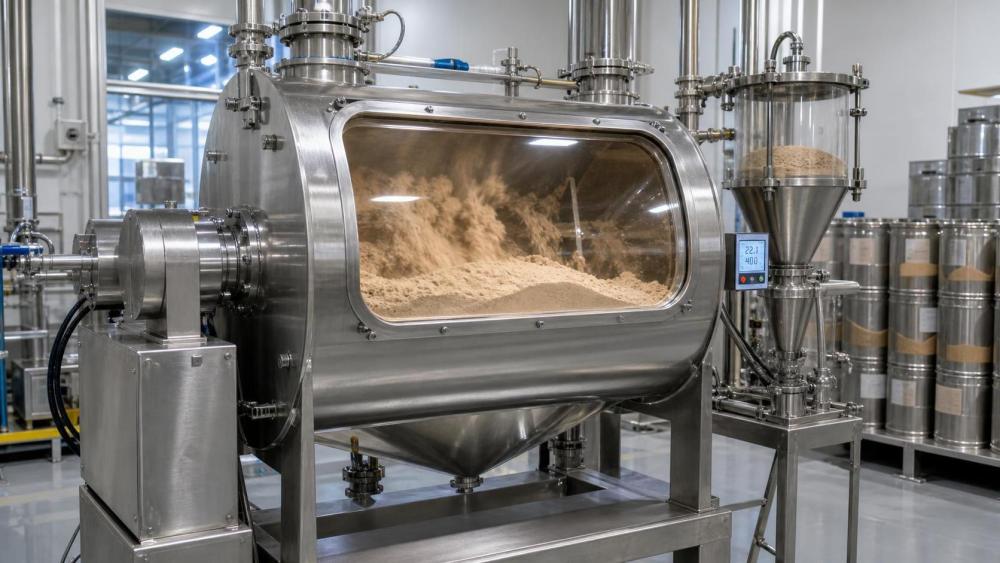
Flavor loss often gets blamed on “temperature” in a vague way, but evaluators need to separate ambient conditions from actual product heating. Frictional heat generated by ribbons, paddles, plows, or high-speed intensifiers can locally raise product temperature enough to drive off volatile compounds, even when the room itself looks acceptable.
This matters most for citrus, mint, coffee, dairy, and other profiles with delicate top notes. A short excursion can be enough to shift the aroma balance. You may not see a mass loss large enough to trigger concern on paper, but the sensory impact will show up immediately in side-by-side evaluation.
The useful check is simple: record powder temperature before loading, at discharge, and, if possible, near the point of highest shear. If discharge temperature consistently rises during normal runs, the flavor system is being stressed whether or not caking is visible. The next step is usually to reduce residence time, lower agitator speed, change fill level, or move flavor addition later in the sequence.
Do not confuse longer mixing with better uniformity
Overmixing is one of the easiest ways to lose flavor while believing you are improving quality. Once the flavor powder is adequately distributed, extra time mainly adds mechanical stress, air exposure, and heat. In some systems it also increases segregation risk because fines migrate differently from the base powder.
A technical review should ask for the actual endpoint logic. Is the operation using a validated mixing time tied to blend uniformity data, or is the line simply running a standard cycle for every product? Powder flavor delivery systems rarely behave identically across formulas. Salt, sugar, protein, acids, hydrocolloids, and fat-containing powders all change flow and contact behavior.
If a flavor fades during scale-up but not in lab batches, excessive residence time is a prime suspect. Larger equipment often needs more time to achieve distribution, yet that same time can strip volatiles unless the addition point and mixing sequence are adjusted.
Review the order of addition before blaming the flavor house
The point at which a flavor enters the blend has a direct effect on retention. If it is charged early and then exposed to every subsequent dry ingredient addition, especially abrasive or hygroscopic materials, flavor loss becomes much more likely. This is one of those issues that gets missed because the formulation itself looks unchanged.
Good practice is to ask three questions:
- Is the flavor added before or after heavy bulk ingredients are fully moving?
- Does it contact acids, salts, or reactive minors at high local concentration before dispersion?
- Is there an intensifier bar or chopper that hits the flavor directly?
If the answer to any of these is yes, the sequence is worth reworking. In many plants, simply delaying flavor addition until the bulk bed is established cuts aroma loss without any reformulation. The gain comes from shorter exposure and gentler distribution.
Treat moisture as a release trigger, not just a caking issue
Moisture is one of the most underestimated causes of flavor degradation in dry blending. Evaluators often look for visible clumps and stop there. The more relevant problem is that moisture plasticizes the carrier, opens the structure, and accelerates release or reaction of volatile compounds. Even modest humidity exposure during staging or charging can start that process.
Powder flavor delivery systems that contain spray-dried or encapsulated oils are particularly sensitive. Once the matrix takes up water, some aroma molecules migrate faster to the surface. That raises immediate volatilization risk during mixing and weakens storage stability later.
When the process is moisture-sensitive, the right check is not a generic warning. Review storage condition records, packaging integrity of the flavor itself, open-bag exposure time, and whether hygroscopic components are charged before the flavor.
Look for adsorption onto other powders in the formula
Not all flavor loss is evaporation. Some aroma compounds get adsorbed onto the surfaces of other ingredients and become less available for release when the product is used. Proteins, fibers, starches, silica-containing flow aids, and certain mineral salts can all alter aroma expression. In a blended powder, that may show up as lower headspace intensity even if the total flavor load is theoretically unchanged.
This is where technical evaluation needs a little skepticism. If a new base ingredient is introduced and flavor performance drops, do not jump straight to “the flavor is weaker.” Check whether the matrix has changed the binding behavior. A reformulation that improves flowability or nutrition can easily flatten aroma release if the interactions were not screened in the final dry system.
Watch for oxidation when air incorporation increases
Many flavor compounds are vulnerable not only to heat but also to oxygen exposure during mixing. This is more pronounced in systems carrying essential oils or unsaturated aroma components. High-speed blending, repeated transfers, and dusty pneumatic movement increase surface renewal and oxygen contact. The damage may not be obvious at discharge. It often appears later as duller aroma, off-notes, or faster shelf-life decline.
A practical check is to compare process steps, not just ingredients. Does the product go through one blender or several transfers? Is the flavor premixed separately and then conveyed again? Are there dust collection points pulling volatile-rich fines away from the batch? These details matter because flavor loss in powder delivery systems often sits at the interface between mixing and material handling.
Check whether particle breakage is exposing encapsulated oil
Encapsulated flavor powders are only as stable as the shell remains intact. Aggressive mixing tools, high compression in feeders, and repeated recycling of fines can fracture particles and expose core oil to air. Once that happens, losses accelerate. You may see oiling, sticking, or dust changes, but sometimes the only clue is a sharper aroma at the mixer followed by weak finished-product performance.
If you suspect shell damage, compare sieve profile before and after mixing and inspect whether the fines fraction increases. Also review whether the flavor was designed for the chosen equipment. A powder built for gentle ribbon blending may not survive a more aggressive plow or high-shear setup with the same retention.
Separate mixing loss from packaging and storage loss
One of the more expensive mistakes in troubleshooting is blaming the blend step for everything. Sometimes mixing only creates the initial damage, and packaging finishes the job. If the powder leaves the mixer with a slightly weakened flavor matrix and then sits in a package with poor barrier properties or too much headspace, the later decline gets attributed to the wrong stage.
For technical evaluation, this means sampling at more than one point: incoming flavor powder, discharge blend, post-packing product, and retained storage samples. Without that sequence, it is hard to tell whether the root cause is volatilization during mixing, oxidation after filling, or moisture ingress during warehousing.
Use a tighter review sequence when qualifying suppliers or processes
When comparing powder flavor delivery systems, the most reliable approach is a short, disciplined qualification path rather than a broad sensory discussion.
- Review carrier composition and intended protection mechanism.
- Map the real mixing profile: equipment type, speed, fill level, time, and discharge temperature.
- Check formula interactions, especially hygroscopic materials, proteins, fibers, salts, and acids.
- Verify the order of addition and any high-shear contact points.
- Compare aroma at incoming, post-mix, and post-pack stages rather than relying on one finished sample.
That sequence usually tells you where the loss begins. If the aroma drops immediately after blending, focus on heat, shear, and exposure time. If the profile looks acceptable after blending but fades rapidly later, the blend step may have weakened the carrier while packaging or storage finished the degradation.
The useful rule is straightforward: in powder flavor delivery systems, flavor loss during mixing is usually a process-ingredient interaction, not an isolated raw material defect. Evaluate the carrier, the mixer, the order of addition, the moisture path, and the contact surfaces as one system. That is how you decide whether the fix belongs in sourcing, formulation, or line operation.
Related News
- When heat stable flavor formulations are needed for UHT beveragesOct 04, 2026Aromatics & Perfumery Fellow
- How heat stable flavor formulations prevent aroma loss in baked goodsOct 03, 2026Aromatics & Perfumery Fellow
- Using 4-vinyl guaiacol flavour standard to calibrate sensory panelsOct 02, 2026Aromatics & Perfumery Fellow
- Garlic Powder Flavor Profiles and Their Role in Seasoning BlendsSep 28, 2026Aromatics & Perfumery Fellow
Related News
- 00
0000-00
What drives personal care ingredient price volatility in sourcing - 00
0000-00
What drives micelles price differences in cosmetic formulations? - 00
0000-00
How to assess color stability from a natural food colors manufacturer - 00
0000-00
When does amino acid surfactant powder improve cleanser mildness? - 00
0000-00
How to verify a cosmetic nanotechnology supplier's safety documentation
Aromatics & Perfumery Fellow
Weekly Insights
Stay ahead with our curated technology reports delivered every Monday.