





Start with the cost question that actually matters
When buyers compare quotes for water-soluble flavors, the usual mistake is treating flavor formulation ingredients price as a single number problem. It rarely is. Two samples may both be labeled strawberry, mango, vanilla, or coffee, yet the cost gap can come from completely different causes: the aroma source, the carrier system, the required purity, how the flavor behaves in the finished drink, and how much technical work went into making it stay stable in water.
If you are buying for beverages, syrups, powdered drink mixes, dairy drinks, or functional products, price only makes sense after you know what you are paying for. A lower unit price can become the expensive option when dosage rises, flavor fades in storage, or the formula fails in a hot-fill or acidic system. The better buying approach is to check price driver by price driver, in the same order that formulation risk shows up on the factory floor.
Check what the flavor is actually built from
The first pricing split is basic but easy to miss: is the flavor based mainly on commodity aroma chemicals, natural isolates, extracts, essential oil fractions, or a mixed system? Water-soluble flavors often look similar on a quotation sheet, but their raw material architecture can be very different.
Natural raw materials usually cost more because yield is lower, seasonal variation is real, and standardization takes work. An extract with a recognizable top note may also need cleanup, concentration, or blending support before it works in water. Synthetic components can be more cost-efficient and more consistent lot to lot, especially when the target is a stable profile rather than a “from-source” story.
- Ask for the flavor type description, not just the flavor name.
- Check whether the quoted material is extract-heavy, isolate-heavy, or mostly compounded from aroma chemicals.
- Watch for “natural” requests added late in the sourcing process. That single specification change can move price quickly.
If marketing needs a natural positioning, procurement should know that this is not just a label issue. It changes sourcing complexity and usually narrows the supplier pool.
Do not compare price before checking dosage
This is where many quote comparisons go wrong. One supplier may offer a lower kilogram price but require a higher use level to hit the same sensory target. In water-soluble systems, concentration and performance efficiency matter more than the headline number.
A practical buying check is to compare projected cost-in-use, not only cost per kilogram. If one flavor runs at 0.08% and another at 0.15%, the cheaper drum may not be cheaper in production. This gets even more important in products where sweetness, acidity, and functional actives suppress aroma expression.
Ask suppliers to quote against a defined application brief: beverage base, pH range, sugar or sweetener system, process condition, and target dosage window. Without that, price comparisons are mostly noise.
Look at the solubility system, not just the flavor character
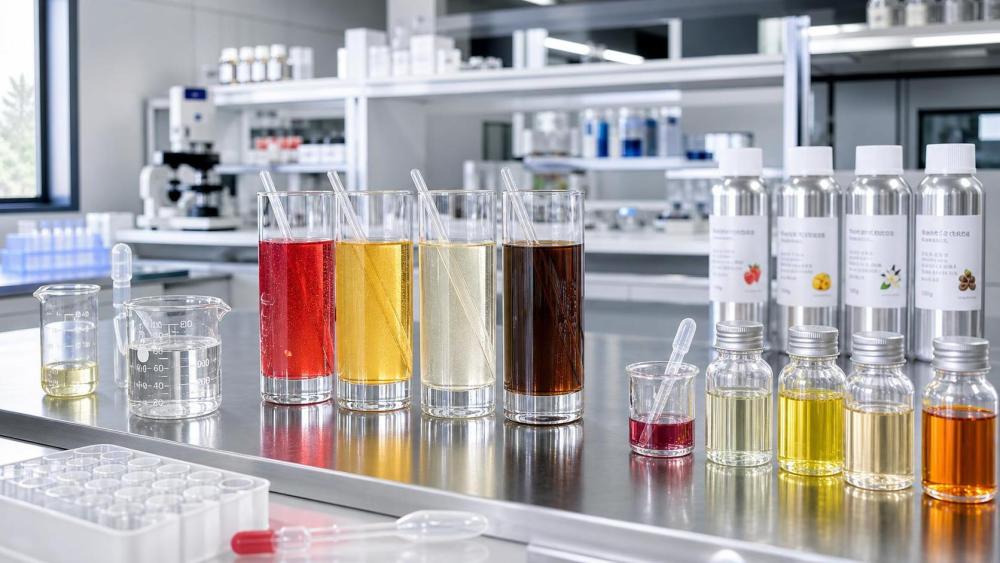
Water-soluble flavors carry their own formulation burden. Some aromatic compounds are not naturally comfortable in water, so the supplier has to make them workable through solvents, emulsification systems, or other compatible carriers. That technical step affects both price and downstream risk.
A quote can rise because the flavor needs a more refined carrier choice, tighter dispersion control, or extra work to prevent ring formation, haze, separation, or top-note loss. For procurement, the question is simple: what is the supplier doing so this flavor remains stable in your specific water-based application?
- Check whether the flavor is intended for clear beverages, cloudy drinks, dairy systems, or powders reconstituted in water.
- Ask what carrier system is used and whether it affects label acceptance in your target market.
- Request stability observations under your actual process condition rather than generic “water-soluble” claims.
The more demanding the application, the more formulation work sits behind the price.
Price usually climbs with sensory precision
Broad, candy-like profiles are generally easier to build than flavor systems that need realistic top notes, clean mid-palate behavior, and a controlled finish. If the brief says “freshly squeezed,” “peeled zest,” “roasted,” “creamy without heaviness,” or “no cooked note after processing,” that usually means more formulation complexity.
This matters in procurement because buyers often receive a low-priced sample that seems acceptable in a quick bench test, then fails when the product is chilled, diluted, sweetened differently, or stored. Better sensory accuracy takes more balancing work and often more expensive ingredients.
A useful check is to separate “good enough for internal screening” from “good enough for final launch.” Those are not priced the same, and pretending they are usually causes re-sourcing later.
Stability requirements can change the price more than buyers expect
Water-soluble flavors are often asked to survive hostile conditions: low pH, heat treatment, light exposure, oxygen, sweetener interactions, minerals, and long shelf life. Each extra condition narrows the pool of workable materials.
Some aroma components are fragile. If the finished product goes through pasteurization, hot fill, or extended ambient storage, the supplier may need to rebuild the formula around more robust components or compensate for expected flavor loss. That can increase cost even when the flavor profile sounds simple on paper.
Do not buy a stable flavor based on a generic certificate alone. Buy it based on its behavior in your product format.
Regulatory fit is a price driver, especially across markets
The same flavor concept may be quoted differently depending on destination market and labeling target. Procurement teams sourcing for more than one region should expect cost differences when the supplier has to meet market-specific composition rules, documentation needs, or label constraints.
The right check is not “is this compliant?” in the abstract. It is: compliant for what product category, sold where, with what declaration strategy? Ask for the specification sheet, allergen statement where relevant, and the document set that supports use in the intended market. When a flavor must fit both technical and commercial label goals, the usable formulation space gets smaller, and price often reflects that.
Supply chain risk is often hidden inside the quote
A surprising amount of flavor formulation ingredients price comes from supply security, not chemistry alone. Materials linked to agricultural harvests, essential oil availability, energy-intensive processing, or single-region sourcing can move sharply. A stable quote may simply mean the supplier has already built risk cost into the number.
Buyers should ask a few blunt questions early:
- Which key materials are most exposed to crop, climate, or geopolitical disruption?
- Are there approved substitutes inside the formula, or does any shortage force reformulation?
- Is the lead time driven by local stock, made-to-order blending, or imported components?
A slightly higher price with better continuity can be the safer buy for core SKUs. Cheap flavor that goes unavailable at the wrong moment is rarely cheap.
Minimum order quantity and pack size can distort the real cost
This is a practical issue, but it affects total spend more often than people admit. Specialty water-soluble flavors may have higher prices partly because demand is lower, production runs are shorter, and inventory handling is less efficient. If your volume is modest, MOQ and drum configuration can outweigh a small difference in quoted unit price.
Check how much you actually need during qualification, launch, and steady production. If the supplier only offers pack sizes that overshoot your usage, aging inventory becomes part of the purchase cost. This is especially relevant for profiles with shorter commercial life or fast-moving seasonal demand.
Technical service is not free, and sometimes it should not be
A low price may assume you are buying a standard item with minimal support. A higher quote may include reformulation rounds, matching work, application adjustment, or troubleshooting in a difficult matrix. In water-soluble systems, that support can save time and prevent repeated pilot failures.
If your project brief is straightforward, paying extra for heavy development support may not make sense. But when the product has processing stress, label restrictions, or a narrow sensory target, technical service is part of the economic picture. Procurement should clarify whether the quote covers an off-the-shelf flavor or active formulation work.
A quick buyer checklist before you approve a quote
- Define the application clearly: product type, pH, sweetener system, process, shelf-life target, and visual requirement.
- Compare cost-in-use, not just price per kilogram.
- Check whether the formula depends on natural extracts, specialty isolates, or standard aroma chemicals.
- Review carrier and solubility design for compatibility with your product and label needs.
- Ask for performance evidence in a matrix close to your own.
- Check documentation against the intended market and product category.
- Assess supply resilience, MOQ, and lead time before locking in a “good” price.
That is usually enough to expose why one water-soluble flavor quote is higher than another. More importantly, it helps you tell the difference between justified cost and avoidable cost.
Use sequence, not instinct, when buying
A reliable buying sequence is simple. Lock the application brief first. Screen for regulatory fit and matrix compatibility next. Compare dosage and stability after that. Only then should you negotiate flavor formulation ingredients price. Doing it in reverse usually rewards the quote that looks cheapest before the technical realities show up.
For procurement teams, the goal is not to buy the lowest-priced flavor drum. It is to buy a water-soluble flavor that lands at the right sensory result, survives the process, fits the label plan, and stays commercially workable over time. That is the price conversation worth having.
Related News
- When heat stable flavor formulations are needed for UHT beveragesOct 04, 2026Aromatics & Perfumery Fellow
- How heat stable flavor formulations prevent aroma loss in baked goodsOct 03, 2026Aromatics & Perfumery Fellow
- Using 4-vinyl guaiacol flavour standard to calibrate sensory panelsOct 02, 2026Aromatics & Perfumery Fellow
- Garlic Powder Flavor Profiles and Their Role in Seasoning BlendsSep 28, 2026Aromatics & Perfumery Fellow
Related News
- 00
0000-00
Verifying halal status of hydrocolloid ingredients in the Middle East - 00
0000-00
How to interpret active matter on a surfactant specification sheet - 00
0000-00
What Quality Checks Should You Run on Fragrance Ingredient Suppliers? - 00
0000-00
How to assess a flavor chemistry manufacturer's batch consistency - 00
0000-00
What drives fragrance ingredients price changes in bulk orders?
Aromatics & Perfumery Fellow
Weekly Insights
Stay ahead with our curated technology reports delivered every Monday.