





On May 12, 2026, South Korea’s Ministry of Food and Drug Safety (MFDS) revised its labeling guidance for health functional foods, adding clearer disclosure expectations for decaffeinated products. The change is worth close attention from importers, ingredient suppliers, processors, and sourcing teams because it links decaffeination claims more directly to process transparency, solvent residue disclosure, and flavor retention communication. For businesses serving the Korean market, the update also points to a more practical sourcing question: whether decaf-related flavor systems and natural preservation solutions can be prepared and supplied in a coordinated way.
What the MFDS revision explicitly changes
According to the information provided, the MFDS updated the health functional food labeling guidance on May 12, 2026. Under the revised approach, decaffeinated products must state which decaffeination method was used, including supercritical CO₂, solvent-based processing, or water washing. The guidance also requires disclosure tied to residual solvent limits and encourages the use of a “natural flavor retention rate” label.
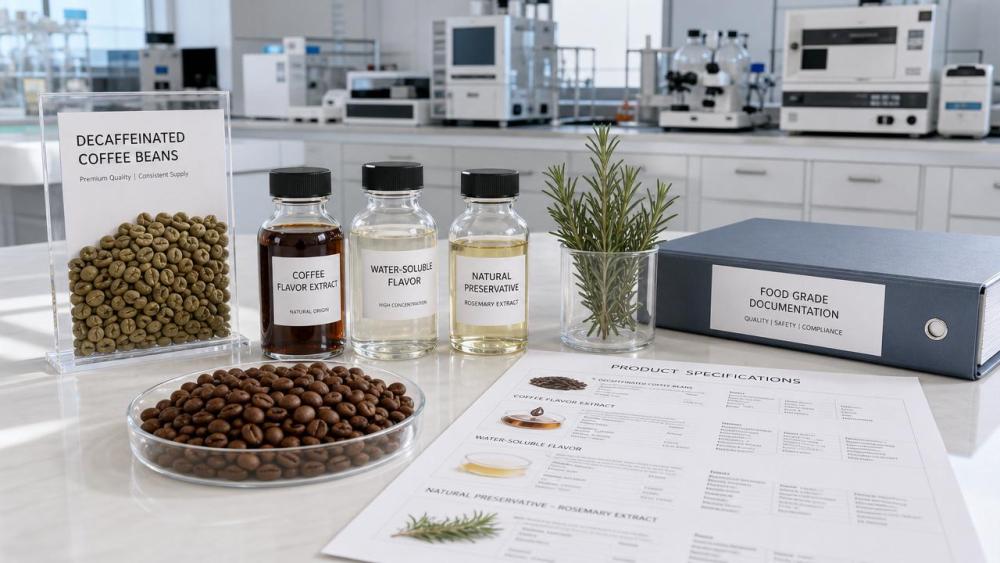
The same information indicates that this revision is expected to strengthen one-stop sourcing demand among Korean importers for China-origin supporting ingredients, especially supercritical essential oils, water-soluble flavors, and natural preservatives such as natamycin and rosemary extract.
Why the impact extends beyond label text
Import and trading businesses face a more documentation-heavy buying process
From an industry perspective, importers and trading firms may feel the effect first because the revised labeling expectations make process-related information more commercially relevant at the point of purchase. The likely impact is not limited to the final package text; it also reaches product specification sheets, supplier declarations, and communication with downstream buyers. What deserves closer attention is whether suppliers can provide decaffeination-method descriptions and residue-related materials in a form that supports Korean market use.
Flavor and ingredient suppliers may need more coordinated product offers
Analysis shows that suppliers of supercritical essential oils and water-soluble flavors could receive more inquiries where flavor performance is discussed together with decaffeination method and flavor retention messaging. This does not confirm a fixed procurement outcome, but it does suggest that ingredient offers tied only to a single product line may be less practical than coordinated proposals that address flavor recovery, solubility, and labeling support together.
Natural preservative providers may be drawn into the same sourcing conversation
Observably, the mention of natamycin and rosemary extract alongside flavor materials points to a broader purchasing pattern rather than an isolated label revision. For preservative suppliers and related service providers, the issue to watch is whether Korean buyers increasingly prefer bundled sourcing discussions that cover both sensory stability and cleaner supporting ingredient choices for decaf applications.
Processors and downstream users may need closer alignment with sourcing teams
For manufacturers and end-use product developers, the impact may emerge in reformulation review, ingredient selection, and supplier qualification. If a product’s market communication places more emphasis on process type and flavor retention, technical teams and procurement teams may need tighter coordination on which material sets are suitable for the Korean market.
What companies should watch now
How official wording is applied in practice
Analysis shows that the immediate business question is not only what the guidance says, but how market participants interpret the required process disclosure and residual solvent limit presentation in day-to-day documentation and labeling workflows. Companies involved in Korea-bound business should continue monitoring any further official wording or implementation clarification.
Whether product files are ready for customer review
For suppliers and exporters, a practical point is document readiness. Buyers may place greater value on materials that already organize decaffeination method descriptions, residue-related information, and flavor-related claims in a consistent file set. The distinction between policy language and customer acceptance in actual procurement is likely to matter here.
Which categories are most exposed to combined sourcing requests
What deserves closer attention is the intersection between decaf positioning and supporting ingredients. Businesses handling supercritical essential oils, water-soluble flavors, natamycin, or rosemary extract may need to assess whether inquiries increasingly shift from single-item requests to package-style sourcing discussions that combine flavor, stability, and compliance communication needs.
How supplier communication and delivery planning may need to adjust
Observably, if Korean importers look for one-stop procurement, supplier response speed, specification consistency, and delivery coordination may become more important in customer communication. This is less about broad strategy language and more about whether exporters can support a smoother handoff across sourcing, compliance review, and order execution.
How this signal should be read at this stage
This section is an editorial observation. It is more appropriate to understand this development as a targeted regulatory and commercial signal rather than a fully settled market outcome. The confirmed fact is the labeling revision and the associated emphasis on decaffeination method disclosure, residual solvent limits, and encouraged flavor-retention labeling. The broader industry implication is that transparency in decaf processing may now shape adjacent ingredient demand more directly than before.
At the same time, the expected increase in one-stop sourcing demand should still be treated as an emerging business direction, not a completed result. Continued attention is warranted because procurement behavior, supplier qualification standards, and labeling practice may not move at the same speed.
What this means for the market right now
In practical terms, this update matters because it connects a labeling revision with sourcing behavior in related ingredient categories. For companies active in decaf-related supply chains, the issue is not simply whether Korea changed wording requirements, but whether those requirements begin to reshape how flavor systems, preservation solutions, and compliance materials are purchased together. At this stage, the development is best understood as a near-term operational signal with possible longer-term supply chain implications, while further market follow-through still needs to be observed.
Basis of this article and what still needs verification
This article is based on the user-provided news title, event date, and event summary. Typical source types for this kind of update may include official notices, company statements, industry association materials, authoritative media coverage, and standards-related documents. A specific official source link was not provided in the input, so the exact source document should be continuously verified in follow-up review. The main areas that still merit observation are any further official clarification, how labeling expectations are applied in practice, and whether one-stop sourcing demand becomes visible in real procurement activity.
Related News
- Which essential oil applications suit sensitive skincare formulas?Sep 28, 2026Aromatics & Perfumery Fellow
- Essential Oil Extracts Price: What Drives Cost Differences in 2026Jul 12, 2026Aromatics & Perfumery Fellow
- Supercritical Essential Oil Applications: Best Uses by Product TypeJul 10, 2026Aromatics & Perfumery Fellow
- Ningbo Tightens CO₂ Extract Shipping DeclarationsJul 09, 2026Aromatics & Perfumery Fellow
Related News
- 00
0000-00
What drives fragrance ingredients price changes in bulk orders? - 00
0000-00
How to assess a food antioxidants distributor’s traceability practices - 00
0000-00
How minimum order quantities shape private label ingredient sourcing costs - 00
0000-00
What drives personal care ingredient price volatility in sourcing - 00
0000-00
What drives micelles price differences in cosmetic formulations?
Aromatics & Perfumery Fellow
Weekly Insights
Stay ahead with our curated technology reports delivered every Monday.