





On 10 July 2026, Ningbo Port began applying a new hazardous goods declaration requirement to shipments of supercritical CO₂-extracted essential oils, shifting attention from routine export paperwork to whether exporters can provide complete UN classification support before departure. For suppliers, traders, logistics providers, and overseas buyers relying on lavender, eucalyptus, tea tree, and similar products, the issue is not only documentation completeness but also the risk that missing technical records could interrupt customs handling, delay delivery windows, and add reclassification costs.
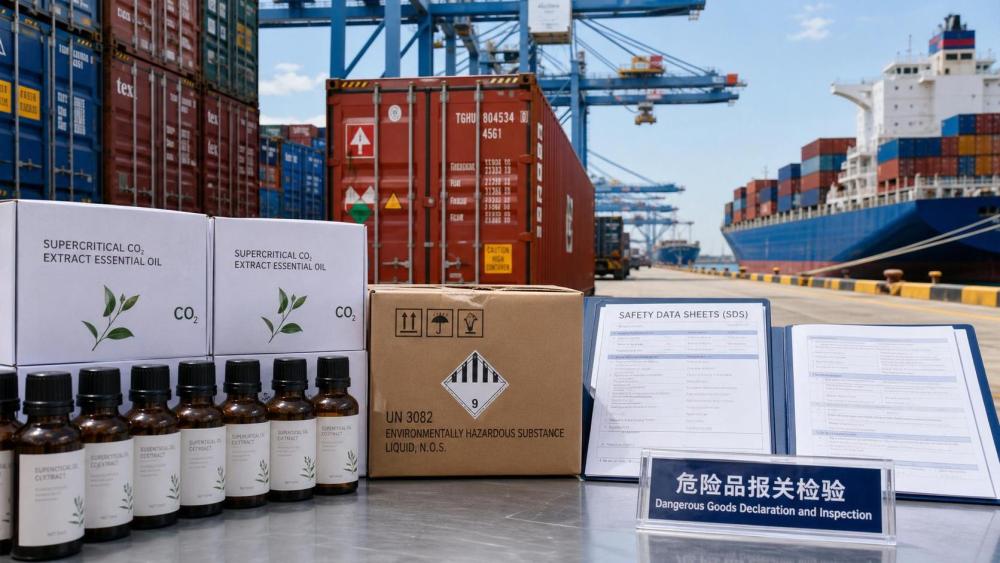
What the new filing requirement covers
The confirmed change is that Ningbo Customs now requires full UN classification documentation for all shipments of supercritical CO₂-extracted essential oils departing after 10 July. The required materials include flash point information, autoignition temperature data, and test reports corresponding to Sections 9 and 10 of the SDS.
The rule applies to products specifically described as supercritical CO₂-extracted essential oils, with examples including lavender, eucalyptus, and tea tree. For consignments that do not meet the documentation requirement, the stated consequence is a 72-hour detention period together with reclassification fees.
The event summary also indicates that this is already affecting just-in-time deliveries to fragrance houses in the EU and the US. Beyond that, no further official detail has been provided in the input on documentation format, review procedure, or any product-by-product exceptions.
Where the pressure is likely to appear first
Export scheduling may become more document-dependent
From an industry perspective, exporters and direct trading companies are the first group exposed to the change because the new requirement applies at the point of departure. Their immediate risk is that a shipment prepared for export may still be held if the supporting UN classification package is incomplete. What deserves closer attention is the shift in timing: document readiness now matters before cargo leaves, not after a question is raised during transit.
Procurement and order fulfillment may need wider lead-time buffers
For procurement teams and overseas buyers, the potential impact lies in delivery planning rather than only product availability. If a consignment faces a 72-hour detention or reclassification fees, just-in-time replenishment becomes harder to maintain. Companies buying these oils for downstream fragrance production may therefore need to watch not just price and volume, but whether suppliers can consistently provide the required hazard documentation set.
Logistics and customs handling teams face a tighter compliance interface
Supply chain service providers, including freight and customs handling teams, may feel the effect through document review and cargo handover coordination. Analysis shows that the operational issue is not simply whether a product can be shipped, but whether the file submitted for shipment contains the technical elements now expected by customs. In practical terms, missing test data or incomplete SDS-related support could become a handoff problem between shipper, laboratory, document team, and port-side operator.
Testing and compliance support functions may come under closer scrutiny
Certification, testing, and compliance support organizations are also relevant because the requirement explicitly references flash point, autoignition temperature, and SDS Sections 9 and 10 test reports. Observably, companies that rely on external technical documentation support may need to verify whether existing files are complete and current enough for shipment use, rather than assuming older product dossiers will still be accepted without challenge.
What companies should watch in the next stage
Check whether existing product files are shipment-ready
Companies handling supercritical CO₂-extracted essential oils should first review whether their current UN classification records contain the specific elements now named in the requirement. The practical focus is not broad compliance language, but whether flash point data, autoignition temperature data, and SDS Section 9-10 test support can be presented in a usable form for export clearance.
Reassess delivery commitments tied to tight replenishment cycles
Where orders are linked to fixed production slots or short delivery windows, businesses should pay closer attention to the possibility of detention and reclassification. Analysis shows that even a limited hold period can matter when shipments are aligned to just-in-time schedules, especially for cross-border fragrance supply arrangements. This does not confirm a universal delay pattern, but it does indicate a need to review buffer time in export and procurement planning.
Monitor how the rule is described and applied in practice
The input confirms the documentation requirement and the consequence for non-compliance, but it does not provide fuller detail on review standards or operational interpretation. For that reason, companies should continue watching for clearer official wording, execution criteria, and any follow-on clarification affecting document scope, filing expectations, or treatment of individual consignments.
Pay closer attention to supplier qualification and traceable records
For buyers and supply chain managers, another practical point is supplier readiness. What deserves closer attention is whether suppliers can provide traceable technical records early enough in the shipment process to avoid last-minute disruption. This is especially relevant where procurement teams depend on repeated exports of the same oil types and may otherwise assume prior shipment experience is sufficient.
How this change is best understood for now
Observably, this development is better understood as an active execution signal rather than a distant policy discussion, because an effective date has been stated and non-compliant consignments are described as facing detention and reclassification fees. At the same time, it is not yet a fully transparent rule set in the material provided here, since the input does not include a full official notice, procedural detail, or broader implementation guidance.
From an industry perspective, the significance lies in how a hazardous goods filing requirement can move from being a technical compliance item to a direct delivery risk for essential oil exports. The immediate lesson is not that trade flow has been fundamentally rewritten, but that technical classification support is now closer to the center of shipment readiness for the affected product category.
A practical reading of the July 10 requirement
In summary, the Ningbo Port change matters because it links export release for supercritical CO₂-extracted essential oils to a more explicit set of UN classification documents. For affected businesses, the main issue is less about headline policy change and more about whether internal files, supplier support, and shipment timing are aligned with the new customs expectation.
It is more appropriate to understand this as a rule already entering execution, while still requiring continued observation on how consistently it is applied and how market participants adjust their document preparation, order scheduling, and delivery commitments around it.
Basis of this article and points still requiring verification
This article is based on the user-provided news title, event date, and event summary. In reporting on this type of development, commonly relevant source categories would include official notices, releases from regulatory authorities, customs or trade administration information, industry association updates, standard-setting documents, and reporting from authoritative trade media.
No specific official source link was provided in the input, so the exact official publication path remains to be verified on an ongoing basis. Further observation is still needed on possible policy detail, execution standards, document interpretation, tender or purchasing document changes, market feedback, and how affected companies implement the requirement in practice.
Related News
- Which essential oil applications suit sensitive skincare formulas?Sep 28, 2026Aromatics & Perfumery Fellow
- Essential Oil Extracts Price: What Drives Cost Differences in 2026Jul 12, 2026Aromatics & Perfumery Fellow
- Supercritical Essential Oil Applications: Best Uses by Product TypeJul 10, 2026Aromatics & Perfumery Fellow
- Ningbo Tightens CO₂ Extract Shipping DeclarationsJul 09, 2026Aromatics & Perfumery Fellow
Related News
- 00
0000-00
Can biomimetic peptides in cosmetics reduce the look of wrinkles? - 00
0000-00
How to assess a bio-based thickener manufacturer's batch consistency - 00
0000-00
Verifying halal status of hydrocolloid ingredients in the Middle East - 00
0000-00
How to interpret active matter on a surfactant specification sheet - 00
0000-00
How Do You Test Hydrocolloid Viscosity After Changing a Thickener?
Aromatics & Perfumery Fellow
Weekly Insights
Stay ahead with our curated technology reports delivered every Monday.