





Sensitive-skin projects often begin with a contradiction: marketing wants a natural aromatic signature, while safety teams want the quietest possible formula. In this context, essential oil applications skincare teams choose must be assessed less as a creative fragrance exercise and more as a controlled exposure decision.
An essential oil is not inherently gentle because it is botanical, nor is it automatically unsuitable because it contains fragrance constituents. The practical question is whether a defined oil, at a defined quality and concentration, in a defined product format, can meet the intended tolerance profile. For technical evaluators, that means reviewing chemotype, oxidation state, allergen composition, use level, leave-on versus rinse-off exposure, packaging, and available substantiation together—not as separate checklist items.
For a product positioned for highly reactive, compromised, post-procedure, infant, eczema-prone, or allergy-prone skin, the most defensible starting point is usually no essential oil and no added fragrance. Yet there are many formulas aimed at “sensitive skin” more broadly—such as mild body care, scalp care, hand wash, or relaxation-oriented bath products—where a carefully governed aromatic system may be feasible. The difference lies in risk framing and formulation discipline.
Begin with the product’s exposure reality, not the oil’s popularity
Lavender, chamomile, tea tree, and citrus oils are familiar names, but familiarity is not a safety classification. A useful technical review begins with the finished product’s actual exposure conditions:
- Leave-on facial products create prolonged contact, often on a thinner or already stressed barrier. This is the highest-caution category.
- Eye-area, lip, intimate-care, and post-shave formulas require even tighter exclusion criteria because irritation can be highly visible and difficult to recover from.
- Rinse-off cleansers and shampoos reduce contact time, but surfactant systems can increase barrier stress. A low essential-oil dose does not offset an otherwise harsh wash base.
- Body lotions and wash products may offer more formulation latitude than facial care, although large-area application can raise total exposure.
- Home-spa and bath applications deserve caution. Essential oils disperse poorly in water unless properly solubilized, so concentrated droplets can contact skin directly.
Product claims should set the boundary. If the front-of-pack message emphasizes “fragrance-free,” “ultra-sensitive,” “barrier-repair,” or “suitable for allergy-prone skin,” adding an essential oil can create a credibility gap even if the fragrance is technically compliant. A calming visual story and a low-irritation sensory strategy do not always need to be delivered through aroma.
Essential oil families that deserve different levels of scrutiny
There is no universal approved list for sensitive skincare, but oils can be grouped by a practical risk-management lens. The following categories help technical teams decide where further work is justified and where substitution is wiser.
Lower-complexity, low-dose candidates for carefully defined use
Some materials are considered more manageable when their composition is well characterized, their purity is controlled, and the final formula is supported by tolerance testing. Roman chamomile (Chamaemelum nobile) and German chamomile (Matricaria recutita) are often explored for calming product concepts. Their appeal comes from a softer herbaceous profile and associations with comfort care. However, “chamomile” is not a single technical entity: species, extraction method, crop origin, and compositional range matter. Members of the Asteraceae family can also raise concern for sensitized consumers with relevant botanical allergies.
Lavender oil is frequently requested for sleep, bath, and body-care positioning. It can work in restrained, non-facial applications, but its linalool- and linalyl acetate-related profile requires attention to oxidation and fragrance allergen declaration. The same issue applies to lavandin, which may be more camphoraceous and less appropriate where a very soft sensory profile is required.
Frankincense and certain woody oils may be considered for low-dose adult body-care concepts because their olfactory impact can be achieved at modest levels. Even so, each supplier specification should be evaluated independently. A pleasing low-note does not eliminate the need for sensitization assessment, impurity review, or batch consistency control.
Materials often better avoided in sensitive-skin positioning
Some essential oils are difficult to reconcile with a conservative tolerance brief. These include strongly aromatic spice oils such as cinnamon bark, clove, oregano, thyme, and savory; phenol-rich materials can be particularly challenging from an irritation perspective. Peppermint and other high-menthol oils can create an immediate cooling sensation that consumers interpret as efficacy, while vulnerable skin may experience it as stinging.
Tea tree oil deserves special mention. It has a recognizable role in blemish-care marketing, but it is not a default choice for sensitive skincare formulas. Its complex terpene composition and well-known oxidation sensitivity mean that an “antibacterial clean” story can quickly become a tolerability issue, especially in leave-on products or in routines already containing exfoliants, retinoids, or acne treatments.
Cold-pressed citrus oils require a separate phototoxicity review. Bergamot, lime, lemon, grapefruit, and other citrus materials can contain furocoumarins depending on the botanical source and processing route. A bergapten-reduced or furocoumarin-free grade may alter the risk profile, but it does not turn a citrus oil into a universally suitable sensitive-skin ingredient. Phototoxicity, oxidation, allergen disclosure, and consumer usage instructions still need evaluation.
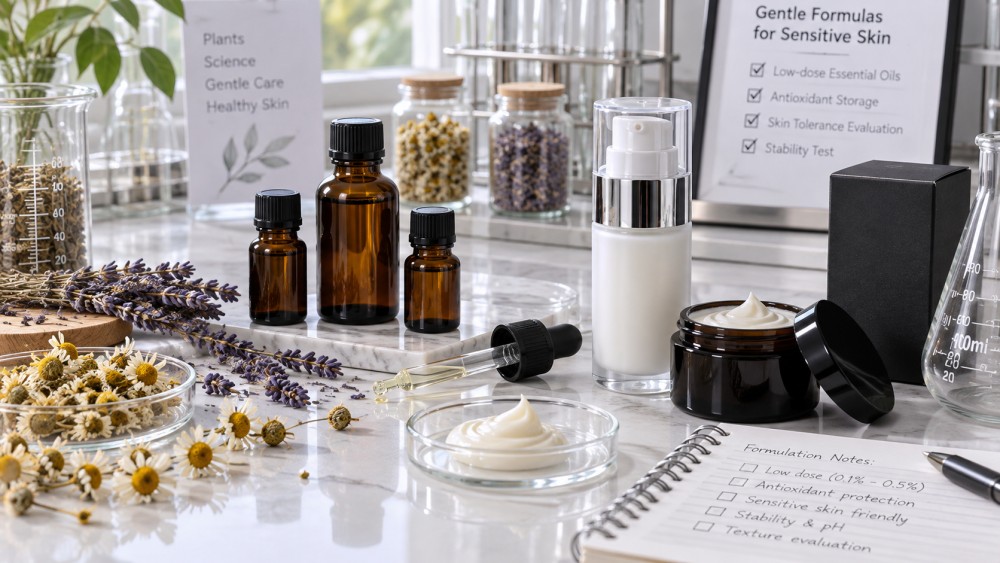
The real formulation challenge is oxidation, not just initial composition
Many essential-oil assessments fail because they examine the certificate of analysis at goods receipt but ignore what happens over the product’s shelf life. Terpenes such as limonene and linalool can oxidize into hydroperoxides with a greater sensitization concern than the freshly distilled material. Heat exposure, headspace oxygen, repeated consumer opening, light, and trace metal contamination can all influence this process.
For technical evaluators, a robust control plan may include peroxide value or relevant oxidation markers where appropriate, incoming-material age limits, protected storage, nitrogen blanketing for bulk handling, and a defined retest period. In the finished formula, antioxidant support and suitable chelation may help protect the system, but they are not substitutes for proper packaging. Airless packs, opaque containers, low-oxygen filling practices, and an appropriately designed stability protocol often have more practical value than adding a fashionable antioxidant label claim.
The odor profile itself can be an early warning sign. A bright citrus note that becomes sharp, metallic, waxy, or stale during accelerated stability testing is not merely a sensory problem; it may indicate chemical change that deserves further investigation. Sensory, analytical, and safety teams should review stability data together.
Choose the delivery format before setting a fragrance dose
Essential oils are lipophilic, volatile mixtures. How they are incorporated can alter local exposure, formula appearance, preservative performance, and consumer experience. A simple statement such as “essential oil at 0.1%” is incomplete without a delivery context.
In an anhydrous balm or oil serum, the essential oil is dissolved in the lipid phase and remains in prolonged contact with skin. This can make even a modest fragrance level unsuitable for a barrier-focused facial product. In an emulsion, partitioning between phases and the presence of emulsifiers may affect release. In a surfactant cleanser, solubilizers and micellar structures influence deposition, while the cleanser itself may contribute to dryness. In a water-based mist, insufficient solubilization can produce droplets or haze, creating uneven application and concentrated contact points.
For sensitive-skin concepts, the goal is not maximal aroma persistence. A restrained “close-to-skin” effect, or an aroma that is perceptible only during rinse-off use, is often more compatible with the product brief. Some brands may achieve the intended emotional cue through non-volatile botanical extracts, packaging language, or texture rather than through a detectable fragrance.
A decision framework for essential oil applications in skincare
Before entering full development, teams can use a staged gate process. It avoids the common scenario in which a concept is fragrance-led at the beginning, then expensive safety and claims adjustments are required shortly before launch.
- Define the consumer vulnerability level. Distinguish ordinary sensitive skin from medically compromised skin, infant skin, acne-treatment users, or consumers with a history of fragrance allergy. Do not use one broad segment label to cover very different risk profiles.
- Set the product exposure model. Identify leave-on or rinse-off status, application frequency, body area, expected use amount, and potential sun exposure.
- Request complete material documentation. This should include botanical identity, plant part, extraction method, country of origin, chromatographic profile, allergen information, safety data, storage guidance, and specifications relevant to oxidation or contaminants.
- Screen for known concern constituents. Review sensitizers, phototoxic constituents, restricted components, and the implications of current fragrance standards and target-market requirements.
- Model the finished-formula dose. Assess the whole aromatic system, not only one essential oil. Natural extracts, fragrance compounds, and even functional ingredients can add overlapping constituents.
- Confirm stability and compatibility. Monitor odor, color, phase behavior, pH where relevant, viscosity, packaging interaction, and preservative robustness over the intended shelf-life conditions.
- Generate product-specific tolerance evidence. The appropriate test strategy depends on the market, claims, formula, and consumer group. Avoid relying solely on supplier literature or traditional-use narratives.
This approach is especially useful when a formula contains high-value actives such as peptides, retinoid alternatives, ceramides, or biomimetic humectants. It makes little commercial sense to invest in a sophisticated barrier-support system, then undermine user acceptance with an avoidable fragrance-triggered reaction.
Regulatory readiness is a moving formulation parameter
Essential oils sit at the intersection of cosmetic ingredient regulation, fragrance standards, consumer labeling, and claims substantiation. Teams selling across regions should avoid treating one market’s compliance review as globally sufficient.
In the European Union, fragrance allergen labeling requirements and cosmetic product notification obligations require careful attention to the finished product and intended use. IFRA Standards are an important risk-management reference for fragrance materials and categories, but they do not replace a full cosmetic safety assessment or local regulatory obligations. In the United States, product safety, ingredient labeling, and claim language should be reviewed in their own context. If a product crosses into therapeutic claims—such as treating eczema, infection, inflammation, or anxiety—the regulatory pathway may change materially.
“Natural,” “pure,” “therapeutic grade,” and “chemical-free” are particularly weak shortcuts for technical communication. Every essential oil is a complex chemical mixture. Better language describes what has actually been controlled: botanical sourcing, compositional specification, restricted-substance screening, low use level, oxidation management, and formula-level skin compatibility evaluation.
Common development mistakes that create avoidable risk
Mistake one: treating essential oils as active ingredients by default. A traditional aromatic association is not proof of clinical efficacy in a finished cosmetic formula. If the oil is present mainly for scent, treat it as part of the fragrance and safety system.
Mistake two: relying on a single supplier GC-MS profile. Batch variability is real. Establish acceptable compositional ranges and change-control expectations, especially for materials sourced from variable harvests or multiple origins.
Mistake three: using “natural preservation” as a reason to add aromatic oils. Essential oils should not be assumed to preserve a cosmetic formula. Preservation efficacy must be demonstrated within the full system, including packaging and expected consumer use.
Mistake four: equating low fragrance intensity with low sensitization risk. A faint odor may still contain relevant sensitizers. Conversely, a technically low-risk aromatic profile can be perceived strongly by some users. Instrumental data and sensory impressions answer different questions.
When a fragrance-free answer is the stronger application solution
For many sensitive skincare formulas, the best essential oil application is no essential oil application at all. This is not a loss of product character. A well-built fragrance-free cleanser can communicate freshness through foam quality and clean rinse; a barrier cream can feel comforting through cushion, spread, and after-feel; a serum can signal precision through elegant absorption and packaging.
Where an aromatic cue remains commercially important, position it in a lower-risk part of the range: perhaps a rinse-off body product rather than a leave-on facial cream, or an adult relaxation product rather than a universal sensitive-skin SKU. Portfolio architecture can protect both sensory ambition and technical integrity.
For evaluators, the most credible conclusion is rarely “this oil is safe” or “this oil is unsafe.” It is more specific: this defined material, controlled for composition and oxidation, at this use level, in this delivery system, for this consumer and market, has—or has not—earned a place in the formula. That is the level of judgment required to make essential oil applications in skincare genuinely compatible with sensitive-skin expectations.
Related News
- Which essential oil applications suit sensitive skincare formulas?Sep 28, 2026Aromatics & Perfumery Fellow
- Essential Oil Extracts Price: What Drives Cost Differences in 2026Jul 12, 2026Aromatics & Perfumery Fellow
- Supercritical Essential Oil Applications: Best Uses by Product TypeJul 10, 2026Aromatics & Perfumery Fellow
- Ningbo Tightens CO₂ Extract Shipping DeclarationsJul 09, 2026Aromatics & Perfumery Fellow
Related News
- 00
0000-00
How to assess color stability from a natural food colors manufacturer - 00
0000-00
When does amino acid surfactant powder improve cleanser mildness? - 00
0000-00
How to verify a cosmetic nanotechnology supplier's safety documentation - 00
0000-00
How rheological thickeners for shampoo affect suspension stability - 00
0000-00
How to assess recombinant collagen ingredients for cream stability
Aromatics & Perfumery Fellow
Weekly Insights
Stay ahead with our curated technology reports delivered every Monday.