





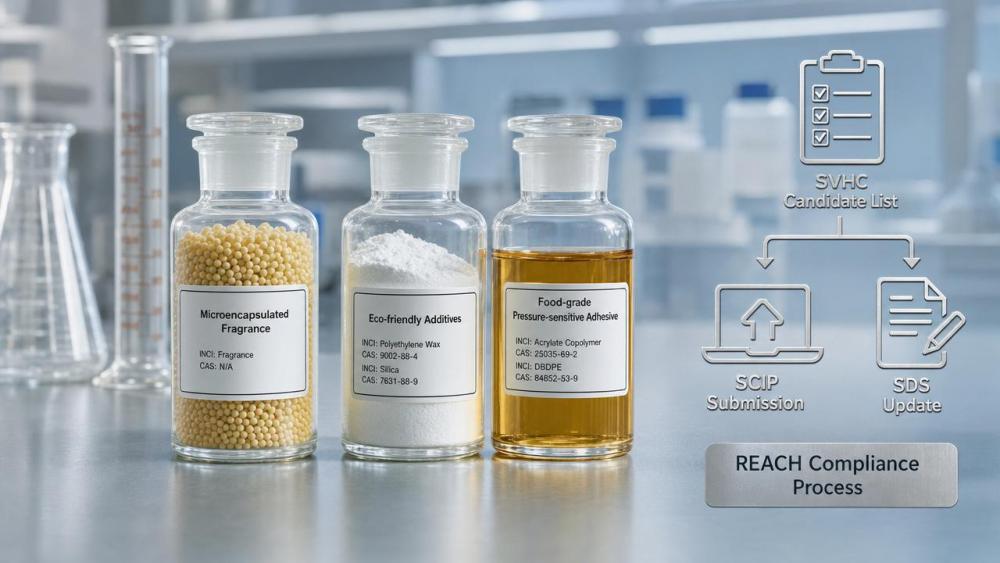
On 5 November 2025, the European Chemicals Agency (ECHA) officially added decabromodiphenyl ethane (DBDPE, CAS 84852-53-9) to the Candidate List of Substances of Very High Concern (SVHC). This regulatory update directly affects exporters of microencapsulated fragrances, eco-friendly builders and softeners, printing inks, and food-contact adhesives to the EU market.
Regulatory Update Confirmed by ECHA
On 5 November 2025, ECHA included DBDPE (CAS 84852-53-9) in the SVHC candidate list. As of 5 May 2026, articles containing DBDPE at concentrations ≥ 0.1% (w/w) will trigger mandatory REACH obligations: notification to ECHA, revision of Safety Data Sheets (SDS), submission to the SCIP database, and provision of safe-use information to downstream recipients.
Impact Across Supply Chain Roles
Exporters handling finished goods
Companies shipping microencapsulated fragrances or eco-builders/softeners into the EU must now assess DBDPE content in microcapsule shell layers and reformulate or document compliance before the 2026 deadline. Non-compliance may lead to customs rejection or market withdrawal.
Raw material suppliers
Suppliers of brominated flame retardants, ink resins, or food-grade adhesive components must verify and disclose DBDPE presence in technical specifications and SDS. Failure to do so risks contractual liability and loss of EU-tier customers.
Contract manufacturers & formulators
Firms producing printed packaging, scented textiles, or functional coatings face new analytical validation requirements. Batch-level testing for DBDPE—especially in encapsulation polymers and laminating adhesives—is now essential for EU-bound shipments.
Supply chain compliance service providers
Third-party labs, SCIP filing agents, and REACH consultants will see increased demand for substance screening, documentation support, and regulatory training—particularly for fragrance encapsulation and food-contact material sectors.
Key Compliance Actions for Affected Companies
Immediate substance screening and inventory mapping
Identify all formulations, intermediates, and incoming raw materials containing DBDPE—especially in microcapsule wall matrices, ink binders, and pressure-sensitive adhesives used in food packaging.
SDS and SCIP database updates
Revise SDS sections 3 (composition), 15 (regulatory information), and 16 (other information) to reflect SVHC status; submit accurate SCIP notifications by 5 May 2026 for all affected articles placed on the EU market.
Downstream communication protocols
Establish documented procedures to provide safe-use instructions to EU importers and converters—particularly for fragrance-loaded substrates and functional adhesives where end-use conditions affect exposure potential.
Industry Observation: A Shift Toward Proactive Substance Management
Analysis shows that DBDPE’s inclusion reflects a broader regulatory trend: increasing scrutiny of brominated flame retardants with persistent, bioaccumulative, and toxic (PBT) properties—even when used functionally outside traditional fire-safety applications. Observably, its use in fragrance microencapsulation and food-contact adhesives was previously under the radar; this listing signals heightened attention to ‘non-obvious’ SVHC exposures in complex formulated products. What deserves closer attention is the growing expectation for upstream suppliers to proactively monitor candidate lists—not just final product exporters—and integrate SVHC assessments into R&D and sourcing decisions well before regulatory deadlines.
Strategic Takeaway for Market Participants
This listing does not ban DBDPE outright, but it significantly raises the compliance bar for EU market access. It underscores that regulatory impact extends beyond obvious industrial chemicals to functional ingredients embedded in consumer-facing formulations. Success will depend less on reactive certification and more on cross-functional substance intelligence, traceable supply chains, and agile formulation management.
Source Information & Verification Notes
This article is based exclusively on the user-provided title, event date (5 November 2025), and summary. Specific official source links were not provided in the input and should be verified continuously. Stakeholders are advised to monitor ECHA’s official SVHC page, upcoming REACH guidance documents on SCIP reporting for complex articles, and sector-specific interpretations from EU trade associations—particularly those representing fragrance, adhesives, and food-contact materials industries.
Related News
- Can biomimetic peptides in cosmetics reduce the look of wrinkles?Oct 17, 2026Cosmeceutical Formulator
- How to assess a bio-based thickener manufacturer's batch consistencyOct 16, 2026Food Rheology Expert
- Verifying halal status of hydrocolloid ingredients in the Middle EastOct 15, 2026Food Rheology Expert
- How to interpret active matter on a surfactant specification sheetOct 14, 2026Prof. Elian Thorne
Related News
- 00
0000-00
Can biomimetic peptides in cosmetics reduce the look of wrinkles? - 00
0000-00
How to assess a bio-based thickener manufacturer's batch consistency - 00
0000-00
Verifying halal status of hydrocolloid ingredients in the Middle East - 00
0000-00
How to interpret active matter on a surfactant specification sheet - 00
0000-00
How Do You Test Hydrocolloid Viscosity After Changing a Thickener?
Industry Global
Weekly Insights
Stay ahead with our curated technology reports delivered every Monday.