





On 31 March 2026, the European Commission officially authorised defatted rapeseed meal as a novel food under EU Regulation (EU) 2015/2283, enabling its use as a protein ingredient in meal replacements, sports nutrition products, and plant-based foods. This regulatory milestone establishes a clear compliance framework for exporters—particularly Chinese rapeseed processing enterprises—seeking market access to the EU.
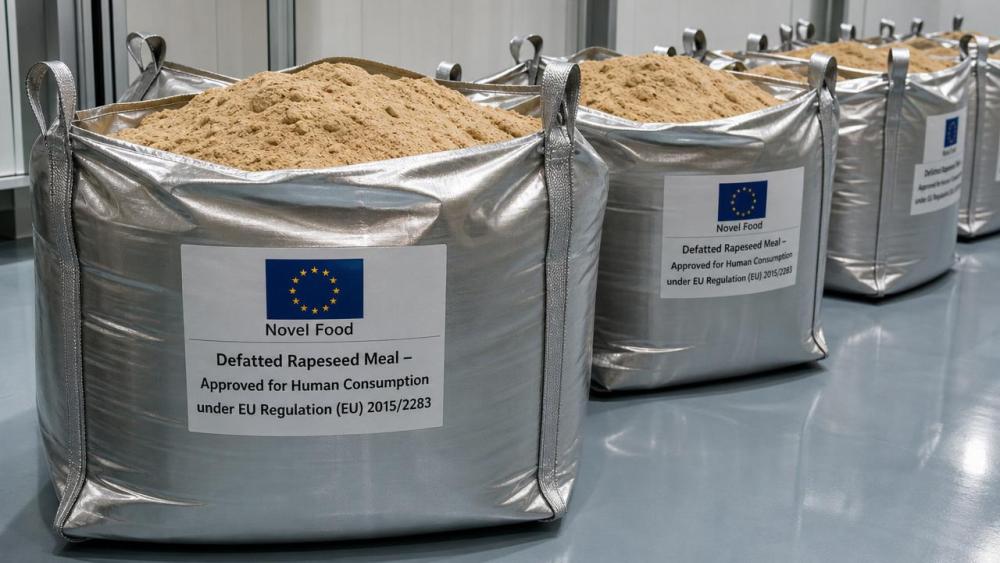
Regulatory Approval Confirmed by EU Commission
The European Commission adopted Commission Implementing Decision (EU) 2026/xxx on 31 March 2026, approving defatted rapeseed meal (defatted rapeseed meal) for human consumption as a novel food. The authorisation permits its use as a source of protein in specific food categories, including meal replacements, sports nutrition foods, and plant-based alternatives. The decision follows a positive safety assessment by the European Food Safety Authority (EFSA), which established an acceptable daily intake level and defined mandatory labelling requirements—including allergen declaration and quantitative indication of inclusion levels.
Impact Across the Supply Chain
Export-oriented food ingredient traders
These enterprises now possess a legally recognised pathway to supply high-purity rapeseed protein powder to EU-based food manufacturers. Previously constrained by novel food pre-market authorisation barriers, they can now align commercial contracts with EU regulatory certainty—reducing legal risk and shortening time-to-market for new product launches.
Raw material procurement firms
Firms sourcing oilseed from China or other third countries must verify that upstream rapeseed lots meet the compositional specifications referenced in the EFSA opinion—particularly residual glucosinolate and erucic acid levels—to ensure finished defatted meal complies with the approved safety profile.
Protein ingredient processors
Manufacturers must adapt production protocols to meet the novel food’s specified purity criteria and implement batch-level traceability systems. The approval explicitly references ISO 22000 certification and EU Organic certification as strong indicators of compliance readiness—making these credentials increasingly decisive in tender evaluations.
Supply chain verification and certification service providers
Third-party auditors and certification bodies are seeing rising demand for combined assessments covering both ISO 22000 food safety management and EU Organic compliance—especially for facilities handling defatted rapeseed meal destined for novel food applications.
Key Compliance Priorities for Exporters
Align production with EFSA-defined safety parameters
Processors must ensure final defatted rapeseed meal meets EFSA’s stipulated limits for anti-nutritional compounds and contaminants. Batch testing reports—validated against EFSA’s reference analytical methods—will be essential for customs clearance and customer due diligence.
Verify certification scope and validity
ISO 22000 and EU Organic certifications must explicitly cover the production of defatted rapeseed meal as a novel food ingredient—not just general oilseed processing. Certification bodies may require scope extension audits before issuing compliant certificates.
Update labelling and technical documentation
All export packaging and accompanying technical dossiers must reflect the EU novel food authorisation number, usage conditions, maximum recommended daily intake, and mandatory allergen statements. Mislabelled shipments risk rejection at EU borders.
Industry Observation: A Strategic Inflection Point for Plant Protein Trade
Analysis shows this approval marks more than a single-ingredient authorisation—it signals a maturing regulatory infrastructure for structurally complex, non-soy plant proteins in the EU. Observably, the EFSA evaluation prioritised functional safety over botanical origin, suggesting future novel food pathways may become more accessible for well-characterised oilseed derivatives—if backed by robust toxicological data. What deserves closer attention is the growing convergence between organic certification and novel food compliance: dual-certified facilities are emerging not as niche players but as preferred suppliers for EU brands seeking both sustainability claims and regulatory defensibility. It is more appropriate to understand this as a shift toward integrated compliance—where food safety, organic integrity, and novel food authorisation are evaluated as interdependent pillars, not isolated requirements.
Toward Structured Market Access
This authorisation does not guarantee automatic market entry, but it removes the foundational regulatory barrier for defatted rapeseed meal. Its real-world impact will depend on how swiftly industry stakeholders—from raw material buyers to brand owners—integrate the novel food requirements into procurement policies, formulation guidelines, and supplier qualification frameworks. Success hinges less on novelty and more on disciplined execution across traceability, certification, and technical communication.
Source Transparency Notice
This article was generated exclusively from the user-provided information: title, event date (31 March 2026), and summary text. Specific official source links were not provided in the input and should be verified continuously. Stakeholders are advised to monitor upcoming EU Commission guidance documents, national enforcement interpretations, and updates from notified bodies regarding certification scope alignment and labelling implementation timelines.
Related News
- What drives fragrance ingredients price changes in bulk orders?Oct 12, 2026Prof. Elian Thorne
- How to assess a food antioxidants distributor’s traceability practicesOct 11, 2026Food Preservation Scientist
- How minimum order quantities shape private label ingredient sourcing costsOct 10, 2026Prof. Elian Thorne
- What drives personal care ingredient price volatility in sourcingOct 08, 2026Prof. Elian Thorne
Related News
- 00
0000-00
What drives fragrance ingredients price changes in bulk orders? - 00
0000-00
How to assess a food antioxidants distributor’s traceability practices - 00
0000-00
How minimum order quantities shape private label ingredient sourcing costs - 00
0000-00
What drives personal care ingredient price volatility in sourcing - 00
0000-00
What drives micelles price differences in cosmetic formulations?
Industry Global
Weekly Insights
Stay ahead with our curated technology reports delivered every Monday.