





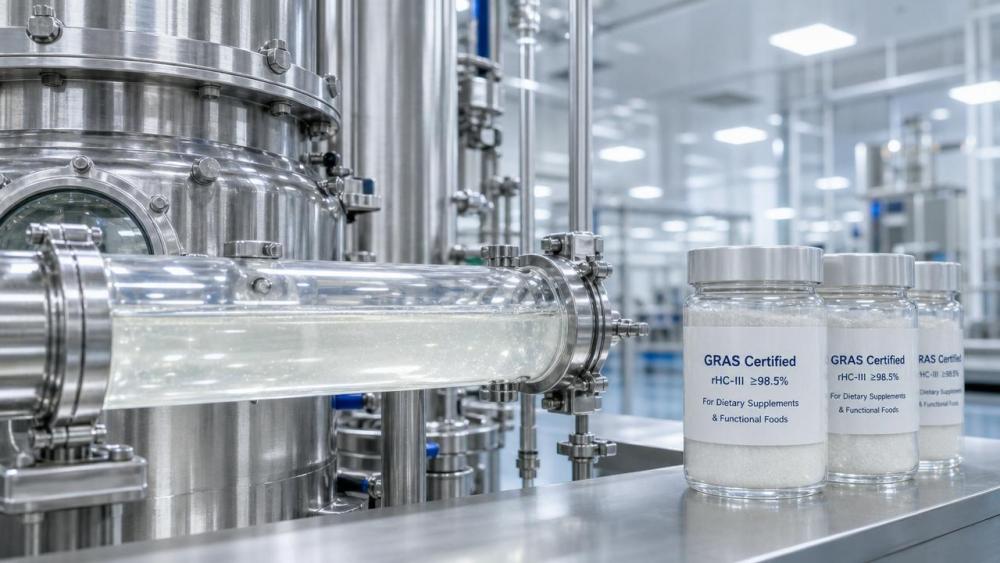
On May 29, 2026, the U.S. Food and Drug Administration (FDA) updated its Generally Recognized as Safe (GRAS) inventory, granting formal GRAS status to a high-purity (≥98.5%) recombinant human type III collagen (rHC-III) developed by a Chinese enterprise—authorizing its direct use in dietary supplements and functional foods. This regulatory shift marks a pivotal expansion from prior cosmetic-only applications and introduces new commercial pathways across North American health-oriented food categories.
Confirmed Regulatory Milestone
The FDA officially added rHC-III—meeting ≥98.5% purity specifications—to its GRAS list on May 29, 2026. The substance, produced via recombinant biotechnology, is now permitted for direct incorporation into dietary supplements and functional food products in the United States. Prior to this determination, its regulatory authorization was limited exclusively to topical cosmetic use.
Impact Across Supply Chain Roles
Export-Oriented Trading Enterprises
These firms now face revised market access conditions: GRAS clearance removes a major regulatory barrier for exporting rHC-III into U.S. food channels. They must update product classifications, labeling claims, and customs documentation to reflect the new food-grade status—and prepare for increased demand from U.S.-based brand owners seeking compliant collagen ingredients.
Ingredient Sourcing Companies
Purchasers of functional food actives must reassess technical specifications and compliance dossiers. The GRAS designation enables rHC-III to qualify for formulations previously restricted to GRAS-listed proteins or peptides. Sourcing teams should verify supplier certifications, batch-specific purity reports (≥98.5%), and alignment with FDA’s GRAS notification scope—including intended use levels and target matrices (e.g., beverages, powders).
Food & Supplement Manufacturers
Manufacturers integrating rHC-III into finished goods must ensure process compatibility (e.g., thermal stability during pasteurization or spray-drying), label compliance (e.g., accurate ingredient naming per 21 CFR §101.4), and safety substantiation consistent with GRAS conclusions. Formulation adjustments may be needed to maintain solubility, taste neutrality, and shelf-life performance.
Supply Chain Service Providers
Logistics, testing labs, and regulatory consultants must adapt service offerings: cold-chain validation for sensitive biologics, accelerated method development for purity quantification (e.g., SEC-HPLC or CE-SDS), and GRAS dossier review support. Third-party auditors may begin incorporating GRAS-related controls into GMP or SQF assessments for collagen-supplemented products.
Key Compliance and Operational Considerations
Verify GRAS Notification Scope and Intended Use Limits
Enterprises must confirm that their proposed application (e.g., dosage level, food category, processing conditions) falls within the parameters covered by the FDA’s GRAS determination—not all uses or concentrations are automatically authorized.
Update Technical Documentation and Supplier Qualification
Revised Certificates of Analysis must explicitly state ≥98.5% purity (by validated analytical method), residual host cell protein/DNA limits, and absence of prohibited solvents or reagents. Suppliers must demonstrate adherence to current Good Manufacturing Practices (cGMP) for food ingredients.
Align Labeling and Marketing Claims with FDA Guidance
Claims referencing ‘collagen support’, ‘skin health’, or ‘joint function’ require substantiation beyond GRAS status—often necessitating separate structure/function claim notifications under 21 CFR §101.93. Misleading or unqualified health claims remain prohibited.
Assess Export Documentation and Tariff Classification
Customs classification may shift from HS 3304 (cosmetics) to HS 2106 (food preparations) or 2937 (amino-acid derivatives), affecting duty rates and import entry requirements. Harmonized System codes and country-of-origin labeling must be reviewed accordingly.
Industry Perspective: A Strategic Inflection Point
Analysis shows that this GRAS clearance reflects broader regulatory maturation for recombinant human-derived biomolecules in food—moving beyond traditional animal-sourced collagen. From an industry perspective, it signals growing acceptance of precision fermentation and mammalian-cell expression platforms for food-grade actives. What deserves closer attention is the likely acceleration in comparability studies required for future variants (e.g., rHC-I vs. rHC-III) and the emerging need for standardized potency assays acceptable to both FDA and international regulators. Observably, the 98.5% purity threshold may become a de facto benchmark for regulatory submissions in other jurisdictions.
Toward Broader Functional Ingredient Integration
This decision does not guarantee automatic market adoption—but it establishes a foundational regulatory prerequisite. Its significance lies not in immediate volume impact, but in validating a new class of biotech-derived functional proteins for oral delivery. For ingredient developers, it reinforces the strategic value of early-stage regulatory engagement; for food brands, it expands the viable toolkit for science-backed wellness positioning—provided technical, labeling, and supply chain readiness keeps pace.
Source Transparency and Ongoing Monitoring
This article synthesizes the provided title, event date (May 29, 2026), and summary description. It references no external documents, official notices, or URLs beyond the input. Specific official source links were not provided in the input and should be verified continuously. Stakeholders are advised to monitor forthcoming FDA guidance on GRAS notification expectations for recombinant proteins, potential updates to the Code of Federal Regulations (21 CFR Part 170), and evolving industry consensus standards for collagen purity and identity verification.
Related News
- Can biomimetic peptides in cosmetics reduce the look of wrinkles?Oct 17, 2026Cosmeceutical Formulator
- How to assess a bio-based thickener manufacturer's batch consistencyOct 16, 2026Food Rheology Expert
- Verifying halal status of hydrocolloid ingredients in the Middle EastOct 15, 2026Food Rheology Expert
- How to interpret active matter on a surfactant specification sheetOct 14, 2026Prof. Elian Thorne
Related News
- 00
0000-00
Can biomimetic peptides in cosmetics reduce the look of wrinkles? - 00
0000-00
How to assess a bio-based thickener manufacturer's batch consistency - 00
0000-00
Verifying halal status of hydrocolloid ingredients in the Middle East - 00
0000-00
How to interpret active matter on a surfactant specification sheet - 00
0000-00
How Do You Test Hydrocolloid Viscosity After Changing a Thickener?
Industry Global
Weekly Insights
Stay ahead with our curated technology reports delivered every Monday.