





Cosmetic Ingredient Compliance in the Middle East: Key Labeling and Registration Risks
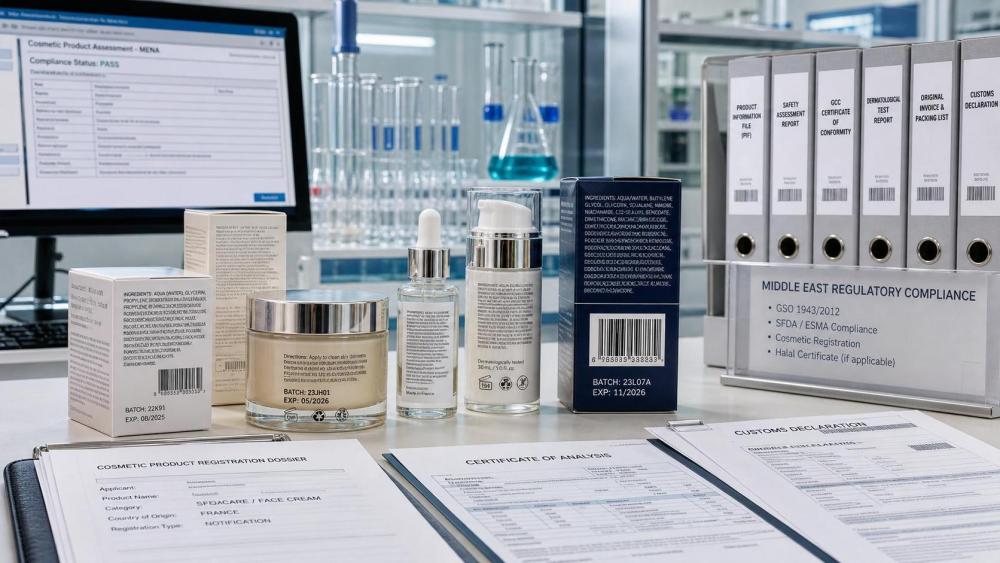
For brands expanding across the Gulf and wider MENA region, cosmetic ingredient compliance Middle East requirements can become a quiet but serious commercial problem.
A product may be technically sound, well tested, and successful elsewhere, yet still face customs delays, registration rejection, or shelf withdrawal.
In most cases, the issue is not formula quality alone. It is the gap between formulation, labeling, documentation, and country-level market access rules.
That is why cosmetic ingredient compliance Middle East strategy must be treated as a launch function, not a last-step paperwork task.
Across the Gulf, regulators are paying closer attention to Arabic labeling, restricted ingredients, product claims, and importer accountability.
The wider signal is clear. Faster regional growth now depends on cleaner compliance execution.
Why cosmetic ingredient compliance Middle East risk is rising
Middle East cosmetics markets are attractive because premium beauty, personal care, and dermocosmetic categories continue to expand.
At the same time, regulatory expectations are becoming more operational and less forgiving of incomplete files.
This matters especially for imported products containing complex fragrance systems, preservatives, actives, botanicals, or multifunctional ingredients.
Many businesses assume one Gulf approval can unlock the full region. In practice, that assumption often creates avoidable risk.
Saudi Arabia, the UAE, and other markets may share broad principles, but registration processes, portal requirements, and supporting evidence can still differ.
So cosmetic ingredient compliance Middle East work needs a market-by-market view, especially for first launch.
The business impact of a small compliance miss
A minor labeling inconsistency can trigger major commercial friction.
- Customs may hold shipments pending clarification.
- Distributors may delay onboarding until product files are corrected.
- Retailers may reject listings if Arabic packs or claims are noncompliant.
- Rework costs can spread across packaging, legal review, warehousing, and relabeling.
For companies managing multiple SKUs, those delays quickly compound into a launch calendar problem.
The labeling risks most often missed
Labeling remains one of the most visible cosmetic ingredient compliance Middle East checkpoints because it is easy for regulators and importers to verify.
It is also where global brands often rely too heavily on templates built for Europe or North America.
1. Arabic labeling gaps
Arabic content is not a cosmetic formality. It is a market access requirement in many cases.
Problems usually appear in translation quality, missing mandatory fields, or inconsistent product naming between the label and registration file.
Even when a sticker is allowed, poor formatting or late application can create inspection issues.
2. INCI list and restricted substance disclosure mistakes
Ingredient lists must align with accepted nomenclature and actual formula composition.
Common failures include outdated INCI names, missing allergens where relevant, and incomplete fragrance or preservative declarations.
This is particularly sensitive for actives, essential oils, exfoliating acids, and ingredients with concentration-based restrictions.
3. Claims that outpace the formula file
Words like “repair,” “medical,” “whitening,” “anti-aging reversal,” or “clinically proven” can draw extra scrutiny.
If the product claim sounds therapeutic or exaggerated, regulators may question whether the item still fits cosmetic scope.
In practical terms, cosmetic ingredient compliance Middle East review should include claims substantiation before packaging is finalized.
4. Batch, shelf life, and responsible party errors
Shelf life statements, period after opening, production codes, and importer details must be consistent across labels and registration documents.
Small mismatches can delay approval because they signal poor file control.
Where registration failures usually happen
Registration risk is broader than submitting a product name and formula summary.
For cosmetic ingredient compliance Middle East programs, the file must connect technical data, labeling, claims, and local importer information.
Country assumptions create repeat delays
One of the biggest mistakes is treating the Middle East as a single approval zone.
Some markets ask for more detailed product information, while others focus heavily on importer records, safety backing, or local platform formatting.
That means a file accepted in one country may still require changes elsewhere.
Missing technical support for high-risk ingredients
Preservatives, UV filters, colorants, peptides, botanicals, and fragrance compounds may need closer justification depending on use level and claim context.
When safety data, specifications, or certificates are incomplete, registration slows down fast.
This is especially relevant for premium anti-aging formulas, where ingredient complexity tends to be higher.
Formula updates without regulatory version control
R&D teams often refine fragrance load, preservative systems, or active percentages after the commercial team has locked artwork.
If the registered formula, supplier documents, and final pack no longer match, compliance exposure increases.
This is a recurring cosmetic ingredient compliance Middle East issue for companies scaling fast across distributors.
A practical control framework before market entry
The most effective way to reduce cosmetic ingredient compliance Middle East risk is to build a pre-launch gate that combines regulatory, technical, and commercial checks.
This does not need to be bureaucratic. It needs to be disciplined.
Pre-launch checklist
- Map target countries separately, with no regional shortcut assumptions.
- Review formula against restricted, prohibited, and concentration-limited substances.
- Verify INCI names, allergens, and raw material specifications.
- Align claims with formula evidence and cosmetic category boundaries.
- Prepare Arabic labeling early, not after artwork approval.
- Check importer, manufacturer, batch, and shelf life details across all files.
- Freeze a regulatory version of the formula before registration submission.
Useful document set for smoother review
How FFAI supports faster, cleaner compliance decisions
For companies working with preservatives, fragrance systems, rheology modifiers, surfactants, and premium cosmetic actives, compliance questions rarely sit in one department.
They sit between R&D, sourcing, regulatory, branding, and market entry teams.
That is where FFAI brings practical value.
FFAI tracks ingredient intelligence, formulation logic, and global compliance signals across food, fragrance, and high-end cosmetic actives.
For cosmetic ingredient compliance Middle East planning, that means better visibility into how technical ingredients translate into registration and labeling risk.
The goal is straightforward: reduce avoidable delays, improve dossier quality, and support stronger commercial timing.
Final takeaway
Cosmetic ingredient compliance Middle East success depends less on reacting to rejection and more on controlling risk before submission.
The most resilient brands treat labeling, ingredient review, and registration planning as one connected process.
In real business terms, that approach protects launch speed, distributor confidence, and long-term brand credibility.
When expansion across the Gulf or wider MENA region is on the table, early cosmetic ingredient compliance Middle East review is one of the highest-return decisions available.
Related News
- How to verify a cosmetic nanotechnology supplier's safety documentationOct 04, 2026Dr. Chloe Vance
- How to set a control sensory flavour standard for panel consistencySep 27, 2026Dr. Chloe Vance
- How to verify compliance documents for cosmetic active compoundsSep 19, 2026Dr. Chloe Vance
- How to verify food grade flavor formulation ingredients for safetySep 18, 2026Dr. Chloe Vance
Related News
- 00
0000-00
How to assess color stability from a natural food colors manufacturer - 00
0000-00
When does amino acid surfactant powder improve cleanser mildness? - 00
0000-00
How to verify a cosmetic nanotechnology supplier's safety documentation - 00
0000-00
How rheological thickeners for shampoo affect suspension stability - 00
0000-00
How to assess recombinant collagen ingredients for cream stability
Dr. Chloe Vance
Weekly Insights
Stay ahead with our curated technology reports delivered every Monday.