





Why does cosmetics regulatory support become a launch bottleneck so late in the process?
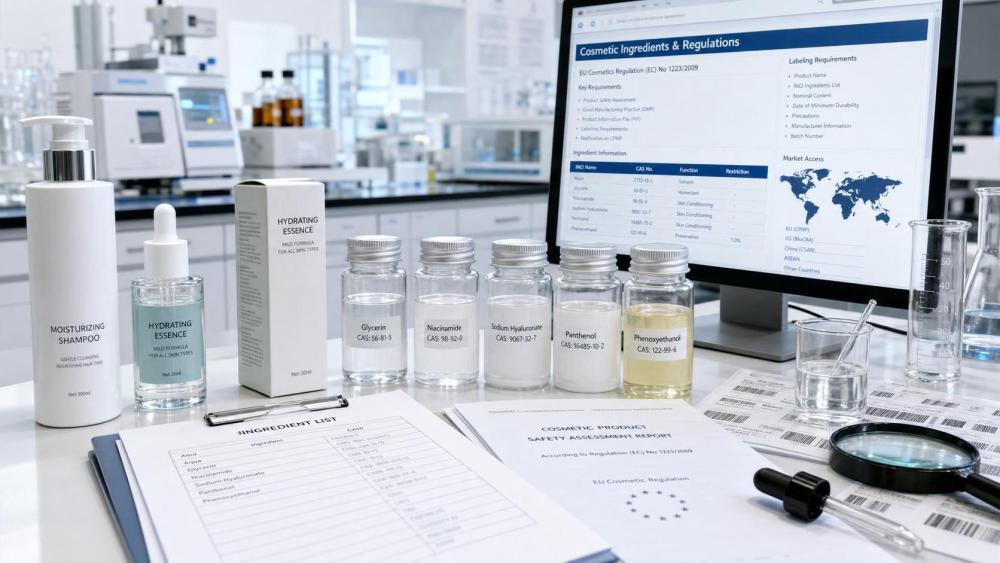
Cosmetic launches rarely fail because the formula looks weak on paper.
They slip because compliance work started too narrowly, too late, or with the wrong assumptions.
That is why cosmetics regulatory support matters long before notification, artwork approval, or customs clearance.
In practical terms, regulatory support connects formulation data, safety substantiation, ingredient sourcing, claims, and market entry rules into one launch path.
When those pieces are handled separately, delay risk increases fast.
A peptide serum may pass internal review, yet stall because impurity limits were never documented.
A shampoo may look market-ready, yet fail regional checks because preservative use conditions differ by destination.
This challenge is especially visible across FMCG categories where ingredients, sensory design, and safety claims move together.
FFAI tracks this intersection closely.
Its intelligence model links ingredient science, transdermal pharmacology, fragrance behavior, and market compliance in a way that reflects real launch pressure.
For anti-aging actives, surfactants, fragrances, and preservation systems, the same lesson keeps repeating.
If the data package is fragmented, timelines break at the final mile.
Which compliance gaps most often delay cosmetic product approvals?
The most common gaps are rarely dramatic.
They are usually small documentation failures that become serious once authorities, distributors, or local representatives review them.
A strong cosmetics regulatory support process usually screens for five trouble spots early:
- Incomplete ingredient identity data, including CAS references, INCI naming, purity ranges, and residual solvent details.
- Safety files that rely on supplier summaries but lack toxicological reasoning for final use concentration.
- Claims language that sounds commercial but cannot be defended by test design, literature, or formula composition.
- Label text that conflicts with local rules on warnings, allergens, function naming, or durability statements.
- Notification submissions prepared from outdated formula versions or packaging revisions.
More often than not, several gaps appear together.
For example, a high-end active may have premium efficacy positioning, yet no stable bridge between supplier dossier and finished product safety report.
That weakens both compliance and launch credibility.
The table below shows where delays usually begin.
Is ingredient documentation really that important if the formula is already finished?
Yes, because a finished formula does not replace traceable ingredient evidence.
Regulators and responsible persons usually assess the product through the ingredient chain first.
That becomes critical for fragrances, preservatives, botanical extracts, and anti-aging actives.
These materials often carry complex impurity, allergen, or stability questions.
In actual projects, one missing document can freeze several downstream tasks.
Artwork may need revision.
Safety assessment may need recalculation.
Notification timing may move because the final formula version is no longer the same one initially reviewed.
This is where cosmetics regulatory support should act less like a filing service and more like a data control function.
A useful review packet usually confirms:
- INCI name, trade name, and supplier code alignment
- Country-specific restricted substance screening
- Residuals, heavy metals, and microbiological limits where relevant
- Allergen, preservative, and fragrance disclosure triggers
- Stability and compatibility references for the intended dosage form
FFAI’s broader industry lens is useful here because cosmetic projects often borrow insights from adjacent ingredient systems.
Preservation behavior, rheology control, and sensory stability are not isolated topics.
They influence compliance evidence as much as they influence product feel.
Where do global launches usually go wrong: safety files, labels, or market notifications?
Usually all three, but not at the same time.
The sequence matters.
A weak safety file creates foundational risk.
A label mismatch creates visible risk.
A wrong notification creates procedural risk.
When teams ask where cosmetics regulatory support adds the most value, the better question is where sequence control is missing.
For EU entry, for example, the Product Information File, CPNP notification, label wording, and responsible person details must align tightly.
A late packaging edit can disrupt everything if the label was changed after dossier approval.
The same problem appears in other markets under different names.
Sometimes the issue is not regulatory knowledge.
It is version discipline.
A practical way to reduce launch drift is to set one regulatory checkpoint before each of these milestones:
- Formula lock
- Claims lock
- Artwork release
- Notification submission
- Commercial shipment approval
Without these gates, cosmetics regulatory support becomes reactive, and reactive compliance is expensive.
How should launch teams judge whether their regulatory support model is strong enough?
A strong model is not measured by how fast documents are collected.
It is measured by how early risks become visible.
That means good cosmetics regulatory support should expose weak supplier files, unsupported claims, formula-market conflicts, and timing assumptions before money is committed.
A quick self-check helps.
The difference between a weak and strong system is often one level of detail.
That detail protects both launch timing and budget discipline.
What does a practical prevention plan look like before the next cosmetic launch?
The most reliable approach is to treat cosmetics regulatory support as a launch workstream, not a finishing task.
Start with a risk map by formula type, target market, ingredient novelty, and claim ambition.
Then match each risk to a document owner and a deadline.
For products built around advanced actives, fragrance complexity, or sensitive preservation systems, that discipline matters even more.
A short prevention plan usually includes:
- Lock the ingredient inventory before final performance testing begins.
- Collect supplier dossiers in a format usable for safety assessment, not just purchasing review.
- Build a claim matrix that separates sensory language from regulated efficacy language.
- Review artwork against the exact market version, including allergens and warnings.
- Run a final notification readiness check against the latest approved formula.
This is also where external intelligence has value.
FFAI’s perspective across food preservation, rheology, fragrance systems, surfactants, and cosmetic actives helps identify cross-category evidence gaps that internal teams may miss.
That does not replace internal control.
It improves the quality of the questions asked before delay becomes visible.
In the end, most postponed launches are not caused by one major compliance surprise.
They come from several manageable gaps left unconnected.
The next step is straightforward.
Review the current launch file against formula data, safety evidence, label accuracy, and market notification sequence.
That single exercise usually shows whether cosmetics regulatory support is helping the launch move, or quietly delaying it.
Related News
- How to verify a cosmetic nanotechnology supplier's safety documentationOct 04, 2026Dr. Chloe Vance
- How to set a control sensory flavour standard for panel consistencySep 27, 2026Dr. Chloe Vance
- How to verify compliance documents for cosmetic active compoundsSep 19, 2026Dr. Chloe Vance
- How to verify food grade flavor formulation ingredients for safetySep 18, 2026Dr. Chloe Vance
Related News
- 00
0000-00
Verifying halal status of hydrocolloid ingredients in the Middle East - 00
0000-00
How to interpret active matter on a surfactant specification sheet - 00
0000-00
What Quality Checks Should You Run on Fragrance Ingredient Suppliers? - 00
0000-00
How to assess a flavor chemistry manufacturer's batch consistency - 00
0000-00
What drives fragrance ingredients price changes in bulk orders?
Dr. Chloe Vance
Weekly Insights
Stay ahead with our curated technology reports delivered every Monday.