





FDA GRAS certifications often become the point where a commercially attractive ingredient meets its hardest regulatory reality. In food preservation, flavors, thickeners, fragrance-adjacent materials, and premium actives entering FMCG pipelines, the question is not only whether a substance performs, but whether its safety conclusion is documented with enough scientific and manufacturing discipline to withstand scrutiny.
That matters because delays rarely come from one dramatic flaw. More often, they come from scattered gaps: an incomplete identity profile, a thin dietary exposure estimate, inconsistent batch data, or toxicology evidence that does not truly match the ingredient on sale. For teams balancing launch speed with defensible compliance, understanding the document logic behind FDA GRAS certifications is more practical than memorizing regulatory jargon.
Why FDA GRAS certifications remain a critical gate
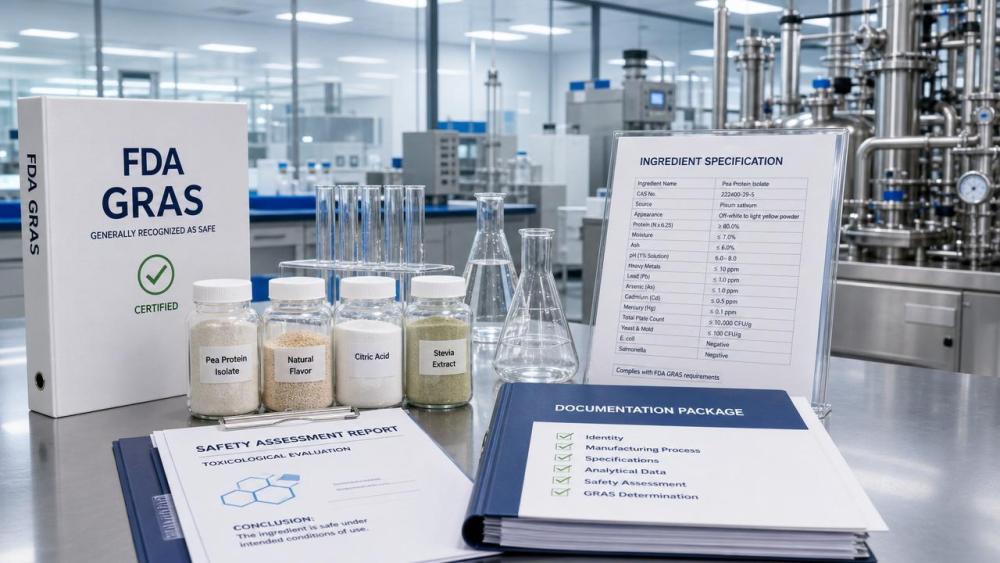
Across the broader ingredient economy, safety expectations have tightened. Clean label positioning, global sourcing, and premium formulation claims all raise the standard for evidence.
FDA GRAS certifications are especially relevant when ingredients move into foods, beverages, or related consumer products with ingestion exposure. A strong file supports regulatory confidence, customer due diligence, and smoother commercialization.
This is highly visible in sectors tracked by FFAI. Antioxidants, preservatives, hydrocolloids, natural colors, flavor systems, and certain specialty actives may begin as innovation stories, yet they succeed only when safety, specification control, and intended use are clearly aligned.
In practice, FDA GRAS certifications also influence supplier credibility. A well-supported conclusion can shorten technical reviews by downstream brands, contract manufacturers, and private-label partners.
What a defensible GRAS package is really built on
The GRAS framework is not just a collection of PDFs. It is a connected safety argument.
The central question is simple: can qualified experts reasonably conclude that the substance is safe under its intended conditions of use?
That conclusion depends on several layers working together. Identity must be exact. Manufacturing must be controlled. Exposure must be realistic. Toxicology must be relevant. Publicly available evidence must be sufficient for expert review.
When FDA GRAS certifications fail to gain traction, one of those layers usually looks stronger in isolation than it does in combination.
Core documents that usually shape the outcome
The exact file structure may differ by ingredient, but most robust submissions depend on a familiar document set.
Usually, the strongest FDA GRAS certifications read like a coherent scientific narrative rather than a stack of attachments.
The approval gaps that most often slow progress
Many issues appear routine at first glance. They become serious when reviewers try to connect product identity, exposure, and safety.
Identity is less precise than the commercial claim
A botanical extract, fermentation product, or flavor preparation may be marketed under one name while covering multiple compositional realities.
If raw materials vary by origin, season, or supplier, specifications must show how that variability is controlled. Otherwise, toxicology data may apply to only part of the commercial material.
Exposure estimates are too optimistic
This is one of the most frequent approval gaps in FDA GRAS certifications. Conservative intake modeling is often more persuasive than aggressive assumptions designed to lower the numbers.
Problems appear when food categories are too broad, replacement scenarios are ignored, or cumulative intake from multiple applications is not considered.
Manufacturing records do not match the safety story
A clean toxicology summary cannot compensate for poor process transparency. Residual solvents, catalysts, microbial controls, allergen cross-contact, and impurity limits all affect how safety is interpreted.
This is especially important for hydrocolloids, preservation systems, and fermentation-derived ingredients, where minor process changes can alter impurity profiles or functional behavior.
Public evidence is thinner than expected
GRAS reasoning depends on generally available scientific information. Proprietary studies can help, but they rarely solve the whole evidentiary burden by themselves.
A submission becomes vulnerable when the literature review is selective, dated, or disconnected from the ingredient’s exact composition and use level.
Where these gaps show up across ingredient categories
The pattern of risk changes by ingredient type, even when the FDA GRAS certifications process follows the same logic.
- For preservatives and antioxidants, reaction byproducts and heat stability often need closer attention.
- For pigments and thickeners, source variability, microbiological quality, and specification tightness often drive the review.
- For flavors and essential oil derivatives, compositional complexity and cumulative exposure can create weak spots.
- For novel actives crossing into ingestible formats, route-of-exposure relevance becomes central.
This cross-category view is one reason intelligence-led platforms such as FFAI add value. Regulatory readiness improves when safety, formulation behavior, and market positioning are assessed together rather than in separate silos.
How to strengthen submission readiness before questions begin
The most effective preparation starts before dossier assembly. It starts when the ingredient definition, process description, and commercial use case are still being finalized.
Build the file around comparability
Ask whether the tested material, manufactured material, and marketed material are truly the same from a safety perspective.
If not, document the bridge clearly with compositional data, impurity rationale, and batch consistency evidence.
Stress-test exposure logic early
A realistic intake model should survive internal challenge. That means testing higher-end use scenarios, overlapping applications, and foreseeable market expansion.
Treat manufacturing as regulatory evidence
Batch records, critical control points, contaminant limits, and change management are not background materials. In many FDA GRAS certifications, they shape whether the safety case feels credible.
Review the literature with the actual ingredient in mind
Supportive studies should match the substance form, purity range, metabolic profile, and intended use. Broad references to related chemicals often create more questions than confidence.
A practical review lens for next-step decisions
Before moving forward, it helps to test the file against a few plain questions.
- Can an independent expert identify the ingredient without ambiguity?
- Do specifications reflect both performance and impurity risk?
- Does the exposure estimate reflect realistic commercial use?
- Do toxicology data match the marketed material and exposure route?
- Would a downstream customer understand the safety rationale quickly?
If any answer is uncertain, the gap is usually worth addressing before external review begins.
Strong FDA GRAS certifications are not built by adding paperwork at the end. They are built by connecting science, process control, and commercial intent into one defensible record. For teams navigating fast-moving FMCG innovation, the next useful step is often a structured gap review: map the ingredient identity, verify exposure assumptions, and challenge whether the available evidence truly supports the exact product that will enter the market.
Related News
- How to verify a cosmetic nanotechnology supplier's safety documentationOct 04, 2026Dr. Chloe Vance
- How to set a control sensory flavour standard for panel consistencySep 27, 2026Dr. Chloe Vance
- How to verify compliance documents for cosmetic active compoundsSep 19, 2026Dr. Chloe Vance
- How to verify food grade flavor formulation ingredients for safetySep 18, 2026Dr. Chloe Vance
Related News
- 00
0000-00
How to assess color stability from a natural food colors manufacturer - 00
0000-00
When does amino acid surfactant powder improve cleanser mildness? - 00
0000-00
How to verify a cosmetic nanotechnology supplier's safety documentation - 00
0000-00
How rheological thickeners for shampoo affect suspension stability - 00
0000-00
How to assess recombinant collagen ingredients for cream stability
Dr. Chloe Vance
Weekly Insights
Stay ahead with our curated technology reports delivered every Monday.