





Fragrance safety in a leave-on product is determined by the finished exposure to each relevant constituent, not by the botanical name on an essential oil label. A lavender, citrus, mint, spice, wood, or floral oil is a variable mixture of naturally occurring aroma chemicals. Its sensory profile may remain recognisable while the concentration of sensitizers, photoreactive fractions, oxidation products, or irritant components changes from one lot to another. That distinction matters because a cream, facial serum, body oil, deodorant, and perfume stay on the skin long enough for repeated dermal contact to shape the safety assessment.
“Natural” describes origin, not toxicological outcome. Essential oil ingredients can be appropriate in leave-on fragrance systems when their identity, composition, use level, stability, and finished-product exposure are understood together. Treating the oil as one fixed ingredient creates a common gap: the formulation may be assessed against a generic description while the supplied material has a different chemical profile or has changed during storage.
Start with the composition, not the common name
An essential oil is usually characterized by a mixture of terpenes, terpene alcohols, esters, aldehydes, ketones, phenols, oxides, and other minor constituents. The same botanical source can yield meaningfully different compositions because of plant variety, origin, harvest timing, plant part, extraction method, distillation conditions, and storage before processing. A leaf oil and a peel oil from related botanical materials should not be presumed to have the same safety profile. Nor should a steam-distilled material be treated as interchangeable with an expressed oil or a solvent extract.
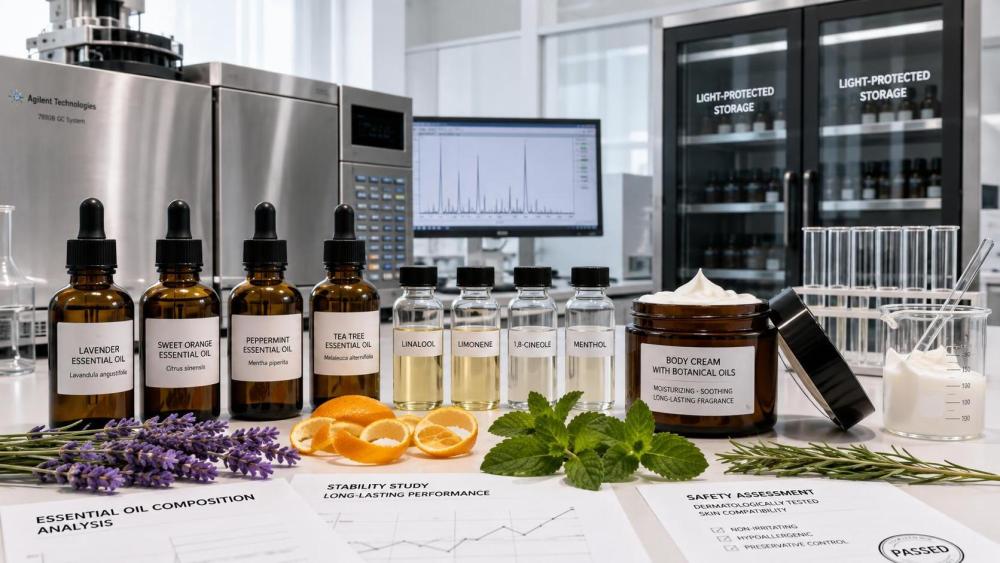
The certificate of analysis is useful, but it is not always sufficient on its own. A safety review benefits from a current chromatographic profile, clear botanical nomenclature, extraction method, lot identification, and stated ranges for relevant constituents. Broad compositional ranges may be acceptable for a natural material, yet they need to be compatible with the fragrance formula and the exposure calculation. If a key constituent rises near the upper end of its permitted range, the finished product may no longer match an assessment built around a nominal or historical value.
Constituents should be evaluated in the context of total exposure from all fragrance inputs. The same declarable or sensitizing molecule can be present in several essential oils, in an added fragrance compound, and occasionally in a functional ingredient. Reviewing each raw material separately can understate the final concentration. Aggregating constituent-level contributions is especially important where multiple citrus, floral, herbaceous, or spice notes are used to build a natural character.
Leave-on exposure changes the safety question
A rinse-off shampoo and a body lotion may contain a similar aromatic raw material, but the safety rationale cannot simply be transferred between them. In a leave-on product, the fragrance remains on the skin after application. The relevant assessment therefore considers application area, amount applied, frequency of use, product format, dilution in the finished formula, and whether use is intended for intact skin, facial skin, underarm skin, lips, or a more sensitive area.
Occlusion can increase the practical importance of an otherwise modest concentration. A fragranced body butter under clothing, a product applied to skin folds, or a deodorant used in the underarm area may produce a different contact environment from a fine fragrance sprayed onto exposed skin. Product vehicle also affects delivery. Alcohol-based sprays evaporate quickly, whereas anhydrous oils, wax-rich balms, and emulsions can retain fragrance material on the skin for longer. Persistence is a sensory advantage, but it also needs to be reflected in the exposure rationale.
Dermal exposure is not the same as skin absorption. A constituent can remain mostly on the surface, volatilize, partition into the vehicle, or penetrate the stratum corneum to differing extents. However, low systemic absorption does not remove concern about local endpoints such as irritation, sensitization, or photoreactivity. Fragrance safety for leave-on products is often decided by these local skin effects before systemic exposure becomes the limiting factor.
Allergen presence requires a concentration-based view
Many essential oils contain constituents associated with fragrance allergy. Their occurrence does not automatically prevent use, but it makes compositional control and accurate calculation necessary. The relevant question is not whether an oil is “allergenic” in general terms. It is which constituents are present, at what concentration in the supplied lot, how much of the oil enters the fragrance concentrate, and what final concentration reaches the consumer product.
Allergen declaration obligations and fragrance-industry restrictions vary by market and product category. A formula intended for several regions should therefore be assessed against the destination market rather than against a single internal declaration threshold. Ingredient naming also needs care: a botanical oil may be listed under its ingredient name, while particular fragrance constituents may require separate declaration where applicable. A labeling decision based solely on the fragrance supplier’s summary can fail when later formula adjustments introduce the same constituent through another route.
A distinction is needed between sensitization hazard and a consumer reaction report. Sensitization concerns the potential to induce or elicit allergic contact dermatitis in susceptible individuals. A complaint of stinging, warmth, redness, or dryness after use may instead reflect irritation, a compromised skin barrier, a high level of ethanol, low product pH, surfactant residue, or interaction with another active. The symptoms can look similar at first review, but the corrective action differs. Reducing one fragrance allergen will not resolve a vehicle-driven irritation issue, while a formula that feels mild in short-term screening can still be unsuitable if it contains a sensitizing constituent at an unjustified exposure level.
Oxidation can alter an oil after approval
Fresh essential oil composition is only one point in the product life cycle. Unsaturated terpenes are susceptible to reaction with oxygen, light, heat, and trace metals. Oxidation can create hydroperoxides and other transformation products with a different sensitization profile from the original constituent. Citrus and coniferous materials often receive close stability attention for this reason, although vulnerability depends on the individual composition rather than a broad fragrance family alone.
The practical control begins before manufacturing. Oxygen headspace, repeated opening of partially used drums, translucent containers, warm warehouses, and long storage periods can all increase variation. A supplier’s recommended storage conditions should be translated into receiving, quarantine, dispensing, and retention-sample practices. Inert headspace management or suitably protective packaging may be justified for oxidation-sensitive materials, but a packaging change must be verified rather than assumed effective.
Antioxidants can slow degradation, yet they do not turn an unstable material into a permanently fixed composition. Their performance depends on compatibility, concentration, point of addition, oxygen exposure, and the overall formula. A fragrance premix protected in a sealed vessel can behave differently once dispersed into an emulsion, exposed to headspace in the retail pack, or repeatedly opened during use. Stability evaluation should look for changes that are relevant to safety as well as odor: chromatographic shifts, peroxide-related indicators where appropriate, color change, off-notes, and loss of top notes can signal that the original risk assessment no longer represents the marketed product.
Photoreactivity is linked to fraction, process, and use pattern
Some botanical materials, particularly certain expressed citrus oils, can contain light-reactive constituents. The concern is not simply “citrus in daytime products.” It is the presence and concentration of the relevant photoreactive fraction, the final concentration in the leave-on product, application to sun-exposed skin, and the expected interval before ultraviolet exposure. A distilled citrus material and an expressed peel oil may have different profiles because the manufacturing process changes which constituents are carried into the oil.
Terminology must match the supplied material. Descriptions such as “folded,” “terpeneless,” “distilled,” “rectified,” or “furanocoumarin-reduced” describe processing choices, but they should not substitute for documentation of the actual composition. A reduced fraction may address one known concern while changing odor balance or increasing the relative contribution of other compounds. Product claims that imply daytime suitability should be reviewed against the complete fragrance system and the intended area of application, rather than inferred from a marketing descriptor attached to one raw material.
Formula interactions can obscure the source of a problem
Essential oil safety cannot be reviewed in isolation from the base. Solubilization determines whether aromatic constituents are uniformly distributed in a water-based product or remain concentrated in droplets. Poor dispersion can create localized exposure that is not represented by a simple bulk calculation. In an emulsion, changes in surfactant system, oil phase, viscosity, or manufacturing temperature can alter distribution, release, and perceived intensity. A fragrance adjustment made to restore odor after a base change can inadvertently increase total constituent exposure.
pH is another boundary condition. It may affect the stability of selected fragrance materials and can independently influence skin tolerance. Preservative changes, botanical extracts, exfoliating acids, retinoid-type actives, and high-alcohol systems may all change the irritation context even where the fragrance concentrate is unchanged. A technically compliant fragrance level does not guarantee that the whole product will be tolerated under the intended use conditions.
Packaging deserves the same attention. Fragrance constituents can absorb into some plastics, migrate through unsuitable closures, or react with packaging-associated materials. The resulting issue may be a fading scent, a changed odor profile, a discolored product, or an altered composition over shelf life. Compatibility testing should cover the marketed container, closure, headspace, and realistic storage orientation. Testing only bulk formula in an inert laboratory vessel leaves a meaningful gap for volatile essential oil ingredients.
Control points that reduce avoidable rework
A defensible file connects raw-material identity to the finished formula without losing traceability. Each essential oil should have a controlled specification that identifies the botanical source, plant part, extraction method, sensory description, relevant marker constituents, storage conditions, and retest or expiry approach. Where variation is intrinsic to the material, approved compositional limits should feed directly into the calculation used for the fragrance safety assessment.
Formula changes require more than a revised fragrance percentage. A new source, harvest, distillation method, antioxidant system, fragrance house adjustment, or packaging format can affect the original conclusion. The most reliable change-control trigger is constituent-based: determine whether the alteration changes the identity, upper-bound concentration, oxidation state, photoreactive fraction, or finished exposure of a relevant component. This avoids treating a supplier name change as inherently high risk while overlooking a subtle extraction change that materially affects composition.
Release testing should be proportionate to the material and risk rationale. Organoleptic review can detect obvious off-notes but cannot establish that a sensitive constituent remains within an acceptable range. Conversely, a full analytical panel for every low-risk, stable material may add delay without improving the decision. Targeted analysis is most valuable when a marker reflects known lot variability, when an oil is oxidation-prone, when a process fraction affects photoreactivity, or when the formula sits close to an internal exposure limit.
Records should preserve the version of the fragrance formula, raw-material documentation, calculation assumptions, label review, stability findings, and final product category. These documents are often created by separate functions and can become inconsistent after a late-stage scent modification. Linking them to one formula revision makes it possible to confirm that the batch, label, and safety rationale describe the same product.
Essential oils bring character and complexity to leave-on fragrances, but their safety profile is dynamic rather than self-evident. A composition-aware assessment, combined with realistic exposure assumptions and storage control, provides a firmer basis for releasing a fragrance that remains appropriate from raw-material receipt through the product’s intended shelf life.
Related News
- How to verify a cosmetic nanotechnology supplier's safety documentationOct 04, 2026Dr. Chloe Vance
- How to set a control sensory flavour standard for panel consistencySep 27, 2026Dr. Chloe Vance
- How to verify compliance documents for cosmetic active compoundsSep 19, 2026Dr. Chloe Vance
- How to verify food grade flavor formulation ingredients for safetySep 18, 2026Dr. Chloe Vance
Related News
- 00
0000-00
Can biomimetic peptides in cosmetics reduce the look of wrinkles? - 00
0000-00
How to assess a bio-based thickener manufacturer's batch consistency - 00
0000-00
Verifying halal status of hydrocolloid ingredients in the Middle East - 00
0000-00
How to interpret active matter on a surfactant specification sheet - 00
0000-00
How Do You Test Hydrocolloid Viscosity After Changing a Thickener?
Dr. Chloe Vance
Weekly Insights
Stay ahead with our curated technology reports delivered every Monday.