





Start with the factory’s real GMP scope, not the certificate cover page
When you evaluate a transdermal delivery ingredients factory, the first mistake is treating GMP as a yes-or-no box. For transdermal ingredients, the useful question is narrower: what exactly is covered, under which quality system, for which material type, and for which manufacturing steps? A site may hold a GMP-related certificate, but that does not automatically mean the specific ingredient you plan to source is produced under the same controls.
Ask for the document set that ties the product to the site and the process: manufacturing license or registration status where applicable, quality manual summary, site master file or equivalent overview, product specification, batch record template, change control procedure, deviation procedure, and the latest audit trail for the product family. If the factory can only show marketing certificates and not the operating documents behind them, you are still at brochure level.
A good technical review starts by mapping three things together: the ingredient identity, the manufacturing area where it is made, and the quality controls applied from raw material receipt to release. If those links are vague, batch consistency problems usually show up later.
Check whether the process fits transdermal risk, not just general ingredient production
Transdermal systems are not judged the same way as a standard industrial intermediate. Even if the ingredient is not the finished patch or gel, its impurity profile, residual solvents, bioburden risk, particle behavior, and functional consistency can directly affect skin delivery, irritation profile, and formulation stability.
This is where many factory assessments become too generic. You need to see whether the plant understands the intended end use. During review, focus on these points:
- How the factory classifies the ingredient: cosmetic active, excipient-like material, penetration enhancer, polymer, botanical fraction, or another functional category.
- Which critical quality attributes are controlled because of transdermal use, not only because they are easy to test.
- Whether cleaning validation and cross-contamination controls reflect the possibility of low-dose skin exposure.
- Whether stability risks are understood under heat, light, oxygen, and moisture conditions relevant to skin delivery formulations.
A factory that says “we can make many kinds of actives” is not saying much. A factory that can explain which process variables shift transdermal performance has probably done the work.
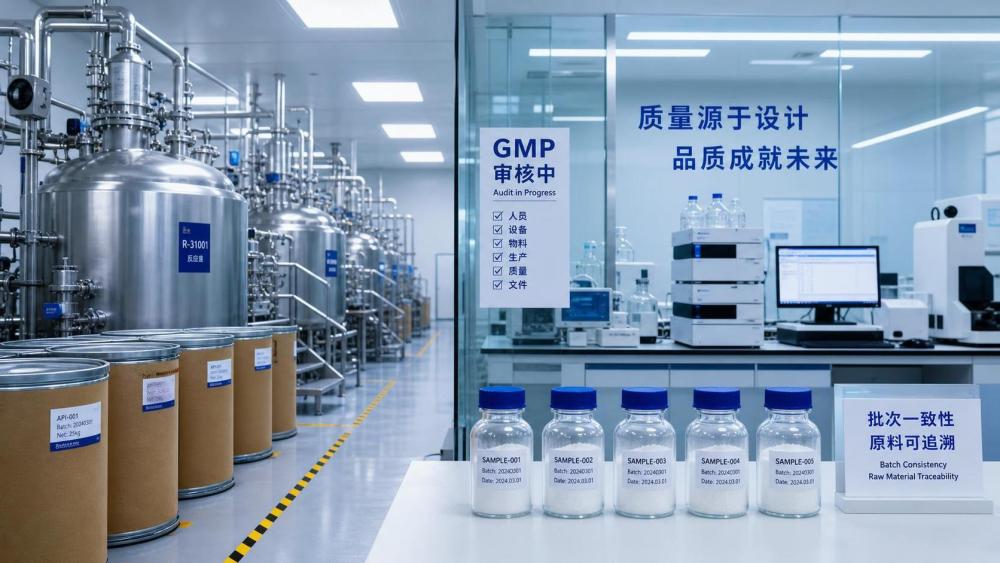
Trace raw materials back to supplier, lot, and incoming test decision
If you want batch-to-batch consistency, do not start with the final COA. Start upstream. Many ingredient factories run a stable core process, but variability enters through botanical feedstock, solvent grade, carrier material, monomer purity, or small changes in supplier processing.
For each major raw material, ask to see how the factory handles:
- Approved supplier qualification.
- Material identification on receipt.
- Sampling controls and quarantine status.
- Release testing versus vendor COA reliance.
- Handling of supplier changes, including reformulation or grade drift.
One practical test: pick a critical raw material and ask the factory to show the trace from supplier lot to finished batch release. If they need too long to retrieve it, or if the chain breaks between warehouse, production, and QC, you have learned something important. Traceability that only works during a scheduled audit is not operational traceability.
Find the real process controls behind batch consistency
Most factories will tell you their batches are consistent. The useful question is how they keep them consistent when raw material variability, operator shifts, equipment loading, and environmental conditions all move a little.
Ask the technical team to walk through the manufacturing process and identify the steps they consider critical. That can include reaction temperature bands, mixing speed, hold time, pH endpoints, filtration sequence, drying endpoint, in-process viscosity target, particle size distribution, or solvent removal conditions. You are not only collecting process facts. You are testing whether the factory knows which variables actually matter.
Be careful with sites that control only final-release numbers. For transdermal ingredients, late-stage pass/fail testing does not replace process discipline. A batch can meet a narrow assay target and still behave differently in a formulation because crystal form shifted, moisture content drifted, odor profile changed, or rheology moved outside the normal process window.
A short review table for technical audits
Do not skip analytical method fit and QC data depth
For a transdermal delivery ingredients factory, QC strength is not just about owning analytical instruments. It is about whether the methods are suitable for the ingredient’s quality risks and whether the data package is deep enough to support your application.
A COA with assay, loss on drying, and a generic appearance line may be enough for some commodity materials. It is often not enough for transdermal use. Depending on ingredient type, you may need to review impurity controls, residual solvents, microbial limits, heavy metals where relevant, viscosity, molecular weight distribution, particle size, carrier ratio, odor profile, or marker compounds for natural extracts.
The point is not to demand every test for every material. The point is alignment. Ask the factory why those specifications were chosen and how they were set. If limits were copied from a broader product family without connecting them to transdermal performance, you may inherit a specification that looks complete but does not protect your formulation.
Look at trend data across batches, not just release specs
A batch that passes specification is not automatically a batch that is consistent. Technical evaluators should ask for historical trend data on the same grade, ideally across enough commercial batches to show process behavior rather than one-off success. You are looking for spread, drift, and hidden clustering.
For example, if assay is always well within limits but viscosity steadily moves toward the upper edge, that may signal a process shift which has not yet become a release failure. If a botanical-derived active shows wider color variation but equivalent functional markers, the commercial impact depends on your formulation and market positioning. This is why batch consistency must be judged against both specification compliance and end-use sensitivity.
Ask for the factory’s own internal alert levels, not only official specification limits. Mature operations usually watch tighter process targets than the customer-facing release range.
Audit deviation, OOS, and change control records before you trust the plant
Nothing reveals manufacturing discipline faster than records for deviations, out-of-specification investigations, and changes. A site that never has deviations is usually a site that is not documenting honestly. What matters is whether the events are investigated properly and whether corrective actions hold.
Review a small sample of actual cases. See whether the root cause goes beyond the first obvious explanation. “Operator mistake” is often a placeholder for poor SOP design, weak training, unclear material status control, or equipment maintenance drift. In change control, look for supplier substitutions, process parameter revisions, equipment changes, site transfers, new packaging components, and revised test methods. Then ask the practical question: how are customers informed when the change could affect transdermal performance or regulatory documentation?
Verify contamination control and cleaning logic
Shared equipment is not automatically a deal breaker, but weak segregation can be. For ingredients used in skin delivery systems, residual carryover, fragrance contamination, sensitizing compounds, or microbiological exposure can create downstream trouble that is difficult to trace later.
During the audit, walk the material and personnel flow if possible. Review line clearance, equipment status labeling, cleaning records, and the logic behind cleaning verification. The key question is whether the cleaning acceptance approach reflects actual risk. A plant making both aromatic materials and transdermal actives on neighboring lines needs much tighter operational discipline than a single-purpose facility.
Match documentation quality to your target market and product file needs
Selection decisions often fail late because the factory can make the ingredient, but cannot support the documentation package your regulatory, quality, or formulation team needs. For transdermal applications, that can include specification sheets, COAs, TDS, SDS, allergen or residual solvent statements where relevant, origin statements, impurity discussions, stability support, and change notification commitments.
This is also where target market differences matter. The same ingredient may require a different documentation emphasis depending on whether you are supporting a cosmetic, a topical wellness product, or a more tightly regulated healthcare pathway. The factory does not need to know your entire commercial strategy, but it does need to supply documents that are internally consistent and traceable to the released material.
Run a final decision screen before approval
By the time you finish the review, the decision is usually clearer than the paperwork makes it seem. A capable transdermal delivery ingredients factory does not just pass audits. It can explain its process, show data trends, trace raw materials cleanly, manage change in a controlled way, and connect its specifications to real end-use performance.
For practical selection, use this order:
- Confirm the actual GMP scope and the exact product-site-process link.
- Test raw material traceability and supplier control on one critical input.
- Review critical process controls and historical batch trend data.
- Check whether analytical methods and specifications fit transdermal use.
- Read real deviation, OOS, cleaning, and change control records.
- Confirm the documentation package you will need after supplier approval, not just before it.
If one area is weak, do not average it away with strengths elsewhere. In transdermal ingredient sourcing, the expensive failures usually come from small quality system gaps that looked manageable during qualification and became serious only after scale-up, filing, or market launch.
Related News
- How to verify a cosmetic nanotechnology supplier's safety documentationOct 04, 2026Dr. Chloe Vance
- How to set a control sensory flavour standard for panel consistencySep 27, 2026Dr. Chloe Vance
- How to verify compliance documents for cosmetic active compoundsSep 19, 2026Dr. Chloe Vance
- How to verify food grade flavor formulation ingredients for safetySep 18, 2026Dr. Chloe Vance
Related News
- 00
0000-00
Can biomimetic peptides in cosmetics reduce the look of wrinkles? - 00
0000-00
How to assess a bio-based thickener manufacturer's batch consistency - 00
0000-00
Verifying halal status of hydrocolloid ingredients in the Middle East - 00
0000-00
How to interpret active matter on a surfactant specification sheet - 00
0000-00
How Do You Test Hydrocolloid Viscosity After Changing a Thickener?
Dr. Chloe Vance
Weekly Insights
Stay ahead with our curated technology reports delivered every Monday.