





How to Use Certification Status in Supplier Evaluation Without Missing Key Risks
Supplier evaluation by certification is useful because it shortens the first stage of screening. A supplier with recognized certificates usually has at least some documented controls, defined procedures, and external review behind its claims. But that does not mean the supplier is automatically low risk. In practice, certificates answer a narrow question: did this site, system, product, or process meet the scope of a stated standard at the time of assessment? Quality and safety teams often need answers to much broader questions.
That gap matters even more in categories such as food preservatives, hydrocolloids, flavors, essential oils, cosmetic actives, and surfactants. These materials sit close to regulatory scrutiny, sensory performance, purity variation, allergen concerns, and process sensitivity. A xanthan gum supplier can hold a valid management-system certificate and still struggle with batch-to-batch viscosity drift. A fragrance ingredient producer can present compliance paperwork while leaving questions around trace impurities or oxidation stability unanswered. A peptide supplier may look strong on paper but still be a poor fit if scale-up controls, residual solvent management, or transport stability are weak.
So the practical question is not whether certification matters. It does. The question is how to use it without letting it hide the risks that actually damage product quality, market access, or consumer safety.
What certification status can tell you
Certification is best treated as a decision signal, not a decision substitute. It helps teams sort suppliers into a more realistic review order.
At a minimum, certification status may indicate that a supplier has documented procedures, some level of internal control, and willingness to undergo independent assessment. Depending on the category and market, that can be a meaningful starting point. In food ingredients, buyers may look for schemes linked to food safety management or GFSI-recognized programs where relevant. In cosmetics, product compliance may depend less on a factory certificate alone and more on technical documentation, raw material composition, restricted substance control, and market-specific notification requirements. In fragrance and active ingredients, certificates may support confidence, but they rarely replace detailed specification review, impurity assessment, and intended-use verification.
This is where many supplier qualification programs lose precision. They treat all certificates as if they carry the same weight. They do not.
Three questions to ask about any certificate
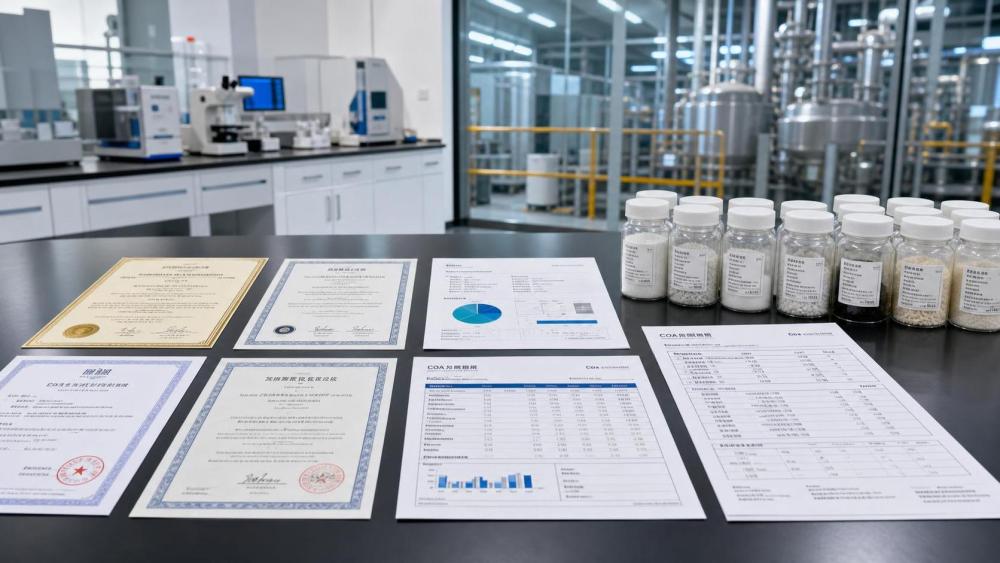
Before a certificate is used in supplier evaluation, verify three basics: scope, issuer, and relevance.
Scope means what exactly was certified: a site, a production line, a management system, or a finished product. A valid certificate for one plant does not automatically cover another plant in the same group. Issuer means who granted it and whether the certification body is credible for that standard and geography. Relevance means whether the certification actually addresses the risk in your application. A general quality management certificate does not prove microbiological suitability for food use, nor does it confirm dermal safety for a leave-on cosmetic active.
Where certificates often fail quality and safety teams
The most common failure is assuming that a certificate proves product consistency. It usually does not. It may show that a supplier has a system for control, but it does not guarantee that the specific parameter you care about is tightly managed. In thickening systems, that parameter may be viscosity profile, hydration behavior, pH tolerance, or salt stability. In antioxidants and preservatives, it may be degradation under heat, interaction with packaging, or carryover effects in a multi-ingredient blend. In surfactants, it may be residual levels, foam profile, color drift, or odor cleanliness.
Another blind spot is regulatory overconfidence. Teams sometimes see terms such as GRAS, REACH-related documentation, or cosmetic notification references and assume the material is fully cleared for their target market. Usually that conclusion requires more nuance. GRAS status, for example, is specific to intended use and context. A European CPNP notification is not a raw-material certificate for universal use. In cross-border supply, the same ingredient may be acceptable in one formulation type and problematic in another because concentration limits, impurity profiles, labeling triggers, or claim substantiation expectations differ.
The third weak point is change control. A supplier may hold the same certificate for years while changing solvent sources, upstream intermediates, drying conditions, packaging format, or subcontracted steps. None of those changes are trivial if you are buying a flavor precursor, a natural extract prone to oxidation, or a premium cosmetic active with narrow stability margins.
A better model: certification plus risk layering
A more reliable method is to use supplier evaluation by certification as the top layer of a wider risk model. The certificate tells you where to start. The rest of the review tells you whether the supplier can actually support your product and market.
For many quality teams, the most practical layering looks like this:
This layered view is especially relevant in the sectors that FFAI tracks closely. A certificate may tell you a preservative supplier has formal systems; it will not tell you how that antioxidant behaves after high-temperature baking. It may show that a cosmetic active supplier documents quality procedures; it will not answer whether the peptide remains stable across transport conditions or interacts with a specific emulsion system. For teams dealing with flavor chemistry, rheological modifiers, or high-purity actives, the bridge between paperwork and molecular performance is where risk usually hides.
How to review suppliers when the certificate looks good
When certification status is strong, the next step is not to relax. It is to ask sharper questions.
Start with the specification and COA history. One certificate cannot replace trend review. If possible, check whether the supplier can provide multiple recent batch results, not just one representative COA. You are looking for spread, not perfection. Tight control on assay may still mask drift in color, odor, particle size, viscosity, microbial load, or trace contaminants.
Then review the manufacturing and sourcing logic at a level proportional to risk. For a low-complexity commodity, a short questionnaire may be enough. For fermentation-derived thickeners, essential oil fractions, or high-end anti-aging actives, you may need to understand whether critical raw materials come from volatile agricultural sources, whether purification is consistent, and whether any step is outsourced. If a supplier hesitates to explain where variation enters the process, that hesitation matters.
It is also worth testing how the supplier handles uncomfortable questions. Ask about out-of-spec events, complaint trends, major process changes, and notification procedures. Competent suppliers rarely promise zero deviation forever. What distinguishes them is how quickly they investigate, communicate, and contain problems.
Category differences matter more than many programs admit
A generic approval workflow tends to miss category-specific risks.
Food-grade antioxidants and preservatives need close attention to intended use, thermal stability, and contamination control. Natural pigments and thickeners often require deeper checks on source variability, microbiological profile, and functional consistency in the real matrix, not just in water. Synthetic flavors and essential oil extracts raise questions around composition complexity, oxidation, allergens, and storage stability. Cosmetic actives bring sharper focus on purity, residuals, compatibility, and evidence quality behind efficacy-related claims. Surfactants may need scrutiny on by-products, odor, color, and performance under different water conditions or formulation systems.
This is one reason intelligence-led review has become more valuable than document collection alone. FFAI’s coverage of food preservation, sensory chemistry, rheological systems, and transdermal active science reflects a useful reality for supplier qualification: certification tells you the supplier has a framework, but technical interpretation tells you whether the framework is enough for your formula, market, and risk tolerance.
Red flags that certificates will not capture well
Some warning signs sit outside the visible certificate layer:
- Specifications that are technically broad enough to pass, but too broad for your process stability
- Frequent reliance on “typical values” instead of release limits
- Unclear origin or inconsistent disclosure of upstream raw materials
- Weak responses on change notification timing and threshold
- Commercial samples that perform well, followed by production lots that behave differently
- Certificates that are valid, but issued for a site not involved in your material’s final manufacturing step
None of these automatically disqualify a supplier, but each one raises the level of verification needed.
A practical conclusion for approval teams
The safest way to use supplier evaluation by certification is to treat certification as an entry point, not an endpoint. It is good for triage, useful for prioritization, and sometimes essential for market access. It is not a reliable stand-alone measure of product fitness, hidden impurity risk, or future consistency.
If your team works across food ingredients, fragrances, cosmetic compounds, or surfactants, the strongest decisions usually come from combining certificate review with application-specific technical checks, market-specific compliance review, and a realistic look at change control. That approach takes longer than collecting paperwork, but it catches the problems that paperwork alone tends to miss.
Before approving a supplier with “good certification status,” confirm one more thing: which risk are you actually trying to reduce—regulatory failure, product inconsistency, contamination exposure, claim weakness, or supply interruption? Once that is clear, the right follow-up questions become much easier to ask.
- food preservation
- food-grade antioxidants
- natural pigments
- synthetic flavors
- essential oil extracts
- cosmetic actives
- xanthan gum
- hydrocolloids
- flavor chemistry
- high-purity actives
- food ingredients
- active ingredients
- food preservatives
- anti-aging actives
- supplier evaluation
- natural pigments and thickeners
- xanthan gum supplier
- supplier evaluation by certification
- European CPNP notification
Related News
- How to verify a cosmetic nanotechnology supplier's safety documentationOct 04, 2026Dr. Chloe Vance
- How to set a control sensory flavour standard for panel consistencySep 27, 2026Dr. Chloe Vance
- How to verify compliance documents for cosmetic active compoundsSep 19, 2026Dr. Chloe Vance
- How to verify food grade flavor formulation ingredients for safetySep 18, 2026Dr. Chloe Vance
Related News
- 00
0000-00
Can biomimetic peptides in cosmetics reduce the look of wrinkles? - 00
0000-00
How to assess a bio-based thickener manufacturer's batch consistency - 00
0000-00
Verifying halal status of hydrocolloid ingredients in the Middle East - 00
0000-00
How to interpret active matter on a surfactant specification sheet - 00
0000-00
How Do You Test Hydrocolloid Viscosity After Changing a Thickener?
Dr. Chloe Vance
Weekly Insights
Stay ahead with our curated technology reports delivered every Monday.